
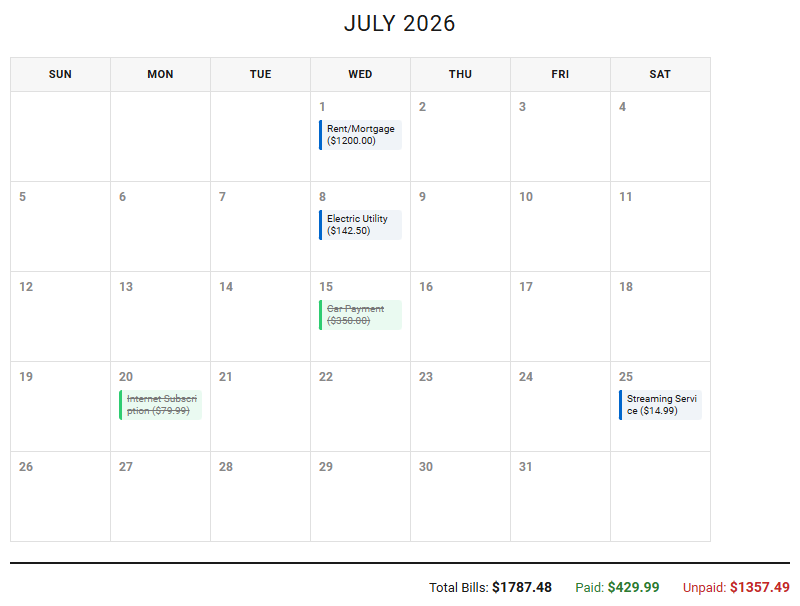
Managing disparate due dates often leads to costly late fees and financial anxiety. While traditional income sources cover these liabilities, bridging the gap between cash flow and recurring bills requires precise timing. A dedicated monthly bill payment tracker calendar grants complete visibility over your financial schedule, though its success stipulates consistent manual updates. By mapping concrete obligations like mortgage payments and utility bills, you regain control. Below, we explore how to leverage this printable tool for optimal monthly budgeting.
Create Your Monthly Bill Payment Tracker Calendar
| Bill Name | Due Day (1-31) | Amount | Paid |
|---|
Done customizing?
Monthly Bill Payment Tracker Calendar - Good to Know
Bill Due Date Calendar
Managing monthly invoices requires precision, and a reliable Bill Due Date Calendar acts as your primary defense against costly late fees. By mapping out every recurring obligation on a visual, time-based grid, you gain immediate clarity on when money leaves your checking account. This proactive approach prevents the anxiety of forgotten payments and protects your credit score from damaging delinquencies. When you visualize these dates, you can plan your cash reserves more effectively around your pay cycles.
- Color-code entries based on urgency or categories like utilities and housing.
- Identify cash-tight weeks before they occur to adjust discretionary spending.
- Establish a reliable routine for reviewing upcoming financial obligations weekly.
Implementing this calendar system allows households to align their payment cycles with their income streams, fostering greater financial peace of mind.
Financial Calendar
A comprehensive Financial Calendar extends beyond basic utility bills to encompass your entire fiscal year. It serves as a master schedule for tax deadlines, quarterly investment reviews, insurance renewals, and annual savings goals. Maintaining this macro-view ensures you are never caught off guard by semi-annual or yearly expenses that typically disrupt monthly budgets. By tracking these milestones, you foster a disciplined relationship with your wealth.
- Quarterly tax estimations and filings for freelancers or business owners.
- Annual insurance premium evaluations to search for better rates.
- Bi-annual portfolio rebalancing sessions to manage investment risk.
This long-term scheduling tool transforms reactive spending habits into strategic, calculated moves, ensuring your money works efficiently throughout the entire calendar year.
Subscription Tracker
In the modern digital economy, micro-transactions and streaming services can silently drain your bank account. A dedicated Subscription Tracker shines a light on these recurring digital drains, cataloging every active trial, software license, and entertainment membership. Many consumers underestimate their monthly subscription spending by hundreds of dollars. By listing renewal dates, billing frequencies, and pricing tiers, you can easily identify underutilized services ripe for cancellation.
- Identify ghost subscriptions that you forgot to cancel after trial periods.
- Compare the value received from a service against its ongoing monthly cost.
- Consolidate family plans to reduce redundant spending across households.
This organized oversight empowers you to regain control over your discretionary cash flow, ensuring you only pay for platforms that deliver genuine, daily value.
Recurring Expense Log
Your Recurring Expense Log is the foundational database for all fixed overhead. Unlike variable spending on groceries or entertainment, recurring expenses remain relatively static, making them highly predictable. This log documents your mortgage, car payments, gym memberships, and student loans in one central repository. Capturing these contractual obligations allows you to establish a realistic baseline for your cost of living.
Knowing this baseline is essential for emergency fund calculations, as it represents the absolute minimum capital required to sustain your lifestyle during unforeseen income disruptions. Regularly auditing this log can also reveal opportunities to renegotiate service contracts, such as internet plans or phone insurance policies, pocketing the difference as immediate monthly savings. It is a critical step toward building long-term financial stability.
Budget Calendar Template
Utilizing a structured Budget Calendar Template bridges the gap between abstract spreadsheets and daily financial realities. This tool overlays your income distribution dates directly onto your payment deadlines, offering a synchronized view of cash inflows and outflows. It visually represents when your accounts will be flush with cash and when they will be stretched thin.
- Visualize cash flow peaks and valleys throughout the month.
- Align paydays directly with high-priority bill payment cycles.
- Reduce transaction friction by scheduling transfers on specific days.
Adopting a pre-formatted template eliminates setup friction, allowing you to focus immediately on strategic allocation rather than administrative design. It transforms budgeting into an intuitive, visual habit that fits seamlessly into your lifestyle.
Auto-Pay Reminder
While automation simplifies financial management, relying blindly on automatic transfers can lead to costly overdraft fees. An Auto-Pay Reminder acts as a vital safety buffer, alerting you a few days before an automated withdrawal occurs. This brief window allows you to verify that your funding account contains sufficient clearance to cover the transaction. It prevents embarrassing transaction declines and maintains your banking standing.
It also prompts you to review the incoming invoice for unauthorized charges or unexpected price hikes before the money leaves your possession. Integrating these notifications into your digital calendar ensures you maintain active stewardship over your capital, combining the convenience of modern automation with the security of manual oversight and continuous financial awareness.
Cash Flow Calendar
A dynamic Cash Flow Calendar focuses specifically on the timing of your liquidity. It tracks exactly when revenues are deposited and when expenses are debited, mapping your daily account balances. This is particularly crucial for freelancers, entrepreneurs, and anyone with irregular income streams where timing mismatches can cause severe financial stress.
- Anticipate temporary deficits before they manifest as overdrawn balances.
- Optimize the timing of non-essential, large retail purchases.
- Coordinate payment terms with clients and vendors more strategically.
Understanding these operational cycles allows you to build targeted cash reserves, ensuring smooth financial operations regardless of seasonal fluctuations or delayed client invoices. It is the key to maintaining consistent liquidity.
Digital Bill Organizer
Transitioning from paper clutter to a Digital Bill Organizer streamlines your administrative workflow and reduces environmental waste. This centralized system aggregates digital invoices, PDF statements, and payment receipts into a secure, searchable cloud database. By eliminating physical mail piles, you minimize the risk of losing critical documents and missing payment deadlines.
Many modern organizers offer advanced features like automatic OCR scanning, which extracts key metadata such as due dates and balances directly from your emails. This seamless integration ensures your financial records are always accurate, accessible, and organized, saving you hours of manual data entry during tax season and keeping your financial life perfectly orderly and stress-free.
Debt Payoff Planner
Eliminating liabilities requires a structured strategy, and a Debt Payoff Planner provides the necessary roadmap for acceleration. This planner tracks your outstanding balances, interest rates, and minimum payments across all credit cards, loans, and mortgages. By consolidating this data, you can model different repayment strategies to see which method saves you the most time and money.
- The Debt Avalanche method, targeting high-interest rates first to minimize overall cost.
- The Debt Snowball method, focusing on smallest balances first to build psychological momentum.
This tool keeps your long-term goals visible, turning overwhelming liabilities into structured, manageable milestones on your path to financial freedom and debt-free living.
Expense Tracker Dashboard
An Expense Tracker Dashboard serves as the control center of your personal economy, translating raw financial data into actionable, visual insights. By aggregating transaction feeds from your bank accounts and credit cards, the dashboard categorizes your spending habits in real-time. Colorful charts and graphs immediately highlight where your money is going, making it easy to spot overspending in categories like dining out or retail shopping.
- Real-time synchronization with major financial institutions.
- Customizable budget caps for specific spending categories.
- Historical trend analysis to track your progress over several months.
This continuous feedback loop keeps you accountable to your financial goals, guiding your daily purchasing decisions with empirical data and robust visual analytics.
Leave a comment