
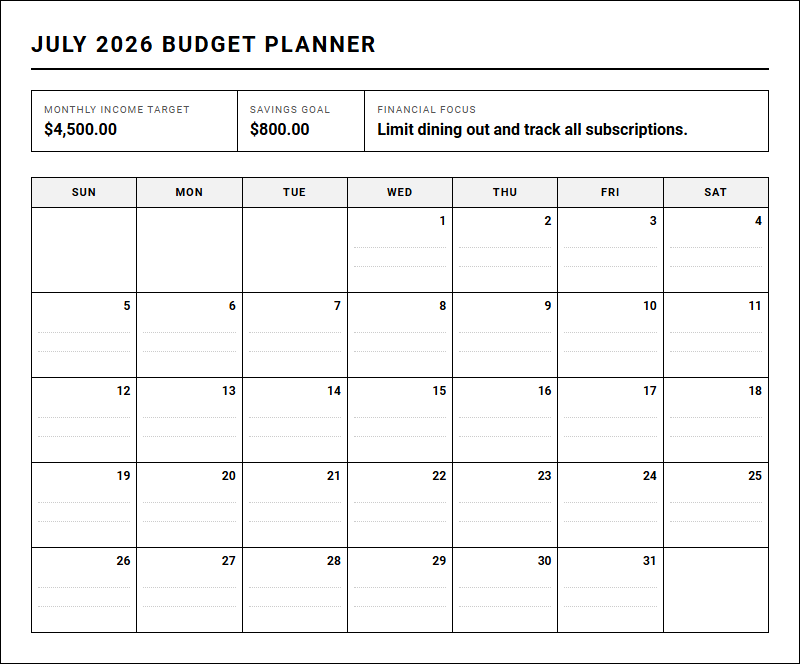
Managing monthly expenses and payment deadlines often leads to significant financial anxiety. While aligning standard income sources with fixed bills provides a financial baseline, maintaining daily oversight remains a challenge. Our printable Monthly Budget Planner Calendar grants the visual clarity needed to master your cash flow. Note that while this tool requires consistent user input to succeed, it excels at highlighting concrete commitments like utility deadlines and subscription renewals. Below, we outline strategies to maximize this template.
Create Your Monthly Budget Planner Calendar
| Monthly Income Target $4,500.00 | Savings Goal $800.00 | Financial Focus Limit dining out and track all subscriptions. |
| Sun | Mon | Tue | Wed | Thu | Fri | Sat |
|---|
Done customizing?
Monthly Budget Planner Calendar - Good to Know
Zero-based budget calendar
A zero-based budget calendar is a highly structured financial planning tool designed to ensure that every single dollar of your income is allocated to a specific category before the month begins. By assigning a unique job to all incoming revenue, you effectively reduce your net financial equation to exactly zero, leaving no room for mindless discretionary spending or unallocated waste.
Integrating this methodology with a calendar allows you to map your income directly against the specific dates your expenses actually occur. This chronological alignment prevents cash flow gaps and ensures that your bills are covered in real-time. To implement this successfully, consider the following steps:
- Identify your total net monthly income across all revenue streams.
- Map out fixed costs on their exact calendar due dates.
- Allocate remaining funds toward savings, investments, and debt reduction.
This proactive strategy transforms budgeting from a reactive post-mortem analysis into an intentional, forward-looking roadmap for wealth accumulation.
Bill payment tracker
A dedicated bill payment tracker serves as an essential organizational shield against late fees, service disruptions, and damaged credit scores. Managing multiple recurring obligations-such as utilities, insurance premiums, subscriptions, and housing costs-requires a highly visual, centralized system to ensure no deadline is overlooked. By organizing your liabilities chronologically, you gain clear visibility into your monthly financial obligations.
Using a structured tracker allows you to categorize bills by payment method, such as automatic withdrawals or manual bank transfers.
To optimize this system, many financial planners recommend utilizing a detailed table format to monitor your ongoing progress throughout the month:
- Record the official name of the billing entity and the exact date due.
- Note the precise amount owed to prevent unexpected balance discrepancies.
- Mark the status clearly as "Pending", "Scheduled", or "Paid in Full".
Maintaining this level of detail offers peace of mind and fosters disciplined cash management habits.
Digital budget planner
Embracing a modern digital budget planner offers unparalleled convenience, real-time synchronization, and automated data visualization for the contemporary saver. Unlike traditional paper journals, digital solutions leverage cloud technology to update your balances across multiple devices instantly. This ensures that you and your household partners always possess an accurate, unified view of your collective financial health.
Most premium digital planners feature interactive charts, automated expense categorization, and direct bank integration to minimize manual entry errors. Key benefits of going digital include:
- Instant calculations that eliminate human mathematical errors.
- Customizable alerts that notify you when spending nears category thresholds.
- Historical data retrieval for effortless year-over-year financial comparisons.
By shifting your financial management to a secure digital environment, you streamline your workflow and unlock sophisticated analytical insights that can accelerate your journey toward long-term financial independence.
Payday budget schedule
A personalized payday budget schedule is the ideal framework for individuals who receive income on a bi-weekly, semi-monthly, or weekly basis rather than once a month. Standard monthly budgets often fail to address the immediate timing of cash inflows, resulting in temporary shortages between paychecks. This specialized schedule solves that dilemma by dividing your monthly expenses into smaller, manageable increments aligned with your specific pay cycles.
When you receive a paycheck, you immediately allocate those specific funds to cover the expenses due before your next payday. Consider this structured allocation strategy:
- Paycheck A: Covers mortgage/rent, initial groceries, and minimum debt payments.
- Paycheck B: Covers utility bills, insurance premiums, and retirement contributions.
This cyclical approach harmonizes your actual cash flow with your immediate financial obligations, effectively eliminating the stressful "feast or famine" cycle often experienced by salaried earners.
Sinking funds tracker
A robust sinking funds tracker is an indispensable tool for managing irregular, large expenses that occur throughout the year. Rather than allowing annual insurance premiums, holiday shopping, vehicle maintenance, or vacation costs to derail your monthly budget, a sinking fund breaks these massive targets down into small, bite-sized monthly savings goals. This proactive planning prevents you from relying on high-interest credit cards when unpredictable bills arrive.
To track your sinking funds effectively, you must monitor several moving variables simultaneously. Successful tracking relies on maintaining clear, documented metrics for each individual goal:
- The specific target event and its ultimate calendar deadline.
- The total monetary amount required to fully fund the event.
- The necessary monthly contribution calculated as: Total Cost / Months Remaining.
Visualizing these accumulating balances reinforces your savings habit and ensures you remain prepared for life's inevitable seasonal expenses.
No-spend challenge calendar
A structured no-spend challenge calendar is a powerful psychological tool designed to disrupt impulsive consumer habits and reset your relationship with money. By committing to specific days, weeks, or an entire month where you restrict all spending exclusively to absolute necessities, you create a dramatic surge in your savings rate. This visual calendar acts as a direct gamification of your personal finance journey.
On this calendar, you color-code each day according to your spending behavior. A successful day involves purchasing only basic groceries, essential fuel, or critical medicine, while non-essential shopping is strictly avoided. Common benefits of this challenge include:
- Rapidly accumulating emergency fund reserves.
- Developing a heightened awareness of unconscious spending triggers.
- Finding free, creative alternatives for entertainment and social socialization.
Refusing to participate in consumerism for a designated period fosters deep gratitude for the assets you already possess.
Cash envelope system planner
The traditional cash envelope system planner is a tactile, highly disciplined budgeting methodology that physically limits your discretionary spending. By withdrawing a predetermined amount of physical currency at the start of each pay cycle and dividing it into labeled paper envelopes, you establish hard spending boundaries. Once an envelope is empty, spending in that specific category must cease immediately until the next cycle begins.
This hands-on system is highly effective for variable categories where overspending is common, such as dining out, groceries, beauty services, and entertainment. To implement this approach effectively, adhere to these simple rules:
- Never borrow physical cash from one envelope to cover another.
- Leave credit and debit cards at home when executing retail transactions.
- Deposit any leftover cash at the end of the month directly into savings.
The physical sensation of parting with paper money triggers cognitive friction, naturally reducing impulse purchases.
Debt snowball calendar
A strategic debt snowball calendar is an empowering visualization tool designed to accelerate your journey to a debt-free life. Popularized by financial experts, the debt snowball method prioritizes paying off your liabilities in order of smallest balance to largest balance, regardless of the interest rates. This calendar maps out your estimated payoff milestones, providing powerful psychological victories early in your journey.
As each small debt is eliminated, the minimum payment you previously dedicated to it is added to the payment of the next smallest debt. This process creates a compounding financial force:
- Month 1-3: Eliminate credit card A with aggressive, targeted payments.
- Month 4-8: Apply card A's payment to medical bill B, snowballing your progress.
- Month 9-12: Roll the combined payments into car loan C for a massive monthly impact.
Tracking this trajectory on a calendar keeps you highly motivated as you watch your total number of active liabilities steadily dwindle to zero.
Financial goal tracker
An inspiring financial goal tracker bridges the gap between your immediate daily spending choices and your grandest long-term life aspirations. Whether you are actively saving for a down payment on a home, building a business, or securing early retirement, a tracker helps define these dreams into actionable metrics. Without clear milestones, abstract financial desires rarely translate into tangible real-world success.
To maximize the efficacy of your goals, your tracker should employ the SMART methodology (Specific, Measurable, Achievable, Relevant, and Time-bound). Utilize a structured layout to monitor your milestones:
- Define the exact monetary target and the date you intend to reach it.
- Establish monthly benchmark indicators to verify you are remaining on track.
- Review your progress quarterly and adjust allocations based on life changes.
Regularly reviewing your progress keeps your long-term vision clear, helping you say no to short-term temptations.
Expense tracking calendar
An expense tracking calendar is a retrospective diagnostic tool that reveals the honest reality of your daily purchasing habits. While a budget outlines how you plan to spend your money, this calendar documents where your capital actually goes. By recording every transaction on the exact day it occurs, you gain immediate clarity regarding your spending frequency and identify unconscious patterns.
Consistently logging your daily transactions highlights critical spending triggers, such as mid-week stress dining or excessive weekend shopping sprees. To make tracking sustainable, try these actionable tips:
- Collect physical receipts daily or check your mobile banking apps every evening.
- Color-code transactions by category (e.g., green for transport, blue for dining).
- Calculate weekly expenditure totals to verify alignment with your monthly limits.
Transforming raw transactional data into a visual calendar format empowers you to make highly informed adjustments to your future spending plans.
Leave a comment