
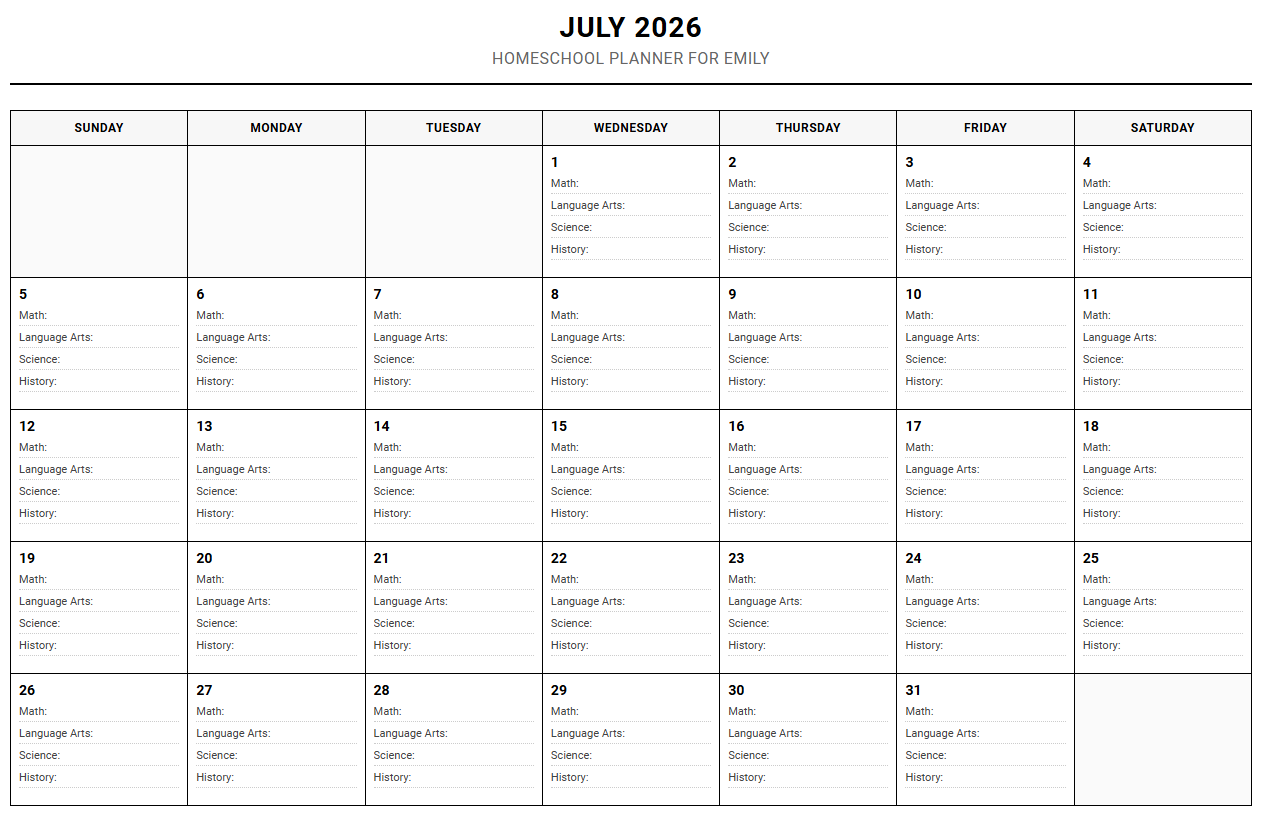
Structuring a cohesive academic year often overwhelms homeschool educators. While traditional state funding and pre-packaged curricula offer baseline resources, they frequently lack daily adaptability. Fortunately, a dedicated monthly printable calendar grants the precise organizational flexibility needed to balance academic standards with real-world pacing. Under the stipulation that state curriculum requirements are met, these templates seamlessly map concrete activities like STEM labs and reading blocks. Below, we outline strategies to optimize your monthly lesson planner calendar.
Create Your Monthly Homeschool Lesson Planner Calendar
Done customizing?
Monthly Homeschool Lesson Planner Calendar - Good to Know
Homeschool curriculum mapping
Homeschool curriculum mapping is a strategic process that allows educators to visualize the entire academic year. By aligning educational standards with personalized learning goals, parents can establish a coherent scope and sequence. This macro-level view ensures that all essential topics are covered without gaps, fostering a seamless transition between grade levels.
When mapping your curriculum, consider the following key elements:
- Educational milestones: Identify the core competencies your child needs to master by the end of the year.
- Resource allocation: Align textbooks, online courses, and hands-on activities with specific learning objectives.
- Assessment checkpoints: Schedule regular intervals to evaluate retention and adjust the mapping as needed.
This systematic approach transforms a overwhelming pile of resources into a structured, manageable path. It empowers parents to maintain academic rigor while preserving the flexibility that makes homeschooling so successful.
Digital homeschool planner
Embracing a digital homeschool planner modernizes your educational management. These cloud-based platforms offer dynamic scheduling, automated grading, and instant lesson rescheduling features. Unlike traditional paper planners, digital solutions adapt to the unpredictable nature of daily life with a simple click, shifting missed assignments to the next available day.
Many modern digital planners provide comprehensive features designed specifically for home educators:
- Real-time synchronization across multiple devices, allowing students to access their checklists independently.
- Automated attendance tracking and grade calculation, which simplifies year-end reporting.
- Resource libraries where you can attach digital worksheets, web links, and reading lists directly to assignments.
Utilizing these digital tools reduces administrative fatigue. Home educators can focus more energy on direct instruction and meaningful engagement with their children, confident that their record-keeping is secure and organized.
Loop scheduling
Loop scheduling is a revolutionary time management strategy that eliminates the pressure of rigid calendar days. Instead of assigning specific subjects to set days of the week, you create a running list of subjects and move through them sequentially. If an unexpected interruption occurs, you simply resume where you left off, preventing the feeling of falling behind.
This method is particularly effective for "enrichment" or "minor" subjects that often get neglected during busy weeks. A typical loop might include:
- Art appreciation and poetry tea time
- Nature study and hands-on science experiments
- Music history and geography puzzles
By looping these subjects, you guarantee they receive equal attention over time. This flexible rhythm reduces daily stress, accommodates natural learning variations, and ensures a rich, well-rounded educational experience without the constraints of a traditional school timetable.
Charlotte Mason planner
A specialized Charlotte Mason planner centers on the philosophy that "education is an atmosphere, a discipline, a life." This planning method emphasizes short, focused lessons, character development, and deep immersion in high-quality literature. Rather than tracking dry worksheets, this planner helps organize oral narration, dictation, and nature study.
Key components of a Charlotte Mason-inspired schedule include:
- Living books: Prioritizing narrative-driven literature over standard textbooks.
- Short lesson blocks: Keeping lessons under twenty minutes to cultivate intense habit of attention.
- Nature journals: Dedicating regular time for outdoor observation and artistic recording.
Using a structured layout tailored to this methodology helps parents cultivate a feast of learning. It ensures beautiful, nourishing subjects like poetry, handicrafts, and composer study are consistently integrated into the child's daily rhythm.
Subject pacing guide
A subject pacing guide serves as a roadmap for individual courses, breaking down a year's worth of content into manageable weekly portions. This tool prevents the common pitfall of rushing through a textbook in May or finishing a curriculum too early in February. By mapping out chapters and units, you establish a healthy, sustainable academic cadence.
To construct an effective pacing guide, consider these steps:
- Count the total number of chapters or modules in your chosen curriculum.
- Divide that total by the number of active instructional weeks in your school year.
- Build in "buffer weeks" to accommodate difficult concepts, illness, or spontaneous field trips.
This deliberate pacing ensures deep comprehension rather than mere completion. It grants students the time they need to master complex ideas while keeping the overall school year on a predictable, stress-free track.
Backward planning
Backward planning, or backward design, is an intentional curriculum planning method that begins with the final destination. Instead of starting with day-to-day activities and hoping they lead somewhere, you first define your final learning outcomes. Once these goals are established, you determine acceptable evidence of mastery, and finally, plan the daily lessons.
This results-oriented framework involves three distinct phases:
- Identify desired results: What should the student know, understand, and be able to do?
- Determine assessment evidence: How will you measure this understanding (e.g., projects, oral exams, or essays)?
- Plan learning experiences: What lectures, readings, and activities will prepare the student for the assessment?
This approach eliminates busywork and guarantees that every assignment serves a direct, educational purpose. It maximizes instructional efficiency and fosters deep, authentic understanding in homeschool students.
Unit study planner
A unit study planner is designed for cross-curricular, thematic learning. This approach takes a single topic-such as "Ancient Egypt" or "The Solar System"-and integrates multiple academic subjects around it. A child might practice math by calculating pyramid dimensions, read historical fiction, write reports, and conduct scientific experiments, all tied to one central theme.
Organizing a unit study requires a planner that tracks several components simultaneously:
- Core spine: The main reference book or resource guiding the study.
- Multi-disciplinary connections: Explicit plans linking the theme to history, science, language arts, and art.
- Hands-on projects: Crafts, field trips, and experiments that bring the topic to life.
This integrated planning method fosters deep immersion and makes learning highly memorable. It is especially useful for families homeschooling multiple children of different ages together.
Homeschool portfolio tracker
A homeschool portfolio tracker is an essential tool for documenting your child's academic journey and ensuring legal compliance. Many states require periodic evaluations, and a well-curated portfolio serves as undeniable proof of progress. This tool helps you systematically collect work samples, reading logs, and standardized test scores throughout the year.
To maintain an organized portfolio, track the following items regularly:
- A representative sample of work from the beginning, middle, and end of the school year.
- A comprehensive list of books read, field trips attended, and extracurricular activities.
- A master log of attendance hours and grades achieved in core subjects.
This consistent documentation process takes the anxiety out of year-end evaluations. It preserves a beautiful record of your child's unique developmental milestones and academic achievements.
Block scheduling
Block scheduling is a time management technique that allocates larger, uninterrupted periods to specific subjects. Instead of juggling six short subjects daily, students focus on two or three subjects for extended blocks of time. This mimics the collegiate model and allows for deep concentration, complex science labs, and thorough essay writing without constant interruptions.
There are two primary variations of block schedules used in homeschooling:
- A/B Rotation: Alternating subjects every other day (e.g., math and history on Mondays/Wednesdays; science and language arts on Tuesdays/Thursdays).
- Semester Blocks: Completing an entire year's course in a single semester by doubling daily instructional time.
This scheduling model reduces the cognitive fatigue associated with constant subject switching. It prepares older students for higher education by fostering deep focus and independent study habits.
Student-led learning schedule
A student-led learning schedule shifts educational ownership to the child, cultivating intrinsic motivation and lifelong curiosity. In this framework, the student has a significant say in what they study, how they demonstrate mastery, and when they complete their tasks. The parent's role transitions from a top-down instructor to an educational facilitator and mentor.
Structuring this schedule successfully requires a balance of freedom and responsibility:
- Establish non-negotiables like daily math practice and reading time.
- Create open blocks where the student selects projects based on current interests.
- Conduct weekly goal-setting meetings to teach time management and self-evaluation.
This collaborative planning method transforms education into an active pursuit. By honoring the child's autonomy, you foster a passion for self-education that persists far beyond their formal schooling years.
Leave a comment