
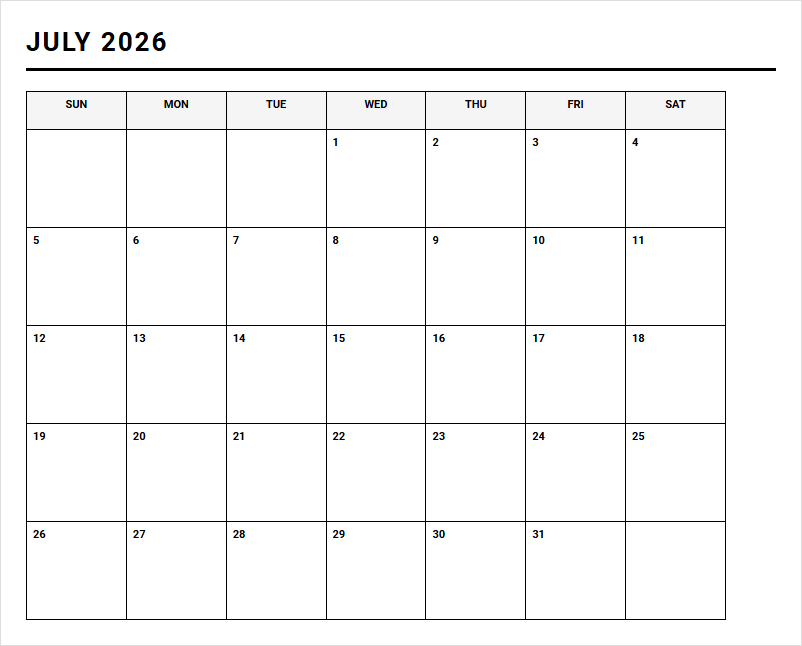
Staying aligned with long-term strategic objectives amidst daily distractions is a constant struggle for modern professionals. While standard funding sources and budgets secure your operational runway, execution requires structured focus.
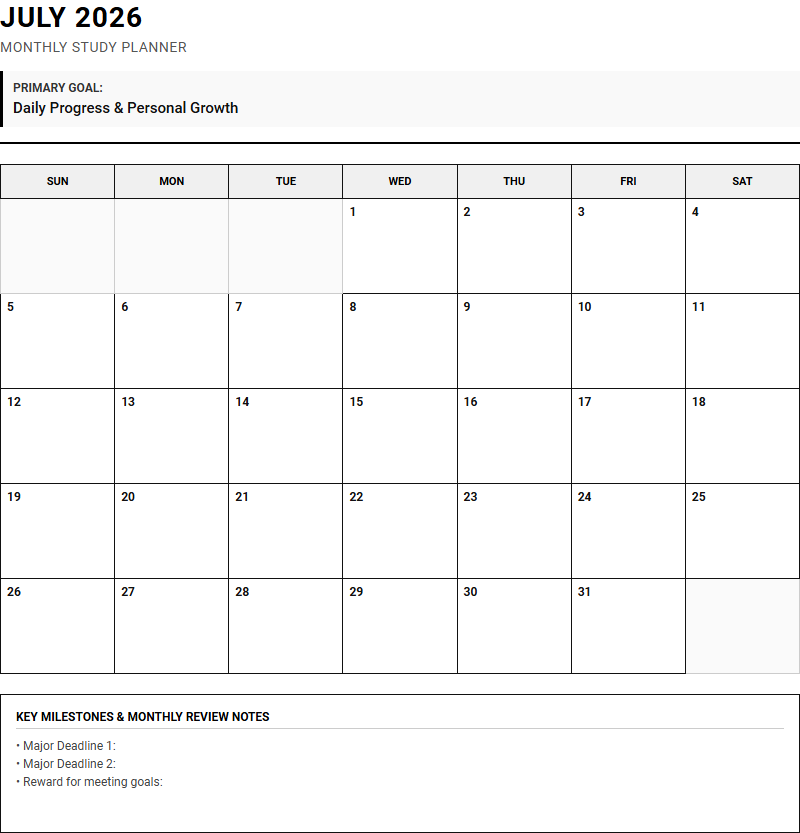
Utilizing a Monthly Goal Setting Calendar grants you the precise visual architecture needed to break down high-level targets. However, this system relies on the stipulation that you define clear, daily actionable items-such as tracking Q4 sales outreach milestones. Below, we outline how to leverage these printable monthly calendars to systematically organize your timeline.
Create Your Monthly Goal Setting Calendar
Done customizing?
Monthly Goal Setting Calendar - Good to Know
SMART Goals
SMART goals provide a robust framework for translating vague ambitions into actionable objectives. By ensuring your goals are Specific, Measurable, Achievable, Relevant, and Time-bound, you eliminate ambiguity from your planning process. Instead of aiming to "get fit," a SMART goal dictates that you will "run five kilometers in under thirty minutes by the end of next month." This precise structure allows you to track progress objectively and maintain motivation.
When you define clear parameters, your brain recognizes the exact path to success, reducing cognitive load and decision fatigue. Implementing this methodology ensures that every resource you invest aligns directly with your broader aspirations. It transforms abstract desires into concrete milestones, providing a reliable roadmap for personal and professional development. Using this structured approach, you establish a firm foundation for sustained productivity and measurable growth.
Habit Tracker
A habit tracker serves as a visual testament to your daily commitment and progress. By recording your daily behaviors, you create an immediate feedback loop that reinforces positive actions. Whether you use a digital application, a spreadsheet, or a simple paper journal, the act of checking off a completed task releases dopamine and builds psychological momentum. Over time, these daily checkmarks form unbroken chains of consistency.
To maximize the effectiveness of your habit tracker, consider these core principles:
- Start small: Reduce initial friction by tracking tiny habits.
- Record immediately: Log your progress right after the behavior
(trigger -> action -> log). - Never miss twice: Prevent breaking your momentum by avoiding back-to-back skips.
By visualizing your consistency, you transform abstract resolutions into daily routines, making long-term success an inevitable byproduct of your structured everyday actions.
Time Blocking
Time blocking is a highly effective productivity technique where you divide your day into dedicated blocks of time. Each block is assigned to a specific task or group of tasks, eliminating the inefficiencies of multitasking. Instead of working from an open-ended to-do list, you schedule exactly when and what you will focus on throughout the day. This method forces you to estimate the time required for each activity, fostering a realistic understanding of your daily capacity.
"Concentrate all your thoughts upon the work at hand. The sun's rays do not burn until brought to a focus." - Alexander Graham Bell
By reserving specific intervals for deep work, administrative chores, and personal breaks, you protect your cognitive energy from constant context switching. This structured approach ensures that high-priority projects receive undivided attention, drastically improving the quality and speed of your output.
OKRs
OKRs, or Objectives and Key Results, represent a powerful goal-setting framework popularized by major tech companies to align individual efforts with organizational strategy. The Objective defines a qualitative, inspirational goal of what you want to achieve. In contrast, the Key Results are quantitative, measurable metrics that track how you will achieve that objective. This combination ensures that your grand visions are tethered to realistic, verifiable outcomes.
- Alignment: Ensures everyone moves in the same strategic direction.
- Focus: Prioritizes a small set of high-impact goals per cycle.
- Transparency: Makes progress visible to the entire team.
By adopting this methodology, you bridge the gap between high-level strategy and daily execution. OKRs encourage ambitious thinking while demanding rigorous accountability, ensuring that your daily labor directly contributes to significant, measurable advancements.
Micro-goals
Micro-goals are the microscopic building blocks of massive achievements. When faced with a monumental project, the sheer scale of the endeavor can lead to procrastination and paralysis. By deconstructing these overwhelming objectives into tiny, manageable increments, you lower the barrier to entry. A micro-goal might be writing a single paragraph, coding one line of script, or reading for five minutes. These bite-sized targets are designed to be almost impossible to fail, helping you bypass the resistance of starting.
The primary value of micro-goals lies in their ability to generate rapid momentum. Once you initiate action, the psychological inertia is broken, and continuing the task becomes significantly easier. Embracing this micro-focused strategy allows you to steadily chip away at complex projects without experiencing burnout, translating minor daily efforts into substantial, cumulative long-term triumphs over time.
Monthly Review
A monthly review is a vital reflective practice that bridges the gap between short-term actions and long-term strategy. Without regular evaluation, it is easy to lose direction and drift away from your core objectives. Spending time at the end of each month to analyze your successes and setbacks allows you to calibrate your approach. You can assess your progress using a simple evaluation matrix:
| Metric Assessed | Target Achievement | Adjustment Needed |
|---|---|---|
| Goal Alignment | High | Maintain current strategy |
| Habit Consistency | Medium | Simplify daily routines |
This systematic assessment empowers you to celebrate your wins, learn from your failures, and adjust your tactical plans for the upcoming month with renewed clarity and focus.
Habit Stacking
Habit stacking is an incredibly efficient behavioral design strategy that leverages your existing routines to build new, positive behaviors. Coined by habits expert James Clear, this method involves identifying a current daily habit and pairing it with a new target behavior. The formula is remarkably simple: After [Current Habit], I will [New Habit]. By anchoring a new action to an established neural pathway in your brain, you drastically increase the likelihood of the new habit sticking.
For example, if you want to practice mindfulness daily, you might stack it onto your morning coffee routine: "After I pour my morning cup of coffee, I will meditate for two minutes." This technique eliminates the need to rely solely on willpower or memory, as the environment and your established behavior act as natural, automatic triggers that guide your routine effortlessly.
Milestone Tracking
Milestone tracking involves breaking down your long-term roadmap into distinct, celebratory checkpoints. While long-term goals provide direction, their distant nature can sometimes lead to a loss of motivation midway through the journey. By establishing intermediate milestones, you create psychological resting points and opportunities to measure your velocity. These checkpoints serve as proof of progress, keeping your enthusiasm high.
- Maintain Momentum: Celebrates incremental progress to sustain drive.
- Facilitate Agility: Provides regular intervals to pivot tactics if needed.
- Reduce Anxiety: Shrinks the perceived distance to the final objective.
When you actively monitor these milestones, you shift your focus from the daunting mountain peak to the manageable path immediately ahead. This balanced perspective ensures sustained endurance and continuous progress toward your final destination.
Focus Theme
A focus theme is a guiding concept or word that dictates your priorities and decisions for a specific period, such as a quarter or a year. Unlike rigid goals, a theme offers a flexible psychological framework that adapts to changing circumstances. Popular themes include terms like Simplification
, Expansion
, or Resilience
. This overarching concept acts as a filter for your daily choices, helping you say "no" to opportunities that do not align with your current season of life.
When you adopt a focus theme, you create a cohesive narrative for your efforts. It provides a sense of direction without the pressure of strict metrics. During times of uncertainty, your theme serves as a north star, grounding your daily actions and ensuring that your energy is consolidated toward a unified purpose, rather than scattered across too many competing interests.
Action Plan
An action plan is the tactical blueprint that bridges the gap between aspiration and reality. Without a concrete plan, even the most inspiring goals remain mere wishes. A well-constructed action plan outlines the exact steps, resources, and timelines required to execute your strategy successfully. It details who is responsible for what, which potential obstacles might arise, and how you will overcome them.
- Identify the core objective and define the desired outcome.
- List all necessary tasks required to achieve that outcome.
- Assign specific deadlines to each task to foster accountability.
By translating your grand strategy into a sequence of immediate, actionable steps, you eliminate ambiguity and pave a clear path forward. This deliberate preparation empowers you to initiate action with confidence, turning strategic vision into tangible, real-world success.
Leave a comment