
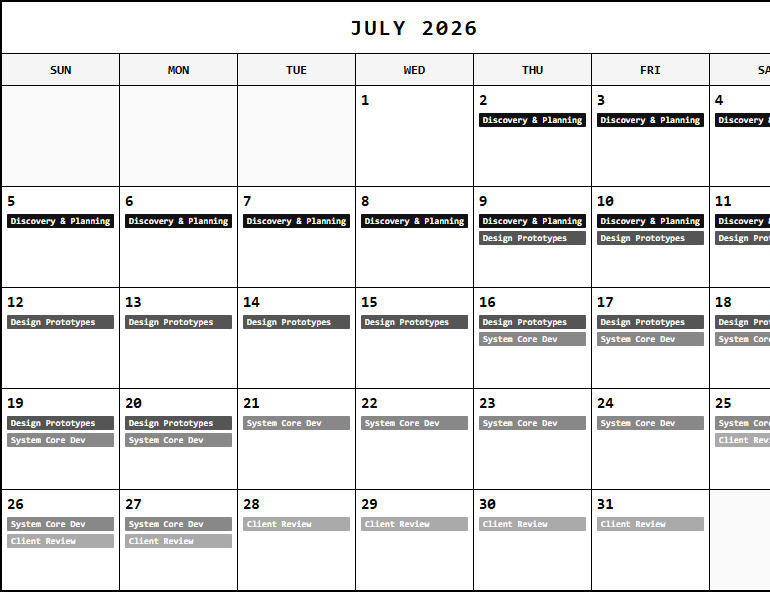
Managing complex project timelines often leads to fragmented communication and missed milestones. While securing standard funding sources and enterprise tool budgets is a traditional starting point, operational alignment requires simplicity. A printable Monthly Project Tracker Calendar grants stakeholders immediate, offline clarity. Under the stipulation that manual tracking requires daily discipline, this tool successfully anchors complex initiatives like agile sprints and product launches. Below, we outline how to integrate this template into your workflow.
Create Your Monthly Project Tracker Calendar
Done customizing?
Monthly Project Tracker Calendar - Good to Know
Milestone Tracking
Milestone tracking serves as the guiding compass for any complex project, marking significant achievements and critical transition points along the development lifecycle. By defining these major checkpoints, project managers can easily monitor high-level progress without getting bogged down in daily micro-tasks. These checkpoints represent the successful completion of major deliverables, phase transitions, or key approval gates.
Implementing a robust tracking system offers several distinct advantages for cross-functional teams:
- Enhanced Stakeholder Communication: Provides high-level visibility for executives who require status updates without technical jargon.
- Team Motivation: Celebrating reached milestones boosts morale and highlights collective momentum.
- Risk Mitigation: Early identification of missed milestones flags potential scheduling delays before they cascade.
By mapping these key events chronologically, organizations align their expectations, secure timely resource commitments, and maintain a clear, unified focus on the overarching project objectives from inception to final delivery.
Gantt Chart View
The Gantt Chart View is an indispensable visual representation of a project schedule, displaying tasks against a horizontal timeline. This timeline-based chart instantly clarifies the duration, start date, and end date of every individual work item. By translating complex spreadsheets into an intuitive visual format, teams can comprehend the entire scope of work at a single glance.
Modern interactive Gantt charts empower project leads to optimize workflows through dynamic features:
- Drag-and-Drop Scheduling: Quickly shift dates as project parameters evolve in real time.
- Visual Progress Bars: Monitor percent-complete metrics directly on the task bars.
- Owner Allocation: View assigned team members alongside their respective work items.
Utilizing this structured visualization ensures that potential bottlenecks are identified early, scheduling conflicts are minimized, and team members remain continuously aligned on immediate and long-term delivery expectations.
Resource Allocation
Effective Resource Allocation is the strategic process of assigning and managing assets in a manner that maximizes operational efficiency. Assets typically encompass human capital, specialized software, budgetary funds, and physical equipment. Aligning the right talent with the right tasks at the right time prevents burnout while maximizing project output quality.
"Strategic resource management balance ensures that team members are neither underutilized nor overwhelmed, preserving long-term project health."
To achieve this equilibrium, resource planners must evaluate team availability, individual skill sets, and competing organizational priorities. Utilizing visual capacity heatmaps and automated workload indicators prevents overallocation. Through precise scheduling and continuous monitoring of utilization rates, organizations can optimize their operational footprint, reduce overhead expenses, and consistently meet delivery targets without sacrificing team well-being.
Task Dependencies
In modern project management, tasks rarely exist in isolation. Understanding Task Dependencies is crucial for mapping the relationship between different activities and determining the correct sequential order of operations. Defining these relationships prevents team members from starting work prematurely on tasks that require inputs from preceding phases.
Typically, these logical relationships fall into several standard categories:
- Finish-to-Start (FS): Task B cannot start until Task A is completed. This is the most common dependency type.
- Start-to-Start (SS): Task B cannot start until Task A has initiated.
- Finish-to-Finish (FF): Task B cannot finish until Task A finishes.
Documenting these linkages within your scheduling software ensures that when a delay occurs in an upstream task, downstream schedules adjust automatically, maintaining accurate project forecasts.
Sprint Planning
Within Agile methodologies, Sprint Planning stands as a collaborative event that initiates a new development iteration. During this session, the product owner and the development team agree upon a defined set of backlog items to tackle during the upcoming sprint, which typically lasts two to four weeks.
The success of this ceremony relies on answering two fundamental questions:
First, what can be delivered in the increment resulting from the upcoming sprint? Second, how will the work needed to deliver the increment be achieved? By breaking down high-priority user stories into manageable sub-tasks, the team establishes a clear commitment. This disciplined focus minimizes scope creep, fosters rapid iterative feedback loops, and guarantees that high-value software increments are consistently prepared for deployment at the end of every cycle.
Project Timeline
A comprehensive Project Timeline serves as the chronological backbone of any initiative, outlining the sequence of events from initiation to closeout. It establishes a realistic schedule for deliverables and keeps all active contributors oriented toward the same completion dates. Without this guiding schedule, projects easily fall victim to structural delays and misaligned expectations.
A well-structured timeline integrates several core components to maintain operational focus:
- Phases: Major developmental stages, such as discovery, design, development, and testing.
- Deadlines: Hard target dates for specific deliverables and external reviews.
- Owner Assignments: Accountability mapping to ensure clarity regarding who drives which phase.
By reviewing and updating this timeline regularly, project managers can proactively address delays, reallocate resources dynamically, and keep external clients fully informed of progress milestones.
Critical Path Method
The Critical Path Method (CPM) is a step-by-step project management technique used to identify the sequence of crucial tasks that directly determine the minimum total duration of a project. By analyzing this path, managers discover which tasks are flexible and which must occur strictly on schedule to avoid delaying the final completion date.
Implementing CPM involves a rigorous mathematical approach to scheduling:
- Identify all tasks required to complete the project scope.
- Define the sequence and dependencies between these activities.
- Estimate the duration of each individual task.
- Calculate the critical path by determining the longest continuous sequence of dependent steps.
By focusing management attention on these critical activities, teams can optimize resource distribution and prevent costly delays where schedule flexibility is zero.
Capacity Planning
To sustain business growth, organizations must master Capacity Planning. This strategic discipline focuses on determining the human and technical resources needed to meet upcoming project demands over an extended timeframe. It bridges the gap between high-level business strategy and daily execution capabilities, ensuring commitments do not exceed realistic output potential.
Organizations must continuously balance two primary variables:
- Resource Supply: The total available working hours, taking into account vacations, holidays, and administrative tasks.
- Project Demand: The estimated hours required to complete active and upcoming initiatives.
Accurate planning prevents the organizational chaos of overallocation. By analyzing historical performance metrics and future pipelines, leadership can make informed, proactive hiring decisions, prioritize high-value projects, and protect team members from systemic burnout.
Time Blocking
For individual contributors and leaders alike, Time Blocking is a highly effective productivity method that involves partitioning the workday into distinct, dedicated blocks of time. Instead of keeping an open-ended, reactive to-do list, professionals dedicate specific time slots to focus entirely on singular tasks or thematic categories of work.
"By treating your calendar as a finite resource, you protect your focus from the constant interruptions of modern digital workplaces."
This approach minimizes the cognitive cost of context switching. During a block dedicated to deep work, notifications are silenced, allowing for uninterrupted concentration on complex problem-solving. By planning the day in advance, individuals gain control over their schedules, prioritize proactive long-term tasks over urgent daily distractions, and achieve a healthier, more predictable work-life balance.
Work Breakdown Structure
The Work Breakdown Structure (WBS) is a hierarchical decomposition of the total scope of work to be carried out by the project team. By breaking down large, complex projects into smaller, more manageable components, the WBS provides a highly structured framework for detailed cost estimating, resource planning, and risk management.
This structural decomposition organizes project components into distinct levels:
- Level 1: The overall project or major phases.
- Level 2: Major deliverables within those phases.
- Level 3 (Work Packages): The lowest level of detail, representing discrete tasks that can be easily scheduled and costed.
By defining work at this granular level, project managers eliminate ambiguity, establish clear accountability, and ensure that no essential deliverables are overlooked during the planning and execution phases of the lifecycle.
Leave a comment