
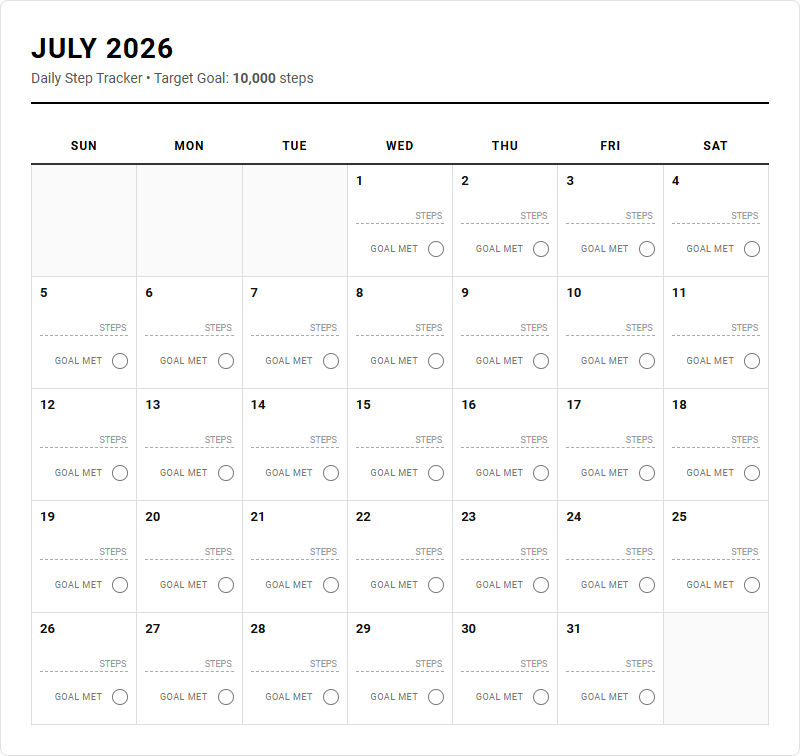
Consistently hitting daily step goals often feels unsustainable amidst busy schedules. While traditional wellness initiatives allocate funding toward expensive wearable tech, these complex tools frequently lead to screen fatigue. Our printable Step Count Tracker grants a tactile, visual alternative that reinforces daily discipline. Note the stipulation: success requires a commitment to manual daily logging. However, this simple practice has helped many consistently cross the 10,000-step threshold. Below, we outline how to utilize this elegant calendar to sustain your momentum.
Create Your Step Count Tracker
Done customizing?
Step Count Tracker - Good to Know
Pedometer
A pedometer is a portable, electronic, or electromechanical device designed to count each step a person takes by detecting the motion of their hips or hands. Originally manufactured as mechanical gear-driven instruments, modern pedometers rely on digital microelectromechanical systems (MEMS) sensors to ensure precise tracking. These devices serve as foundational tools for individuals aiming to increase their daily physical movement and transition away from sedentary habits.
By translating physical vibrations into quantifiable data, a pedometer offers immediate visual feedback on physical output. Integrating this technology into your routine fosters a heightened awareness of daily movement patterns. Many individuals use these compact devices to achieve their health goals, utilizing the real-time feedback to make active choices throughout the day, such as taking the stairs instead of an elevator.
- Ensures real-time physical activity monitoring
- Utilizes highly sensitive internal sensors
- Encourages daily movement awareness
Daily Step Goal
Setting a daily step goal is a widely recognized behavioral strategy designed to encourage regular physical activity and combat sedentary lifestyles. While the standard target of 10,000 steps per day is globally popularized, personalizing this benchmark based on individual fitness levels, health conditions, and personal schedules is highly recommended by medical professionals.
Establishing a realistic daily milestone provides a structured framework for consistency, acting as a powerful psychological motivator. Meeting this daily quota regularly contributes to long-term cardiovascular fitness, improved metabolic health, and effective weight management. Adjusting step counts gradually ensures sustainable progress, minimizes injury risks, and builds physical stamina over time.
- Assess current baseline movement levels.
- Incrementally increase target step counts weekly.
- Track consistency using digital applications.
Non-Exercise Activity Thermogenesis
Non-Exercise Activity Thermogenesis (NEAT) represents the energy expended for everything we do that is not sleeping, eating, or sports-like exercise. This includes vital everyday activities such as walking to the office, typing, performing household chores, agricultural work, and even fidgeting. NEAT plays a crucial role in regulating our total daily energy expenditure (TDEE).
Unlike structured workouts, which typically occupy a very small fraction of the day, NEAT spans several hours and can vary significantly among individuals depending on their lifestyle choices, occupation, and daily routines. Cultivating a high-NEAT lifestyle by choosing to stand, walk, or move more frequently can burn hundreds of extra calories daily, dramatically supporting long-term metabolic health and weight maintenance efforts without causing physical exhaustion.
Step Streak
A step streak refers to the consecutive number of days an individual successfully meets or exceeds their established daily step goal. This gamified concept leverages behavioral psychology to build strong, lasting habits through consistency and positive reinforcement. Maintaining a streak creates a powerful psychological momentum, making individuals less likely to skip their daily walks even on busy days.
Many modern fitness applications use push notifications, virtual badges, and community leaderboards to celebrate these milestones, driving user engagement. While preserving a streak is incredibly motivating, it is vital to balance consistency with adequate recovery. Incorporating active rest days allows your body to repair, preventing physical burnout and overuse injuries while sustaining long-term health habits.
- Enhances user motivation through gamification
- Builds long-term habits via positive reinforcement
- Promotes daily accountability and consistency
Accelerometer
An accelerometer is the core technological component inside modern activity trackers, smartwatches, and smartphones that measures acceleration forces. These sensors detect movement along three axes-lateral, vertical, and sagittal-to determine the intensity, speed, and direction of physical motion. By converting physical movement into digital electrical signals, the sensor differentiates between walking, running, and idle sitting.
Advanced algorithmic processing allows the accelerometer to filter out false movements, such as driving over a bumpy road or washing dishes, ensuring high accuracy in step counting. This micro-sensor technology enables modern wearables to provide users with precise, real-time data regarding their physical exertion, daily step counts, and sleep patterns, making it indispensable for modern personal health tracking and biometric analysis.
Walking Cadence
Walking cadence refers to the rate at which steps are taken, typically measured in steps per minute (SPM). This metric serves as a key indicator of walking intensity and overall biomechanical efficiency. While a leisurely stroll might average around 80 SPM, brisk walking for moderate-intensity aerobic exercise usually requires maintaining a cadence of at least 100 SPM.
Tracking your cadence helps evaluate physical fitness improvements and optimize walking biomechanics. Adjusting your stride frequency can reduce joint stress, improve cardiovascular efficiency, and enhance training volume. Monitoring this metric is highly beneficial for fitness enthusiasts and physical therapy patients alike who wish to walk more efficiently:
- Low Intensity: Under 80 steps per minute
- Moderate Intensity: 100 to 119 steps per minute
- Vigorous Intensity: 120+ steps per minute
Active Calories
Active calories refer to the energy your body burns specifically during physical movement and structured exercise, separate from your Basal Metabolic Rate (BMR). When you engage in activities like walking, jogging, or cycling, your muscles require additional energy, which increases your caloric burn. Tracking active calories helps individuals manage their daily energy balance accurately.
This metric is calculated using heart rate data, step counts, age, weight, and gender, offering a personalized view of physical exertion. Understanding this expenditure is essential for aligning nutritional intake with personal fitness, weight loss, or athletic performance goals. Monitoring active calories ensures you refuel your body appropriately after intense exertion while maintaining a healthy caloric deficit if weight reduction is your primary objective.
Wearable Syncing
Wearable syncing is the process of transferring fitness data from your tracking device to a smartphone, tablet, or cloud-based software platform. This seamless communication usually occurs via Bluetooth or Wi-Fi, ensuring that your step counts, sleep metrics, and heart rate data are permanently logged and updated in real-time. Syncing allows fitness applications to generate comprehensive historical reports.
These applications analyze long-term health trends and provide personalized insights. It also facilitates community integration, enabling users to share achievements, join step challenges, and sync data with third-party health apps for a holistic overview of their wellness journey. Regular syncing ensures that your progress is securely backed up and accessible across multiple digital interfaces.
Gait Analysis
Gait analysis involves the systematic study of human motion, specifically looking at how we walk or run. By evaluating metrics such as stride length, step symmetry, ground contact time, and foot strike patterns, gait analysis offers valuable insights into movement efficiency and biomechanical alignment. This assessment can identify muscular imbalances or abnormal patterns that might lead to chronic injuries over time.
Many high-end wearables and specialized sports clinics utilize advanced sensors to conduct detailed gait assessments. This technology helps athletes and fitness enthusiasts optimize their posture, select correct footwear, and improve running economy. Addressing gait abnormalities can alleviate stress on the knees, hips, and lower back, promoting pain-free movement and enhanced physical longevity.
Sedentary Alert
A sedentary alert is a digital notification programmed into smartwatches and activity trackers designed to combat prolonged periods of physical inactivity. When the sensor detects that you have been stationary for a set duration, usually one hour, it triggers a gentle vibration or sound prompting you to stand up and move around.
These gentle reminders are vital in modern work environments where prolonged sitting is common. Breaking up sedentary time with short walks or light stretches helps improve circulation, reduce muscle stiffness, boost metabolic health, and maintain steady energy levels throughout the day. Actively responding to these alerts can mitigate the negative health risks associated with a desk-bound lifestyle.
Leave a comment