
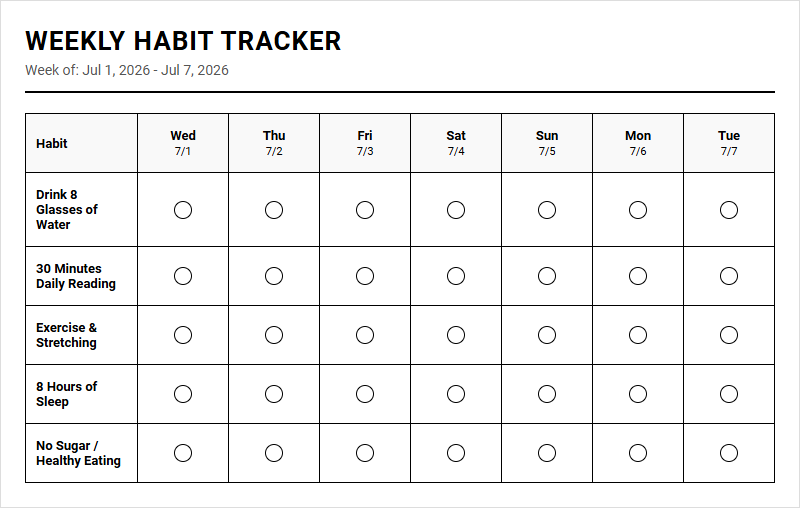
Maintaining consistent wellness routines often feels overwhelming, leading many to abandon their fitness goals. While people frequently rely on complex digital apps or costly gym memberships for accountability, a tactile weekly habit tracker offers a superior, distraction-free visual cue. Notably, these printable templates provide immediate cognitive reinforcement. However, success stipulates a commitment to daily updates. Whether you are tracking 10,000 daily steps or hydration, this guide outlines how to leverage our printable calendar for sustained lifestyle changes.
Create Your Weekly Habit Tracker
Done customizing?
Weekly Habit Tracker - Good to Know
Habit stacking
Habit stacking is a highly effective behavioral design strategy that leverages your existing daily routines to build new, positive behaviors. Instead of trying to insert a new action into a random part of your day, you pair it directly with an established trigger that you already perform without thinking. This process creates a cognitive bridge, utilizing the neural pathways already strengthened by years of repetition.
To successfully implement this method, you can utilize a simple, structured formula to map out your daily transitions:
- Identify an immutable daily anchor (e.g., brewing morning coffee).
- Select a small, immediate new habit (e.g., writing a quick to-do list).
- Execute the new action immediately after the anchor event concludes.
By chaining these behaviors together, you reduce the cognitive load required to initiate change. The momentum of the first activity naturally propels you into the next, making consistency far easier to maintain over time.
Streak tracking
The psychological power of streak tracking lies in our innate desire for order and progress preservation. By visually documenting every consecutive day you complete a target behavior, you build a powerful visual chain. This external representation of consistency serves as a potent motivator, transitioning your focus from the effort of the task itself to the preservation of the unbroken streak.
Maintaining a streak triggers a dopamine release each time you log a successful day. However, to prevent burnout and anxiety, behavioral scientists suggest incorporating a "never miss twice" rule. This framework allows for occasional disruptions while preventing a single slip from spiraling into total abandonment of the routine.
Whether utilizing a physical calendar with red markers or a specialized digital application, the continuous visualization of your commitment reinforces your self-efficacy and transforms sporadic actions into permanent lifestyle changes.
Keystone habits
A keystone habit is a foundational behavior that naturally triggers a positive chain reaction throughout other areas of your life. Unlike isolated routines, these unique habits possess the power to organic restructure your daily schedules, priorities, and personal values without requiring conscious effort across multiple domains.
"When people start habitually exercising, even as infrequently as once a week, they start changing other, unrelated patterns in their lives, often without realizing it."
Common examples of these catalytic behaviors include regular physical exercise, maintaining a consistent sleep schedule, or practicing daily gratitude. When you establish a keystone habit, you cultivate a sense of discipline and self-worth that spills over into your diet, productivity, financial management, and interpersonal relationships. Investing energy into these leverage points ensures that a single positive change amplifies your entire personal development journey.
Micro-habits
The philosophy of micro-habits focuses on reducing a desired behavior to its smallest, most effortless iteration. By shrinking the barrier to entry, you bypass the mental resistance that typically accompanies large lifestyle changes. Instead of striving to read for an hour, write a chapter, or exercise for thirty minutes, you commit to much simpler versions:
- Reading just one page of a book each night.
- Writing a single sentence in a journal.
- Performing two push-ups immediately after waking up.
These minuscule actions require virtually no willpower, making them highly resilient against stress, fatigue, and busy schedules. While the immediate physical output of a micro-habit is small, the primary objective is to master the art of showing up. Once the neurological pathway for the behavior is established through daily repetition, scaling the habit upward becomes a natural progression.
Identity-based habits
True, lasting behavioral modification is not built upon what you want to achieve, but rather on who you wish to become. Traditional approach models focus heavily on outcome-based goals, such as losing twenty pounds or writing a novel. In contrast, identity-based habits shift the focus to the root of human behavior: your self-image and core belief system.
Every action you take is a vote for the type of person you believe you are. If you want to build a writing habit, your goal should not be to write a book, but to become a writer. Each time you sit down to write, even for five minutes, you cast a vote for that identity. Over time, your habits and your self-concept align, making positive behaviors effortless because they are a direct expression of your authentic self rather than chores you must force yourself to perform.
Implementation intentions
An implementation intention is a highly specific plan that predetermines exactly when, where, and how you will execute a target behavior. Developed by psychologist Peter Gollwitzer, this strategy removes the ambiguity that often leads to procrastination. By defining your environmental cues in advance, you delegate the decision-making process to your subconscious mind.
The standard structure for formulating an implementation intention is highly formulaic:
If [Situation X] occurs, then I will perform [Behavior Y].
For example, instead of vaguely planning to study more, you write: "If it is 6:00 PM on Tuesday, then I will open my textbook at my kitchen table." This precise mental mapping ensures that when the cue arrives, you do not waste time or energy debating whether to act. You simply execute the pre-programmed response, significantly increasing your chances of success.
Gamified habit tracking
Injecting play and structural design principles into daily routines, gamified habit tracking transforms personal growth into an engaging experience. By translating abstract self-improvement goals into tangible metrics like experience points, character levels, virtual currency, and unlockable achievements, this method taps into our fundamental desire for play and reward.
- Avatar Progression: Watch your digital representation grow stronger as you complete real-world tasks.
- Quest Structures: Frame difficult weekly routines as epic challenges to overcome.
- Social Guilds: Join forces with friends to complete shared accountability missions.
This gamified framework is particularly beneficial for tasks that lack immediate real-world gratification. By associating a tedious habit with instant digital rewards, you bridge the gap between present effort and future payoff, maintaining high engagement during the critical early stages of behavioral adoption.
Habit loop
To systematically construct or deconstruct any human behavior, one must thoroughly understand the mechanics of the habit loop. Popularized by modern neurological research, this three-step neurological loop acts as the engine behind every routine in our lives:
- The Cue: A environmental trigger that instructs your brain to go into automatic mode.
- The Routine: The physical, mental, or emotional action that you perform.
- The Reward: The positive feedback that helps your brain determine if this loop is worth remembering.
By dissecting your current behaviors into these distinct components, you gain the power to consciously redesign them. If you wish to eliminate an unwanted habit, you must identify the underlying cue and reward, then carefully substitute the routine with a healthier alternative that satisfies the same craving.
Friction reduction
The concept of friction reduction centers on optimizing your physical and digital environments to make desirable behaviors as easy as possible to execute. Human beings are biologically wired to follow the path of least resistance. Therefore, by proactively removing obstacles, distractions, and decision-making steps, you make positive actions almost inevitable.
If you want to practice guitar in the morning, do not keep it packed away in a closet; place it on a stand in the middle of your living room. Conversely, you can increase friction for negative habits by putting your phone in another room or deleting social media apps. Designing your surrounding environment to cooperate with your long-term goals reduces the reliance on willpower, allowing you to establish new routines naturally and with minimal psychological friction.
Digital habit dashboard
A customized digital habit dashboard serves as a modern command center for personal growth, unifying your tracking metrics, schedules, and goals into a single interface. By leveraging customizable platforms like Notion, specialized mobile applications, or dedicated spreadsheets, you create a centralized space to analyze your behavioral trends over time.
These advanced digital tools offer real-time data visualization, automated reminders, and seamless integration with other productivity software. They allow you to cross-reference your habit completion rates with other metrics like sleep quality, daily mood, and work productivity. Having a comprehensive, visual overview of your self-improvement journey provides invaluable insights, allowing you to iteratively refine your routines based on empirical evidence rather than intuition.
Leave a comment