
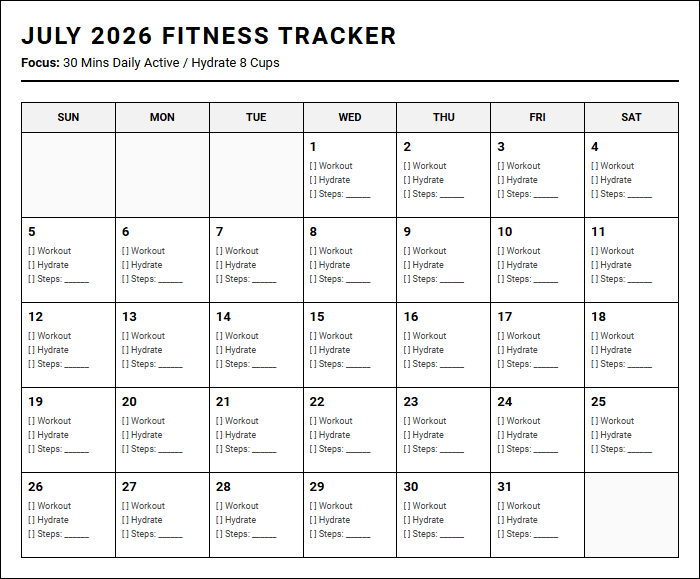
Maintaining fitness consistency is notoriously difficult, often leading to abandoned routines. While digital apps and wearables offer data, they frequently clutter the user experience. A physical monthly printable calendar grants immediate, high-visibility accountability. Admittedly, tracking only succeeds when paired with disciplined daily entries. Successful athletes leverage these templates to log daily cardio milestones and strength splits. Below, we outline how to utilize our monthly fitness tracker calendar to optimize your routine and sustain momentum.
Create Your Monthly Fitness Tracker Calendar
Done customizing?
Monthly Fitness Tracker Calendar - Good to Know
Activity streak tracker
Maintaining long-term exercise habits relies heavily on psychological momentum. An activity streak tracker serves as a visual representation of your commitment, transforming daily efforts into an unbroken chain of success. By logging even minimal movement daily, you leverage the behavioral science of gamification to ward off procrastination.
To maximize this tool, consider these structured strategies:
- Define a minimum threshold: Establish a baseline, such as ten minutes of stretching, to keep the streak alive on busy days.
- Visualize your progress: Use prominent color-coding to make your daily victories immediately apparent.
- Forgive but resume immediately: Never allow a missed day to turn into two consecutive misses.
This systematic approach builds profound neural pathways, reinforcing the identity of someone who prioritizes physical well-being. Over time, protecting the streak becomes an autonomous drive, reducing the cognitive friction typically required to initiate daily exercise routines.
Non-scale victories log
Relying solely on gravitational body weight offers an incomplete, often discouraging picture of your physical evolution. A non-scale victories (NSV) log shifts your focus toward holistic markers of vitality, strength, and mental clarity. By documenting qualitative improvements, you build a resilient foundation for long-term lifestyle adherence.
"True physical transformation is felt in daily life long before it is reflected on a digital scale."
Record your personal breakthroughs across these essential domains:
- Sleep Quality: Falling asleep faster and waking up with sustained morning energy.
- Functional Strength: Carrying heavy groceries or climbing stairs without experiencing breathlessness.
- Mental Resilience: Utilizing exercise as a primary stress-management tool rather than a chore.
- Sartorial Fit: Noticing how clothing drapes comfortably over newly toned muscle groups.
This qualitative database acts as a crucial emotional buffer during inevitable weight plateaus, proving that your body is continuously adapting and thriving.
Workout consistency calendar
A structured workout consistency calendar serves as your roadmap for physical preparation. Instead of leaving exercise to chance, scheduling your physical activity ensures it receives the same priority as professional commitments. This calendar helps you transition from sporadic bursts of motivation to structured, predictable routines.
Implement these design principles for your personal tracking layout:
- Pre-program weekly blocks: Map out specific times for resistance training, cardiovascular work, and recovery active rest.
- Integrate color hierarchy: Apply distinct colors to differentiate between intense sessions, active recovery, and complete rest days.
- Conduct weekly retrospectives: Analyze empty calendar slots to identify systemic scheduling bottlenecks or fatigue trends.
This visual tool removes decision fatigue, allowing you to execute planned sessions automatically. Over months, this calendar provides undeniable evidence of your dedication, cementing training as an unnegotiable part of your weekly identity.
Habit loop tracker
Every repetitive action is driven by a subconscious three-step loop: a cue, a routine, and a rewarding sensation. A habit loop tracker deconstructs your fitness behaviors to modify unwanted habits or build powerful new routines. By analyzing these neurological components, you gain direct control over your daily automation.
Consider the structure of a successfully engineered fitness loop:
- The Cue (Trigger): Placing your running shoes directly beside your bed the night before.
- The Routine (Behavior): Completing a programmed twenty-minute morning cardiovascular session.
- The Reward (Reinforcement): Enjoying a high-protein breakfast smoothie while checking off your daily log.
By consciously mapping these elements, you dismantle destructive habits-such as evening sedentary snacking-and replace them with constructive actions. This meticulous behavioral tracking ensures your fitness journey relies on systemic architecture rather than fleeting willpower.
Daily step goal calendar
Non-Exercise Activity Thermogenesis (NEAT) constitutes a massive portion of daily energy expenditure, yet it is frequently ignored. A daily step goal calendar monitors this baseline movement, protecting you against the metabolic hazards of a sedentary desk job. It encourages continuous, low-intensity physical activity throughout your waking hours.
To maintain consistent step counts, integrate these lifestyle habits:
- Pace during conversations: Walk around your workspace during phone calls and virtual meetings.
- Active commuting: Park at the far end of parking structures or exit public transit one stop early.
- Post-meal ambulation: Commit to a ten-minute brisk walk immediately following lunch and dinner.
Tracking these numbers visually ensures that brief periods of intense gym work are not offset by hours of complete immobility, supporting healthy metabolic rates and cardiovascular function.
Body recomposition tracker
Body recomposition-the simultaneous process of losing adipose tissue while building lean skeletal muscle-requires specialized metrics. Because muscle tissue is significantly denser than fat, your total weight might remain unchanged even during dramatic physical transformations. This tracker records localized anthropometric measurements and body composition estimates.
For accurate data collection, prioritize these essential tracking methods:
- Circumference measurements: Measure key areas weekly, including the chest, waist, hips, biceps, and thighs.
- Standardized progress photography: Take photos under identical lighting, angles, and fasting conditions bi-weekly.
- Bioelectrical impedance or calipers: Track body fat percentage trends rather than isolated daily values.
This multi-dimensional data ensures you do not abandon a highly successful program simply because the bathroom scale displays a temporary plateau, highlighting real physical changes.
Macro and hydration log
Optimal physical performance and body composition are fueled by precise nutritional input. A macro and hydration log tracks your daily consumption of proteins, carbohydrates, lipids, and water. This granular data allows you to align your nutritional intake with specific athletic demands and recovery needs.
Ensure your nutritional log captures these fundamental variables:
- Target protein intake: Consuming adequate amino acids to support lean muscle repair and synthesis.
- Carbohydrate timing: Fueling high-intensity training sessions and replenishing depleted muscle glycogen.
- Essential lipid tracking: Maintaining hormone production and joint health through unsaturated fats.
- Hydration metrics: Logging daily fluid ounces to optimize cellular function and prevent cognitive fatigue.
By connecting how you fuel your body with your actual training output, you convert nutrition from a source of anxiety into a powerful instrument for recovery and athletic development.
Progressive overload tracker
Skeletal muscles only adapt when subjected to physical demands that exceed their current capacity. A progressive overload tracker is a critical tool for systematic strength development, ensuring you continuously challenge your muscular system. By recording every set, repetition, and load, you eliminate guesswork in your strength training program.
Track these primary variables to stimulate continuous physical adaptation:
- Absolute load: Increasing the total weight lifted on specific compound exercises over time.
- Volume metrics: Increasing total sets or repetitions performed at a given intensity level.
- Density and tempo: Reducing rest periods between sets or slowing down eccentric phases of movement.
Consistently referencing historical training data prevents you from repeating identical workouts month after month. This structured progression forces your muscular and nervous systems to adapt, grow stronger, and build resilience against injury.
Active minutes calendar
While daily step goals measure general movement, an active minutes calendar monitors the intensity of your physical exertion. It tracks time spent within elevated heart rate zones, distinguishing between casual walking and deliberate cardiovascular training. This distinction is critical for monitoring aerobic capacity and heart health.
Aim to categorize and log your active minutes using these parameters:
- Moderate-intensity zone: Activities where conversation is possible but challenging, such as brisk cycling.
- Vigorous-intensity zone: High-effort training where verbal communication is limited to short phrases, like interval running.
- Cumulative weekly targets: Striving to meet or exceed recommended public health cardiovascular guidelines.
By tracking these metrics, you ensure your training program includes both fat-oxidizing aerobic work and anaerobic conditioning, promoting balanced cardiovascular fitness.
Monthly fitness dashboard
A monthly fitness dashboard aggregates all individual tracking metrics into a cohesive, high-level summary. This centralized system allows you to step back from daily details and observe broader trends in your physical health. It bridges the gap between daily habits and your ultimate long-term wellness goals.
Your comprehensive monthly summary should analyze these core performance areas:
"Consistent evaluation of aggregated data turns sporadic efforts into a refined, high-performance training system."
Review total monthly workouts completed, average hydration levels, sleep quality trends, and strength progressions. Use these insights to make informed modifications for the upcoming month, such as adjusting calorie targets or revising workout frequencies. This consistent reflection ensures your fitness plan adapts to your changing lifestyle demands.

Leave a comment