
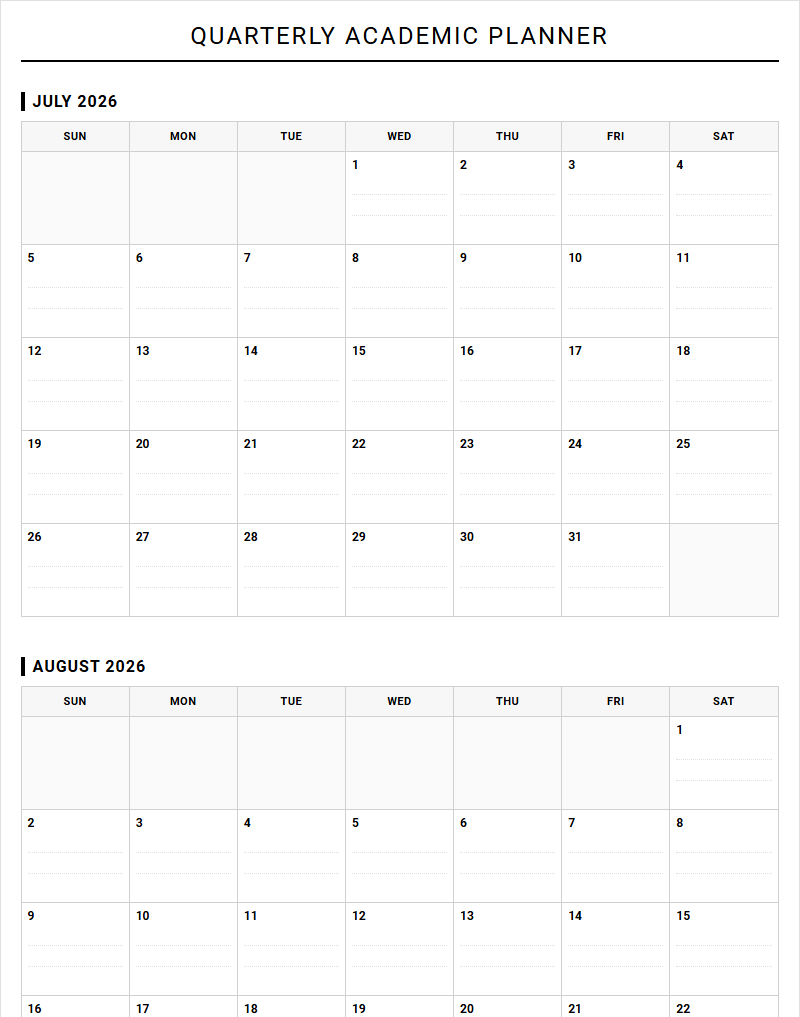
Balancing complex syllabi across fragmented academic terms often leaves educators and students facing severe planning fatigue. While standard institutional funding typically secures only rigid annual agendas, our printable Quarterly Academic Planner grants users dynamic control over their immediate scheduling needs. Under the stipulation that users maintain consistent weekly tracking, proven frameworks like the 12-Week Course Matrix demonstrate immense organizational value. Below, we outline how to utilize and print this essential tool for academic success.
Create Your Quarterly Academic Planner
Done customizing?
Quarterly Academic Planner - Good to Know
Quarterly study cycle
Managing academic demands requires a structured approach to your academic term. A quarterly study cycle divides your term into manageable phases, ensuring you transition smoothly from initial preparation to final exams. This structured methodology prevents cognitive fatigue and ensures consistent performance across all subjects.
- Phase 1 (Weeks 1-3): Focus on foundational concepts, active listening, and establishing study routines.
- Phase 2 (Weeks 4-7): Shift energy toward intensive review sessions, mid-term assessments, and identifying knowledge gaps.
- Phase 3 (Weeks 8-10): Dedicate time to rigorous synthesis of all materials to peak at exam time.
By treating the term as a dynamic journey rather than a static marathon, you maintain high cognitive function. Implementing this cycle involves setting weekly milestones, reviewing lecture notes within twenty-four hours, and scheduling dedicated rest periods to optimize memory consolidation throughout the quarter.
Syllabus mapping
Syllabus mapping transforms a chaotic pile of course documents into a unified, actionable roadmap. At the start of each semester, extract key deadlines, reading assignments, and grading criteria from every syllabus. Consolidating this data into a single master schedule reveals overlapping deadlines and potential bottlenecks early in the term.
This preemptive visualization allows you to allocate resources efficiently, ensuring major projects receive adequate preparation time. To map your syllabus effectively, categorize tasks by weight and complexity:
- Identify high-value deliverables worth more than 15% of your final grade.
- Break down large projects into smaller, weekly sub-tasks.
- Input all dates into a centralized calendar system.
By translating course requirements into concrete, scheduled actions, you remove ambiguity from your daily routine, empowering you to approach your coursework with clarity and reduced academic anxiety.
Time blocking
Time blocking is a highly effective time-management technique that involves dividing your day into distinct blocks of time, with each block dedicated to a specific task or activity. Unlike a traditional to-do list, which only tells you what needs to be done, time blocking dictates exactly when you will do it.
This method fosters deep focus by eliminating multitasking and reducing decision fatigue. When designing your daily schedule, allocate dedicated blocks for:
- Lectures and academic seminars
- Deep-work study and research sessions
- Physical exercise and meal preparation
- Personal leisure and social activities
Ensure you build in buffer blocks to accommodate unexpected delays or complex topics that require extra attention. By treating these time blocks as non-negotiable appointments with yourself, you cultivate a disciplined work ethic while safeguarding your free time.
GPA goal tracker
A GPA goal tracker serves as a quantitative compass for your academic journey, keeping you aligned with your long-term aspirations. To utilize this tool effectively, establish realistic GPA targets at the beginning of the academic year. Break down these overarching objectives into course-specific grade goals, calculating the precise scores needed on exams, essays, and participation.
| Course Name | Target Grade | Required Exam Average | Current Status |
|---|---|---|---|
| Advanced Calculus | A- (3.7) | 88% | On Track |
| Organic Chemistry | A (4.0) | 92% | Attention Needed |
Regularly updating your tracker with real-time grades provides immediate feedback, allowing you to identify which classes require additional focus before your cumulative grade is impacted. Monitoring your progress mathematically removes guesswork from your study strategy.
Assignment dashboard
An assignment dashboard acts as the central command center for your academic responsibilities, offering a real-time overview of all pending tasks. By organizing assignments by due date, subject, and status, this tool prevents critical deadlines from slipping through the cracks. A well-designed dashboard utilizes clear visual indicators to denote priority levels and completion stages.
Grouping tasks into logical categories allows you to assess your immediate workload at a single glance. To maximize the utility of your dashboard, update it daily with new information and adjust task priorities as deadlines shift. This proactive management strategy ensures you are never surprised by an upcoming project or exam. Externalizing your to-do list into a structured interface frees up mental bandwidth, allowing you to focus entirely on executing your academic work with precision.
Spaced repetition schedule
A spaced repetition schedule is a highly efficient, scientifically proven method designed to combat the natural forgetting curve. This cognitive strategy involves reviewing information at increasing intervals-such as one day, three days, one week, and one month after initial exposure. By spacing out your review sessions, you force your brain to retrieve information just as it is about to be forgotten, which significantly strengthens long-term memory retention.
Creating a systematic schedule requires tracking when each concept was last reviewed and predicting the optimal time for the next session. This method is particularly effective for vocabulary acquisition, scientific formulas, and historical dates. Instead of wasting hours re-reading familiar material, you target your efforts precisely where cognitive decay is occurring. This disciplined approach to studying ensures you retain vast amounts of complex information throughout the entire term and beyond.
Course workload manager
The course workload manager is an indispensable tool designed to balance your academic commitments across multiple disciplines. Different courses demand varying levels of cognitive energy, reading volume, and practical application. A workload manager helps you quantify these demands by assigning difficulty scores and estimated weekly study hours to each class.
By visualizing your total weekly commitment, you can distribute your study sessions evenly, preventing academic burnout caused by lopsided schedules. Adjusting your daily study volume based on these insights ensures you allocate sufficient cognitive resources to challenging subjects without neglecting easier courses. Maintaining a balanced distribution of energy across your entire curriculum stabilizes your performance and fosters a healthier, more sustainable relationship with your academic responsibilities throughout the semester.
Academic milestone tracking
Academic milestone tracking shifts your focus from daily minutiae to major developmental achievements throughout your educational path. While daily tasks keep you moving, milestones mark significant checkpoints such as completing a research proposal, mastering a difficult coding language, or submitting a thesis draft. Tracking these milestones provides a broader perspective on your academic growth and reinforces your sense of progress.
To implement this system, define clear, measurable criteria for each milestone and celebrate their completion to maintain high intrinsic motivation. This practice prevents the feeling of stagnation that often accompanies long, challenging academic terms. Documenting these achievements also creates a valuable record of your skills and accomplishments, which can be referenced when applying for internships, scholarships, or post-graduate positions, keeping you inspired and focused on the bigger picture.
Active recall planner
The active recall planner is a strategic framework centered on the most effective learning methodology available: active testing. Unlike passive reading, active recall requires you to actively stimulate your memory for a piece of information during the learning process. An active recall planner structures this process by pairing your study topics with specific self-assessment prompts, flashcards, or practice questions.
Instead of simply highlighting textbooks, you schedule regular sessions where you test your comprehension under exam-like conditions. This practice forces your brain to retrieve information, which builds stronger neural pathways and highlights immediate areas of weakness. Your planner should categorize topics by mastery level, allowing you to dedicate more time to challenging concepts. Utilizing this active retrieval method accelerates the learning curve and boosts exam confidence.
Term-at-a-glance dashboard
A term-at-a-glance dashboard provides a high-level, macro perspective of your entire academic semester on a single visual canvas. This comprehensive overview captures all critical dates, including university holidays, major exam blocks, project deadlines, and social events. By mapping out the entire term in advance, you can easily identify high-stress weeks where multiple commitments converge.
This early warning system allows you to adjust your preparation strategies weeks in advance, ensuring you are never caught unprepared. A functional dashboard balances academic deadlines with personal commitments, promoting a healthy work-life integration. Placing this dashboard in a highly visible location keeps your long-term objectives at the forefront of your daily awareness. This macro-level organization prevents cognitive overload and provides the structural clarity needed to navigate a demanding academic term with poise and sustained academic success.
Leave a comment