
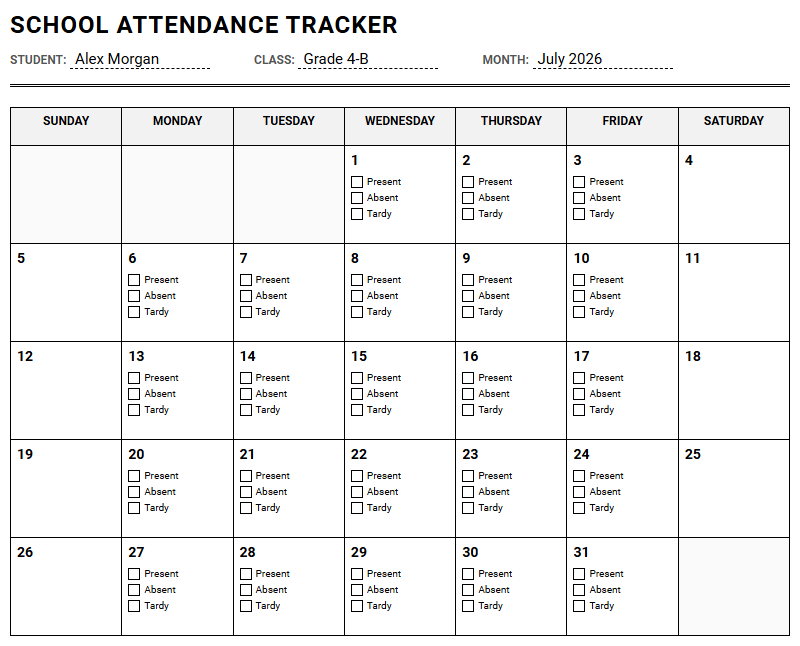
Managing fluctuating student attendance patterns throughout the school year remains a persistent administrative challenge. While school district budgets often prioritize expensive, automated software, simpler interventions are overlooked. Implementing a printable school attendance tracker grants educators immediate visual oversight of classroom presence. Under the stipulation that users maintain daily updates, this tool optimizes documentation. It is ideal for identifying chronic absenteeism patterns early. This guide details how to effectively implement this printable calendar.
Create Your School Attendance Tracker
Done customizing?
School Attendance Tracker - Good to Know
Student Information System integration
Modern educational institutions rely heavily on cohesive digital ecosystems. Integrating attendance platforms directly with a Student Information System (SIS) eliminates data silos, ensuring that daily attendance records seamlessly synchronize with student profiles, grading books, and demographic databases. This synchronization reduces administrative burdens on educators, allowing them to focus more on instructional time rather than manual data entry.
Implementing a robust integration strategy offers several key technical advantages:
- Bidirectional data sync: Real-time updates ensure both systems reflect accurate student statuses instantly.
- Reduced human error: Eliminating manual exports and imports minimizes the risk of duplicate or lost records.
- Unified reporting: Administrators can generate comprehensive reports combining academic performance with attendance trends.
By establishing a secure, API-driven connection, schools can protect sensitive student data under FERPA guidelines while maintaining an agile, modern administrative workflow that supports student success across all grade levels.
Chronic absenteeism analytics
Addressing chronic absenteeism requires a shift from reactive monitoring to proactive intervention. Advanced analytics tools empower educators to identify patterns of irregular attendance long before they escalate into academic failure. By analyzing historical data and demographic factors, predictive models can flag students who are statistically at risk of falling behind due to missed instructional days.
Using visualization dashboards, administrators can slice and dice attendance data to uncover systemic issues:
- Day-of-week trends to identify if specific days experience higher rates of truancy.
- Subgroup analysis to see if transport, health, or socioeconomic factors impact specific student cohorts.
- Early warning thresholds that trigger automatic interventions when a student misses a set percentage of school.
Data-driven insights allow school counselors to design targeted support plans, transforming raw attendance numbers into actionable strategies that foster student engagement and improve overall graduation rates.
Biometric check-in
Biometric authentication has emerged as a highly secure and efficient method for verifying student identity during morning roll calls. By utilizing unique physical characteristics-such as fingerprints or facial geometry-schools can completely eliminate buddy punching and unauthorized campus entry. This technology ensures that the student marked present is indeed physically inside the classroom.
While security is paramount, the speed of biometric scanners also dramatically accelerates the morning check-in process, preventing bottlenecks at school entrances. Modern biometric systems store encrypted mathematical representations of templates rather than actual images, safeguarding student privacy. This approach provides parents and administrators with peace of mind, knowing that identity verification is both foolproof and compliant with modern privacy standards. The resulting data stream offers unmatched accuracy, providing an indisputable ledger of daily campus attendance.
QR code attendance tracking
QR code attendance tracking offers a highly cost-effective and agile alternative to traditional paper rosters. Under this system, teachers display a dynamic QR code on a projector screen at the start of class, or students carry personalized ID badges featuring unique codes. Students quickly scan the code using their mobile devices or a central classroom scanner, instantly registering their presence.
To prevent academic dishonesty, such as students sharing codes with absent peers, modern platforms utilize dynamic QR codes that rotate every few seconds and incorporate geolocation validation. This ensures that a scan is only valid if performed within the designated classroom. The simplicity of this setup requires minimal hardware investment, making it an ideal solution for resource-constrained districts looking to modernize their operational workflows quickly and securely.
Automated truancy alerts
Time is of the essence when a student goes missing from school. Automated truancy alerts bridge the communication gap between classrooms and homes by instantly dispatching notifications to parents or guardians. As soon as a teacher marks a student absent without prior excuse, the cloud-based system sends an automated SMS, email, or push notification detailing the unexcused absence.
This rapid communication cycle yields significant benefits for student safety and accountability:
- Immediate awareness: Parents learn of skipped classes in real-time, preventing day-long truant behavior.
- Streamlined communication: Integrated portals allow parents to reply directly with digital excuse notes or medical certificates.
- Audit trails: The system maintains detailed logs of all sent alerts and parent responses for official documentation.
Automating this process frees school office staff from making hundreds of manual phone calls daily, optimizing administrative resources.
Geofencing check-in
Geofencing leverages GPS and cellular technology to establish virtual boundaries around school buildings or specific campus zones. When students enter these pre-defined geographical areas, their mobile attendance applications can automatically register them as present, or prompt them to check in manually with a single tap on their screens.
This technology is particularly beneficial for large high school campuses, university lecture halls, and off-site field trips where traditional roll call is impractical. Administrators can set strict parameters, ensuring that check-ins are only accepted if the student is physically within the designated virtual boundary. By automating check-ins based on location, schools can significantly reduce classroom disruptions at the start of each period, ensuring that valuable teaching time is fully utilized for instruction rather than administrative tasks.
RFID student tracking
Radio-Frequency Identification (RFID) technology offers a passive, frictionless approach to campus attendance. Students carry smart ID cards embedded with passive RFID chips, which are automatically read by receivers positioned at school entrances, classroom doorways, or on school buses. This setup allows for continuous, real-time tracking of student movement without requiring any active scanning effort from the students themselves.
In addition to streamlining morning registration, RFID systems provide invaluable data during emergency situations. In the event of an evacuation, administrators can instantly verify which students are safely at muster points and pinpoint the last known location of anyone missing. This dual utility for both daily operational efficiency and emergency preparedness makes RFID a cornerstone of modern smart-school infrastructure designs.
Contactless roll call
Hygiene and efficiency have taken center stage in modern classroom management, driving the rapid adoption of contactless roll call solutions. By moving away from shared physical sheets or touch-based devices, schools can maintain a healthier environment while speeding up daily procedures. Contactless methods include voice recognition, ultra-wideband sensors, and Bluetooth low energy (BLE) beacons that detect student devices as they enter the classroom.
These advanced proximity-based systems work quietly in the background, allowing teachers to begin lessons immediately without interruption. Students simply walk in, and their presence is registered passively. By blending advanced sensor technology with everyday school routines, contactless roll call minimizes physical contact points, supports public health initiatives, and maximizes the time dedicated to active learning and peer-to-peer collaboration.
Mobile attendance application
A dedicated mobile attendance application puts powerful management tools directly into the hands of teachers, parents, and students. For educators, a mobile app provides an intuitive interface to quickly mark attendance, view student photos, and flag behavioral notes on the go, whether in the classroom, gymnasium, or outdoors. This portability ensures accurate records regardless of the learning environment.
For parents and students, the application serves as a transparent portal for tracking attendance history, viewing upcoming schedule changes, and submitting absence justifications. Features like instant push notifications keep families informed of any discrepancies immediately. By fostering open communication and providing easy access to vital records, mobile apps build a collaborative bridge between home and school, driving up overall student accountability and engagement.
Real-time absence management
Real-time absence management transforms how school administrations handle daily staffing and student supervision. Instead of waiting until the end of the day or week to compile attendance summaries, administrators have access to live dashboards showing up-to-the-minute attendance figures across all classrooms. This immediate visibility is crucial for managing unexpected teacher absences and coordinating substitute coverage efficiently.
Furthermore, real-time data allows school security and medical staff to respond swiftly to sudden student departures or unexplained absences during the school day. If a student is marked present in first period but absent in second, immediate alerts prompt swift investigation. This high-resolution monitoring ensures a secure learning environment, optimizes campus resource allocation, and guarantees that student safety remains the top priority throughout the academic day.

Leave a comment