
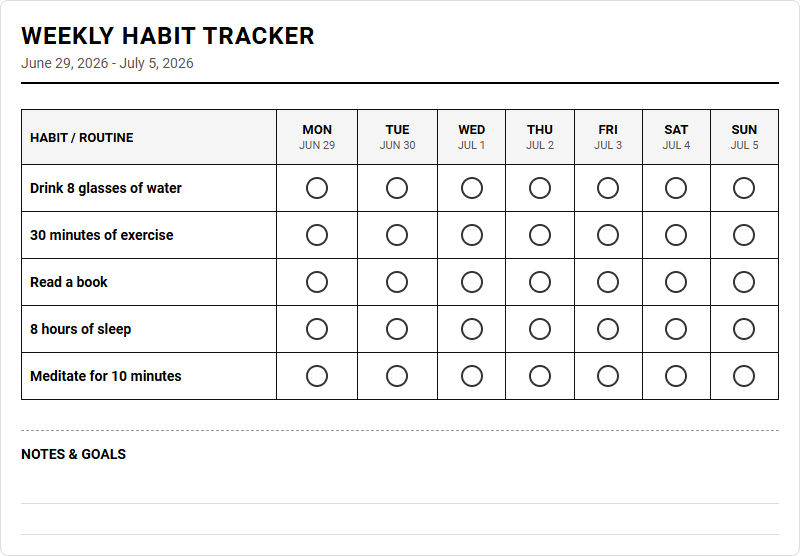
Staying consistent with personal goals often feels like an uphill battle. While traditional time-management tools offer basic scheduling, they rarely sustain long-term behavioral change. Fortunately, a Weekly Habit Tracker Calendar grants you immediate visual reinforcement. Successfully adopting this system requires a daily commitment rather than sporadic effort. Utilizing this printable calendar for concrete practices like daily hydration or reading builds lasting momentum. Below, we explore how to optimize your tracking for peak productivity.
Create Your Weekly Habit Tracker Calendar
Done customizing?
Weekly Habit Tracker Calendar - Good to Know
Habit Stacking
Habit stacking is a highly effective behavioral modification strategy that leverages your existing daily routines to build new, positive behaviors. Instead of associating a new habit with a specific time or location, you anchor it directly to an established cue that you already perform automatically every day.
This method utilizes the existing neural pathways in your brain, making the adoption of new routines require significantly less cognitive effort. To implement this technique successfully, you can utilize a simple, structured formula:
"After I [Current Habit], I will [New Habit]."
By pairing actions sequentially, you create a natural flow of productivity. Consider these common, highly practical integrations for your daily schedule:
- After I pour my morning coffee, I will meditate for two minutes.
- After I close my laptop for the day, I will immediately change into my workout clothes.
- After I brush my teeth at night, I will floss one tooth.
This systematic pairing reduces decision fatigue, transforming erratic attempts at self-improvement into a seamless chain of positive, compounding daily rituals.
Micro-habits
The philosophy of micro-habits focuses on scaling down your grandest goals into incredibly small, almost effortless daily actions. By reducing the barrier to entry, you eliminate the mental resistance and procrastination that typically thwart ambitious new resolutions. A micro-habit should be so ridiculously easy that you cannot find a reasonable excuse to skip it, even on your most exhausting days.
Instead of committing to a grueling one-hour gym session, a micro-habit approach invites you to do just one push-up or stretch for two minutes. Rather than attempting to write an entire book chapter, you commit to writing a single sentence. Through this approach, you focus entirely on building consistency first, rather than intensity.
Over time, these tiny actions establish a solid foundation of repetition. Once the behavior is safely locked into your subconscious, you can naturally and effortlessly scale up the duration and intensity of the habit.
Notion Habit Tracker
A Notion Habit Tracker offers a highly customizable digital workspace designed to help you visualize, monitor, and analyze your personal growth goals. Unlike rigid, pre-made applications, Notion allows users to build bespoke tracking systems utilizing advanced databases, progress bars, and relations that align perfectly with their unique workflows.
By incorporating visual checkboxes, formula properties, and automated templates, you can turn daily self-reflection into an interactive, engaging experience. Many advanced productivity enthusiasts build comprehensive dashboards that link their daily habits directly to broader weekly reviews and quarterly goals.
When designing your Notion tracker, consider incorporating the following structured elements:
- Daily Checkboxes: For quick, satisfying tracking of routine tasks.
- Progress Bars: Visual formulas that show your daily completion percentage.
- Weekly Archives: Database views that aggregate your historical consistency.
This digital hub provides the structural clarity needed to identify patterns, address bottlenecks, and maintain long-term accountability.
Aesthetic Digital Planner
An aesthetic digital planner merges the scientific principles of productivity with beautiful visual design, making the process of daily organization incredibly satisfying. Designed to be used on tablets with styluses, these planners mimic the tactile joy of traditional paper journaling while offering the infinite flexibility of modern digital organization tools.
The visual appeal of an aesthetic planner is not merely superficial; it serves a practical psychological purpose. Beautiful layouts, soothing color palettes, and elegant typography evoke positive emotions, which actively reduces the friction and anxiety often associated with task management and goal setting.
Many digital planners feature hyperlinked tabs, customizable widget sections, and dedicated spaces for mood tracking, gratitude prompts, and habit monitoring. By transforming your daily planning session into an artistic, mindful ritual, you cultivate a deeper emotional connection to your schedule, helping you remain inspired and organized throughout your hectic week.
Habit Streak
The concept of a habit streak relies on visual momentum to keep you motivated. Popularized by productivity systems and gamified apps, a streak measures the consecutive number of days you have successfully completed a target behavior. The psychological desire to "protect the streak" becomes a powerful driving force, especially on days when your intrinsic motivation is low.
As your streak grows from three days to thirty days, the mental cost of breaking the chain begins to outweigh the effort required to perform the habit. To maximize this effect, keep your progress visible using a physical wall calendar or a dedicated mobile widget.
However, maintaining a streak requires a healthy, resilient mindset. To prevent discouragement when life inevitably interrupts your routine, implement the famous resilience rule:
"Never miss twice."
Missing one day is an accident; missing two days in a row is the start of a new, undesirable habit.
Keystone Habits
A keystone habit is a singular, foundational behavior that naturally triggers a positive chain reaction throughout other areas of your life. When you focus your energy on establishing a keystone habit, you do not need to micro-manage every single aspect of your daily routine. Instead, this dominant habit automatically reorganizes and improves your other behaviors.
Regular exercise is a classic example of a keystone habit. When you commit to a consistent workout routine, you typically experience spontaneous improvements in other, unrelated areas:
- You naturally crave more nutritious, whole foods.
- Your sleep quality improves, leading to higher focus during the workday.
- Your stress levels decrease, which improves your personal relationships.
Other powerful keystone habits include daily food journaling, making your bed every morning, or practicing regular meditation. Identifying and prioritizing these high-leverage behaviors maximizes the efficiency of your personal development journey.
Implementation Intentions
An implementation intention is a highly specific plan that predetermines exactly when, where, and how you will execute a desired behavior. Developed by psychologist Peter Gollwitzer, this strategy removes the ambiguity that leads to procrastination by shifting the decision-making process from the moment of action to an earlier, calmer planning phase.
Many people fail to achieve their goals because their plans are too vague, such as "I will eat healthier" or "I will study more." By contrast, an implementation intention utilizes a rigid, highly structured prompt:
"If [Situation X] occurs, then I will perform [Response Y]."
By explicitly linking a situational cue to your intended action, you program your subconscious brain to recognize the opportunity when it arises. When the designated situation occurs, the planned behavior is triggered automatically, bypassing the need for intense willpower or spontaneous motivation.
Dopamine Menu
A dopamine menu is a personalized, curated directory of healthy, nourishing activities that you can turn to when you need a quick mood boost, a break, or a stimulation adjustment. Instead of mindlessly scrolling through social media or consuming processed snacks when you feel bored or fatigued, you choose an intentional activity from your pre-designed menu.
To make your dopamine menu effective, categorize your activities into distinct courses based on time and energy requirements:
- Appetizers: Quick 5-minute boosts, like stretching or petting a dog.
- Entrées: Deeply fulfilling activities, such as reading a book or painting.
- Sides: Activities you can pair with chores, like listening to an engaging podcast.
Having this menu readily available removes the cognitive burden of finding healthy stimulation, helping you redirect your energy toward positive, life-affirming behaviors.
Routine Builder
A structured routine builder serves as an architectural blueprint for your day, organizing individual habits into a cohesive, logical sequence. Instead of viewing your day as a chaotic series of random tasks, a routine builder groups actions into thematic blocks, such as a morning startup routine, a deep-work ritual, or an evening wind-down sequence.
This systematic approach provides a reliable rhythm to your day, preparing your mind and body for the specific tasks ahead. An effective morning routine builder prepares your focus, while a thoughtful evening routine signals your nervous system to relax, facilitating deep, restorative sleep.
By intentionally planning the transitions between activities, you minimize downtime and prevent distractions from hijacking your productivity. Designing your daily flow with a structured routine builder ensures that your most critical habits are prioritized, creating a balanced and sustainable lifestyle.
Identity-Based Habits
Building identity-based habits requires a profound shift in focus: instead of focusing on what you want to achieve, you focus on the person you wish to become. This concept, popularized by behavioral psychology, asserts that lasting behavior change is a direct reflection of your self-image. When your habits align with your core identity, they become effortless and self-sustaining.
Most people focus on outcome-based goals, such as losing twenty pounds or writing a book. However, these outcomes are merely the results of your actions. Real change occurs when you shift your belief system:
- Instead of trying to run a marathon, adopt the identity of a runner.
- Instead of trying to read more books, adopt the identity of a reader.
Every small action you take serves as a vote for the type of person you want to be, gradually building undeniable proof of your new identity.
Leave a comment