
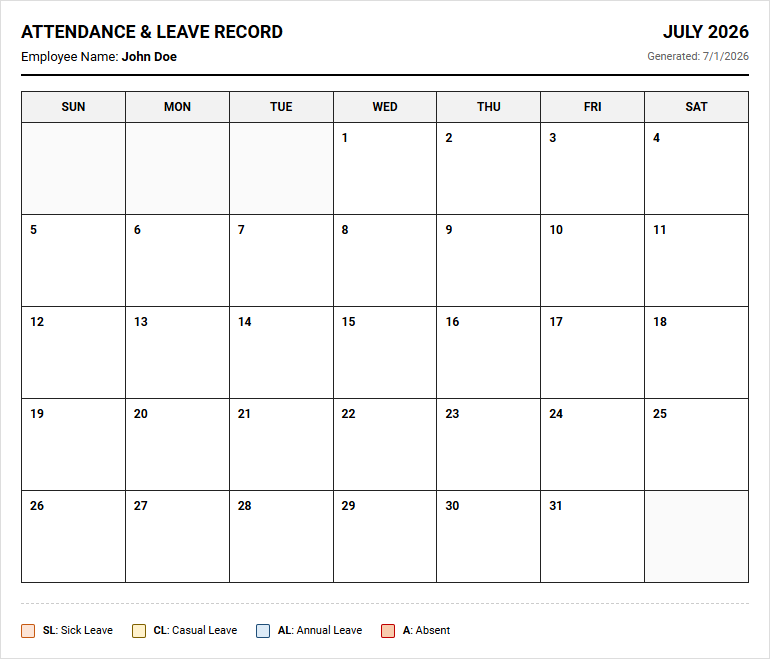
Managing overlapping staff absences and tracking precise leave hours often drains vital administrative resources. While complex HR enterprise databases offer one route to oversight, these systems can be costly and difficult to deploy. Utilizing a dedicated Business & Project Trackers printable calendar grants immediate operational clarity without technical overhead, provided managers commit to daily manual updates. Whether tracking sick leave, FMLA, or annual vacation days, this guide outlines how to optimize your attendance workflow.
Create Your Employee Attendance and Leave Tracker
Done customizing?
Employee Attendance and Leave Tracker - Good to Know
Paid Time Off Accrual
Paid Time Off (PTO) accrual represents the systematic method through which employees earn paid leave over designated periods. Instead of receiving a lump sum of days at the beginning of the year, workers accumulate hours incrementally, typically per pay period, weekly, or monthly. This structured framework provides clear advantages for both employers and staff.
- Predictable Forecasting: HR departments can project future absences and liability costs easily.
- Fairness: Employees earn time proportionally to their tenure and active working hours.
Many organizations define specific accumulation rates based on job roles or years of service. For instance, a junior employee might accrue 3.07 hours per bi-weekly pay cycle (equivalent to two weeks annually), whereas senior staff earn significantly more. Managing this process manually often introduces errors, making digital time tracking software vital to maintain compliance, update balances in real-time, and ensure transparent policy enforcement.
Bradford Factor
The Bradford Factor is a powerful human resource tool used to calculate and measure employee absenteeism patterns. This specific formula measures the disruptive impact of frequent, short-term, unplanned absences, which are often more challenging to manage than longer, continuous periods of illness.
The calculation is represented mathematically as:
B = S² × D
Where:
- S (Spans): The total number of separate spells of absence over a 52-week period.
- D (Days): The total duration of those absences in days.
Because the formula squares the number of instances, frequent short-term sickness results in a much higher Bradford score than a single, long-term sickness. For example, a person absent for one day ten times scores 1,000, while someone absent once for ten days scores 10. This metric allows managers to identify trends, trigger reviews, and implement positive interventions early.
Geofencing Attendance
Geofencing attendance technology utilizes GPS, cellular data, and Wi-Fi to establish invisible virtual boundaries around a specific physical location, such as a construction site, retail branch, or corporate office. When employees enter or exit this designated zone, mobile-enabled time tracking applications automatically prompt them to log their hours, or clock them in and out automatically.
This geographic positioning system ensures high levels of accuracy in remote and distributed workforce management. It addresses several critical administrative challenges:
- Accurate Dispatching: Confirms that field representatives are physically present at client locations.
- Logistical Clarity: Provides automated, real-time records of hours spent on specific job sites.
By integrating geofencing parameters with payroll software, companies dramatically reduce disputes over billable hours, minimize administrative errors, and improve accountability without compromising staff privacy, as tracking typically ceases once employees step outside the predefined digital parameter.
Biometric Clock-in
Biometric clock-in systems rely on unique physiological characteristics to verify an employee's identity and record their precise attendance. By scanning fingerprints, iris patterns, facial structures, or hand geometry, this advanced technology ensures that the individual logging hours is indeed who they claim to be.
This framework provides several critical operational benefits for modern enterprises:
Elimination of Buddy Punching: Colleagues cannot log hours on behalf of absent coworkers.
Superior Data Security: Modern biometric systems convert physical scans into encrypted mathematical algorithms, ensuring personal data is protected against external cyber threats.
Additionally, the rapid speed of authentication prevents bottleneck congestion at main entranceways during shift changes. Integrating biometrics with cloud-based scheduling platforms streamlines payroll processing, eliminates physical paper logs, and establishes a highly reliable, indisputable audit trail of employee workplace presence.
Presenteeism
Presenteeism refers to the counterproductive practice of employees attending work despite being physically ill, mentally exhausted, or otherwise disengaged. While superficially resembling high dedication, this phenomenon poses significant long-term dangers to organizational health, overall productivity, and workplace safety.
"When workers operate under capacity, their performance declines, leading to costly mistakes, lowered morale, and potential contagion."
The primary drivers behind presenteeism include:
- Fears of job insecurity or negative performance evaluations.
- Inadequate paid sick leave policies forcing staff to work while unwell.
- Overwhelming workloads that continue to pile up during absences.
Cultivating a supportive workplace culture that prioritizes mental wellness, encourages appropriate rest, and offers flexible remote-work options helps mitigate these risks, leading to a healthier, more vibrant, and sustainable workforce.
Absence Management System
An Absence Management System is a centralized digital software platform designed to track, analyze, and manage all forms of employee time-off requests. From annual vacation leaves and sick leaves to parental leaves and unexpected compassionate time off, this system automates what was historically a highly fragmented, paper-heavy process.
Modern platforms integrate seamlessly with existing corporate scheduling and payroll engines, offering powerful utilities:
- Automated Workflows: Managers receive instant notifications to approve or deny requests based on current team capacities.
- Self-Service Portals: Employees easily view active accrual balances, submit leave requests, and upload medical certificates.
By standardizing compliance and offering clear visibility into overall workforce availability, companies prevent critical staffing shortages. These data-driven tools empower organizations to notice underlying absenteeism trends, minimize operational disruptions, and maintain optimal productivity levels across all operational departments.
FMLA Tracking
Family and Medical Leave Act (FMLA) tracking is a critical legal compliance obligation for employers in the United States, providing eligible workers with up to 12 weeks of job-protected, unpaid leave annually for specific family and medical reasons. Accurately monitoring this leave is essential, as compliance failures can lead to severe legal and financial liabilities.
Effective FMLA administration involves managing several complex components:
- Intermittent Leave: Tracking sporadic absences, which can occur in hours or days rather than continuous weeks.
- Certification Dates: Managing strict timelines for medical documentation submission and subsequent re-certifications.
Using dedicated tracking systems ensures that employee eligibility is calculated correctly and that continuous or intermittent time off is recorded in real-time. This automated monitoring protects organizations from compliance risks while ensuring employees receive their full legal protections during challenging life events.
Hybrid Work Scheduling
Hybrid work scheduling has emerged as a cornerstone of modern corporate structures, balancing remote flexibility with essential in-office collaboration. This model requires sophisticated scheduling systems to organize when and where staff work, ensuring teams align without wasting expensive physical office space.
To operate successfully, organizations often adopt structured planning methodologies:
- Set Collaboration Days: Designating specific days where entire teams gather in-office for meetings.
- Hot-Desking Solutions: Allowing flexible booking of desks and meeting rooms via interactive digital floorplans.
When executed correctly, hybrid scheduling optimizes overhead costs, boosts employee satisfaction, and increases productivity. Managers can monitor office utilization rates and adjust facility resources in real-time, creating a highly adaptable environment that meets both the dynamic needs of employees and the overall strategic goals of the business.
Touchless Time Attendance
Touchless time attendance solutions have gained rapid popularity, particularly in post-pandemic work environments where hygiene and physical safety are paramount. These systems allow employees to clock in and out without touching shared physical keypads, finger scanners, or paper sign-in books.
Common modalities of touchless tracking technology include:
- Facial Recognition: High-speed cameras verify identity as employees walk through entryways.
- Mobile QR Codes: Workers scan dynamic screens using their personal smartphones to verify attendance.
- NFC or RFID Badges: Employees wave cards near a scanner for instant authentication.
These touch-free methods significantly reduce the spread of pathogens, streamline entry queues, and minimize device maintenance costs. By integrating with cloud platforms, touchless clock-ins capture accurate time stamps in real-time, providing immediate data to HR professionals while fostering a safer, cleaner, and highly efficient working environment.
Time Theft
Time theft represents a pervasive issue where employees receive payment for hours they did not actually work. This behavior manifests in various ways, ranging from extended breaks and early departures to "buddy punching"-where a coworker clocks in on behalf of an absent colleague.
The financial impact of this practice is substantial, often leading to:
- Unnecessary payroll inflation that erodes company profit margins.
- Decreased team morale as diligent staff carry the workload of disengaged peers.
To combat this, modern companies deploy advanced attendance solutions such as biometric authentication, geofenced mobile tracking, and randomized automated audits. Educating the workforce on accurate reporting practices and implementing transparent, user-friendly software helps align employee habits with organizational expectations, reducing time theft and fostering a culture of honesty and operational efficiency.
Leave a comment