
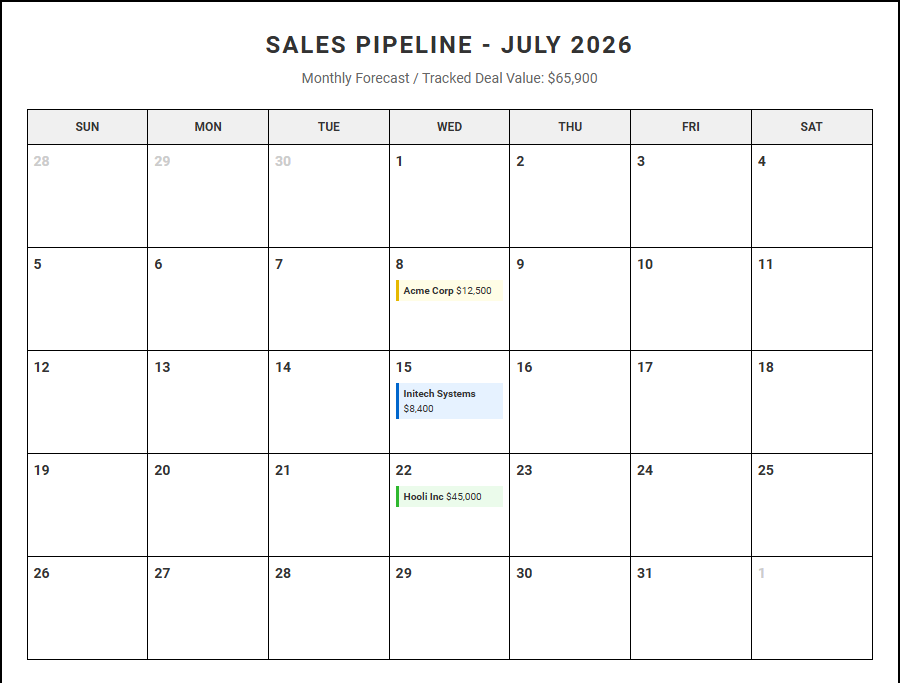
Sales professionals often struggle to maintain consistent visibility over daily lead flows, resulting in costly missed follow-ups. While enterprise CRMs offer robust digital databases, their complex interfaces can easily obscure immediate priorities.
Incorporating a Business & Project Trackers printable calendar grants instant visual control over your pipeline, mapping critical milestones like the 'initial discovery call' at a glance. Successfully utilizing this physical system, however, stipulates a commitment to daily manual updates. Below, we outline strategies to seamlessly integrate this tracker into your sales workflow.
Create Your Sales Pipeline and Lead Tracker Calendar
| Lead / Company | Value | Stage | Follow-up Date | Action |
|---|
SALES PIPELINE CALENDAR
Active Leads & Follow-ups
| Sun | Mon | Tue | Wed | Thu | Fri | Sat |
|---|
Done customizing?
Sales Pipeline and Lead Tracker Calendar - Good to Know
Lead Scoring
Lead scoring is a powerful, data-driven methodology used to rank prospects against a scale that represents the perceived value each lead represents to the organization. By implementing a standardized numerical system, sales and marketing departments can align their efforts to prioritize high-value prospects, ensuring that sales representatives focus their valuable time on leads most likely to convert.
An effective lead scoring model typically relies on a combination of two distinct data categories:
- Explicit Data: Demographic and firmographic details provided by the prospect, such as job title, industry vertical, geographic location, and annual company revenue.
- Implicit Data: Behavioral tracking data that indicates a prospect's level of interest, including website visits, email open rates, content downloads, and webinar attendance.
By continuously analyzing these interactions, organizations can dynamically adjust lead scores in real time, triggering immediate sales alerts when a prospect crosses a predefined threshold, maximizing conversion rates and shortening the overall sales cycle.
Pipeline Velocity
Pipeline velocity measures the speed at which active prospects move through your sales cycle and generate realized revenue. It serves as a vital health indicator for your entire revenue engine, providing valuable insights that help executive leadership forecast future growth with greater precision. To calculate pipeline velocity, organizations analyze the number of active opportunities, the average deal size, the overall win rate, and the length of the sales cycle.
To systematically accelerate pipeline velocity, sales organizations must identify and address specific operational friction points. Key focus areas include:
- Optimizing internal qualification processes to filter out low-intent opportunities earlier.
- Enhancing sales enablement materials to address customer objections proactively at critical decision stages.
- Streamlining legal and procurement workflows to reduce final-stage contract delays.
Decreasing the average sales cycle length even by a few days can dramatically increase quarterly revenue output without requiring a corresponding increase in raw lead volume.
Touchpoint Cadence
A structured touchpoint cadence defines the precise sequence, timing, and communication channels used by sales representatives to engage prospects. Designing a balanced cadence requires finding the perfect equilibrium between persistent follow-up and respecting the prospect's boundaries. A multi-channel approach is crucial in modern business-to-business environments, as relying on a single channel rarely yields optimal engagement rates.
An optimized outreach strategy typically incorporates a diverse mix of communication mediums deployed over a set timeframe:
- Direct Emails: Highly personalized messages addressing specific pain points.
- Phone Calls: Direct, real-time conversations to establish immediate human connection.
- Professional Social Networks: Strategic touchpoints, such as LinkedIn connection requests and content interactions.
- Text Messaging: Short, time-sensitive updates, when explicitly permitted by the prospect.
By mapping out a systematic schedule, sales teams eliminate guesswork, maintain professional consistency, and ensure that valuable opportunities never fade due to simple neglect or inconsistent communication.
Deal Stage Aging
Deal stage aging refers to the practice of tracking the exact number of days an active sales opportunity remains in a specific phase of your sales pipeline. When a deal sits static in any single stage for longer than your historical average win time, it serves as an immediate red flag indicating that the opportunity may be stalling, losing momentum, or quietly slipping away to a competitor.
"Monitoring the age of your deals within individual pipeline stages is often a far more accurate predictor of forecast accuracy than relying solely on subjective sales representative assessments."
By integrating automated alerts within your Customer Relationship Management (CRM) system, sales managers can easily identify these stagnant accounts. This visibility allows teams to intervene with targeted coaching, introduce executive sponsors, or adjust the deal strategy to overcome specific roadblocks before the prospect goes completely cold and disengages permanently.
Next-Action Date
Defining and enforcing a strict next-action date is the absolute cornerstone of proactive pipeline management. Every single open sales opportunity within your pipeline must have a clearly documented, scheduled future activity associated with it. When an opportunity lacks a scheduled next step, it effectively ceases to exist as an active deal, sliding instead into administrative limbo.
Establishing clear next steps helps sales teams maintain continuous momentum and operational discipline. The most effective next-action dates share several core characteristics:
- They are mutually agreed upon by both the sales representative and the prospect.
- They are tied to a specific, tangible event, such as a scheduled product demonstration or a contract review session.
- They are documented directly inside the CRM to maintain organizational transparency and accurate reporting.
This relentless focus on forward progress ensures that deals move steadily toward closure and prevents prospects from slipping through the cracks of a busy schedule.
Lead Decay Rate
Lead decay rate measures the speed at which inactive or uncontacted leads lose their viability and conversion potential over time. Fresh inbound leads possess their highest conversion probability in the minutes immediately following their initial submission. As hours and days pass without meaningful engagement, the probability of establishing contact and closing the deal drops exponentially, a phenomenon often referred to as lead decay.
To combat this natural erosion of lead value, high-performing sales organizations monitor decay metrics closely and implement rapid-response protocols. Strategies to mitigate lead decay include:
Implementing real-time routing algorithms to connect hot leads with active reps instantly, and setting strict Service Level Agreements (SLAs) that mandate follow-up within minutes. Additionally, establishing automated nurturing workflows for older leads helps recapture lost attention, systematically reviving dormant contacts and extracting maximum value from your historical marketing investments.
Activity-Based Selling
Activity-based selling is a highly structured operational philosophy that shifts a sales team's daily focus from high-level, unpredictable revenue outcomes to the specific, controllable daily activities that directly drive those results. While a sales representative cannot directly control whether a prospect signs a contract on any given day, they maintain complete control over the number of outreach calls they make, emails they write, and meetings they schedule.
By breaking down ambitious annual quotas into manageable, daily behavioral inputs, sales leaders can create a predictable roadmap to success. Representative daily inputs typically include:
- Initiating fifty targeted outbound cold calls to qualified prospects.
- Sending thirty personalized follow-up emails to active opportunities.
- Scheduling and conducting two comprehensive product demonstrations.
This systematic focus reduces sales anxiety, establishes clear performance expectations, and builds a highly repeatable sales process grounded in statistical predictability.
Follow-up Automation
Follow-up automation utilizes modern technology workflows to send timely, highly relevant communications to prospects based on specific behavioral triggers or pre-set calendar intervals. This technology ensures that no prospect is ever neglected due to manual oversight or sales team bandwidth constraints. By automation-enabling the early, repetitive stages of the outreach process, organizations scale their communication efforts infinitely.
Integrating automation into your sales stack offers several distinct operational advantages:
- Guaranteed Consistency: Ensures every prospect receives uniform, high-quality messaging right on schedule.
- Increased Efficiency: Frees your skilled sales representatives from administrative burden, allowing them to focus on high-value conversations.
- Hyper-Personalization: Dynamically inserts relevant prospect data into automated sequences to maintain an authentic, human feel.
By delegating routine follow-ups to automation tools, human representatives can dedicate their energy to negotiations and relationship building, driving higher conversion rates across the board.
RevOps Alignment
Revenue Operations (RevOps) alignment is the strategic unification of marketing, sales, and customer success departments under a single, centralized operating model. Traditionally, these departments operated in isolated silos, using disparate data sources and chasing conflicting key performance indicators. This fragmentation often led to a disjointed customer experience and significant operational inefficiencies.
A fully aligned RevOps model eliminates these friction points by establishing a single source of truth for customer data. This integration ensures that a customer transitions seamlessly from marketing awareness to sales acquisition, and finally to customer success onboarding. By sharing identical metrics, unified technology stacks, and collaborative revenue goals, the organization operates as a cohesive unit. This alignment optimizes resource allocation, eliminates wasted spend, and creates a highly predictable foundation for sustained, scalable business growth.
Win Rate Forecasting
Win rate forecasting leverages historical sales conversion data, predictive machine learning algorithms, and current pipeline metrics to project future revenue outcomes with high precision. Rather than relying on subjective sales rep intuition or simple guesswork, data-driven forecasting analyzes past performance trends under similar market conditions to calculate the mathematical probability of closing active deals.
To build an accurate, modern forecasting model, organizations must analyze several critical variables:
- The historical win rates of individual sales representatives across different product lines.
- The average conversion rates of specific lead sources and marketing campaigns.
- The current macroeconomic indicators and seasonal purchasing patterns within your target industry.
By refining these forecasting models continuously, executive leadership can make confident, data-backed decisions regarding corporate investments, hiring plans, and product development timelines, steering the business toward reliable, long-term financial stability.
Leave a comment