
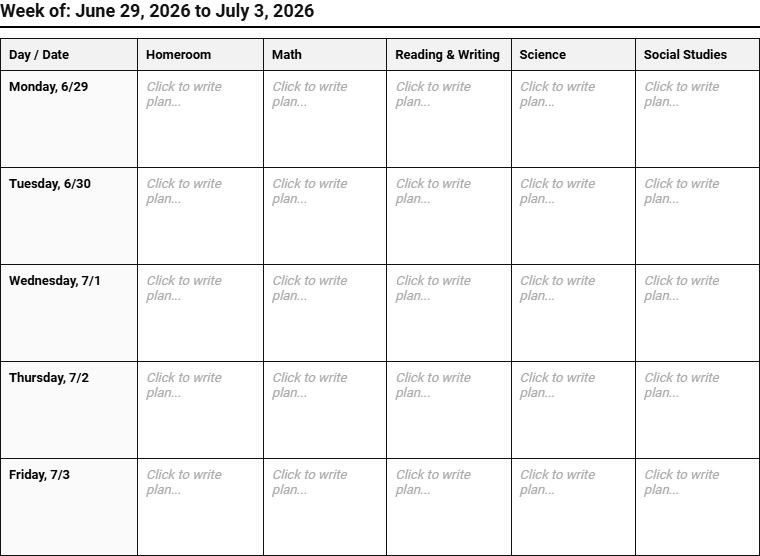
Mapping out an entire academic year often leaves educators overwhelmed and short on prep time. While district-funded materials and standard administrative planners offer basic frameworks, they rarely match daily classroom realities. Our printable teacher lesson plan calendars grant educators the ultimate scheduling autonomy. Although utilizing these templates requires alignment with school district pacing guides, features like our weekly block layouts ensure seamless curriculum tracking. Below, we review the best printable calendar formats to streamline your prep work this year.
Create Your Teacher Lesson Plan Calendar
Done customizing?
Teacher Lesson Plan Calendar - Good to Know
Curriculum mapping
Curriculum mapping serves as the foundational architecture for educational programs. It is a systematic process that indexes what is taught, how it is assessed, and when instruction occurs across a grade level or entire school district. By visualising the educational landscape, educators can identify redundancies, address learning gaps, and ensure a cohesive transition for students as they advance through their academic journey.
To execute an effective mapping strategy, administrators and teachers typically document three primary components:
- Core Content: The specific subject matter, concepts, and essential questions addressed in each unit.
- Assessment Methods: The formative and summative tools used to evaluate student understanding and skill acquisition.
- Instructional Resources: The textbooks, digital media, and laboratory materials leveraged to facilitate deep learning.
This collaborative exercise fosters open communication among faculty members, allowing departments to align their instructional goals and verify that every student receives a rigorous, equitable, and comprehensive education.
Scope and sequence
The scope and sequence document serves as the structural backbone of instructional design. It outlines both the breadth of content to be covered (the scope) and the specific order in which it will be delivered over a set period (the sequence). Without this critical framework, lessons risk becoming disjointed, leaving students overwhelmed by sudden spikes in complexity or bored by unnecessary repetition.
When developing a robust scope and sequence, curriculum developers focus on a logical progression of skills:
- Introduction of Foundational Concepts: Establishing basic terminology and fundamental theories.
- Guided Practice and Scaffolding: Providing structured opportunities for students to apply new knowledge.
- Independent Mastery: Requiring students to synthesise information and solve complex, novel problems.
By defining these parameters clearly, educators can maintain a balanced cognitive load for learners, ensuring that academic expectations remain developmentally appropriate throughout the school year.
Pacing guide
A pacing guide is a chronological roadmap that assists educators in managing class time efficiently. It breaks down the broader curriculum into manageable weekly or daily segments, ensuring that teachers allocate sufficient time to complex topics while still covering the entire syllabus before high-stakes assessments. This tool is particularly valuable in maintaining instructional equity across multiple classrooms teaching the same course.
"A well-crafted pacing guide does not restrict teacher creativity; rather, it provides the structural boundaries within which innovative pedagogy can safely thrive."
While strict adherence to schedule is important, effective pacing guides incorporate built-in buffer days. These flexible intervals allow for remediation, enrichment activities, or unexpected school closures. By balancing structured timelines with professional flexibility, teachers can address individual student needs without falling behind on key academic milestones or rushing through crucial unit summaries.
Year-at-a-glance
The Year-at-a-glance (YAG) document is a high-level, single-page visual overview of the entire academic year. It offers a macro-perspective of the curriculum, allowing stakeholders-including teachers, administrators, parents, and students-to comprehend the educational trajectory quickly. By condensing months of instructional planning into a single layout, the YAG highlights how different units connect over time.
| Term | Primary Unit focus | Target Standards |
|---|---|---|
| Quarter 1 | Foundations of Literary Analysis | CCSS.ELA-LITERACY.RL.9-10.1 |
| Quarter 2 | Argumentative Writing & Research | CCSS.ELA-LITERACY.W.9-10.1 |
| Quarter 3 | Historical Perspectives in Fiction | CCSS.ELA-LITERACY.RL.9-10.9 |
This layout facilitates strategic planning, helping teachers identify busy assessment periods and plan major cross-curricular projects well in advance of their start dates.
Backward design
Backward design is a highly acclaimed instructional planning framework popularized by Jay McTighe and Grant Wiggins. Unlike traditional planning, which often starts with selecting activities and resources, this methodology begins with the end in mind. Educators start by identifying the desired results-what students should know, understand, and be able to do at the completion of a unit.
The process follows three distinct steps:
- Stage 1: Identify Desired Results: Determine the established goals, enduring understandings, and essential questions.
- Stage 2: Determine Acceptable Evidence: Design performance tasks, quizzes, and projects to assess deep understanding.
- Stage 3: Plan Learning Experiences: Structure targeted lessons, lectures, and activities that prepare students for the assessments.
By prioritizing learning outcomes over classroom activities, backward design ensures that every minute of instruction purposefully contributes to meaningful, long-term comprehension and transfer of knowledge.
Block scheduling
Block scheduling is an administrative system that replaces the traditional seven-period school day with fewer, longer class periods. Typically, classes under a block format run for 80 to 90 minutes. This structure allows for deep, immersive learning experiences that are difficult to execute within a standard 45-minute timeframe, such as science laboratory experiments, intensive writing workshops, and extended group collaborations.
To succeed under this system, teachers must shift away from continuous lecturing and instead adopt a multi-modal instructional approach:
- Warm-up & Focus: A quick, ten-minute activity to engage minds and review previous material.
- Direct Instruction: Twenty minutes of targeted mini-lectures presenting new content.
- Active Learning: Forty minutes of hands-on application, group work, or self-directed research.
- Synthesis & Reflection: Ten minutes to assess understanding and clarify misconceptions.
This deliberate orchestration keeps student attention high and maximises the pedagogical benefits of extended class periods.
Digital planner template
A digital planner template leverages modern software solutions to streamline the daily administrative burdens of educators. Unlike traditional paper planners, digital versions offer dynamic editing capabilities, cloud synchronisation, and integration with learning management systems. These templates allow teachers to quickly update lesson plans, hyperlink resources, and share files across multiple platforms instantly.
A typical structured planning entry might look like this:
    Unit: Ecosystems & Energy Flow

    Objective: Analyze trophic levels in food webs.

    Resource Link: [https://school-lms.edu/bio-web]

    Homework: Complete trophic cascade simulation worksheet.
By utilising customizable formats, teachers can save hours of repetitive typing each week. The ability to copy, paste, modify, and archive past templates makes future semester preparation highly efficient, giving teachers more energy to focus directly on student engagement and feedback.
Co-planning calendar
A co-planning calendar is a collaborative tool designed for co-teachers, departmental peers, and cross-curricular teams. It establishes a shared workspace where educators can align their daily lessons, assign instructional responsibilities, and coordinate grading deadlines. This collaborative framework is essential for general education teachers working alongside special education specialists or language support staff.
Effective implementation of a co-planning calendar relies on specific routines:
- Weekly Synchronization: Setting a fixed time to outline the upcoming week's instructional goals together.
- Role Clarification: Clearly documenting who will lead direct instruction, who will facilitate accommodations, and who will manage materials.
- Student Data Review: Sharing observations regarding student progress to adjust future instructional paths.
Through this open, shared documentation, instructional teams reduce friction, eliminate planning redundancies, and create a highly supportive learning environment tailored to diverse classrooms.
Thematic unit planning
Thematic unit planning is an instructional method that organizes diverse curriculum standards around a central, engaging theme. By connecting reading, writing, science, history, and the arts to a single conceptual umbrella, students can synthesize information across disciplines. This holistic approach makes learning more meaningful, as it mirrors how knowledge is integrated in the real world.
For example, a unit themed around "Global Sustainability" can incorporate various academic requirements:
- Social Studies: Researching the historical impact of industrialization on regional environments.
- Language Arts: Analyzing persuasive rhetoric used in environmental speeches and essays.
- Mathematics: Graphing statistical trends in renewable energy adoption rates globally.
This interdisciplinary approach sparks curiosity and helps students develop critical thinking skills by demonstrating the interconnectedness of various fields of study.
Standards alignment
Standards alignment is the deliberate process of matching classroom instruction, learning activities, and student assessments with state, national, or international educational benchmarks. It ensures that the curriculum is teaching the skills and concepts deemed essential by educational authorities. Proper alignment is crucial for preparing students for standardized tests and ensuring equity across different educational environments.
To verify proper standards alignment, educators must ensure harmony among three pillars:
- Learning Objectives: What the state standards demand students should master.
- Instructional Tasks: The actual cognitive demands of the classwork assigned to students.
- Assessment Metrics: The criteria used to measure whether mastery of the standard has been achieved.
When these three elements are in perfect harmony, teachers can be confident that their instructional practices are valid, rigorous, and directly supporting the academic success of every learner in the classroom.
Leave a comment