
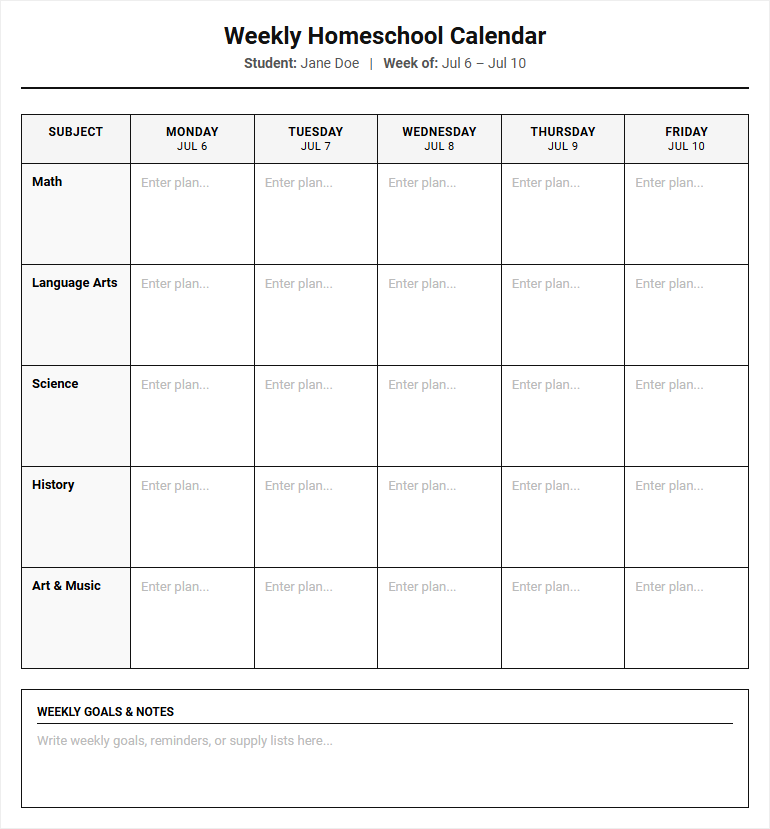
Managing a diverse homeschool schedule often leads to lesson-plan burnout and tracking confusion. While standard state educational funding or district curriculum budgets provide baseline textbooks, they rarely cover practical organizational tools. Utilizing a dedicated printable weekly calendar grants educators the precise structural flexibility needed to balance multi-grade lessons. Note the stipulation: these templates serve as organizational frameworks, not curriculum replacements. Utilizing proven layouts, such as the Charlotte Mason weekly matrix, simplifies daily planning. Below, we review the best printable academic calendars to streamline your homeschool routine.
Create Your Weekly Homeschool Calendar
Done customizing?
Weekly Homeschool Calendar - Good to Know
Loop scheduling
Loop scheduling offers a liberating alternative to rigid, calendar-bound lesson plans. Instead of assigning specific subjects to designated days of the week, families curate a running list of activities or subjects. When your scheduled school time begins, you simply pick up where you last left off on the list, regardless of what day it is on the calendar.
This method prevents the overwhelming feeling of falling behind when life interrupts your routine. It is particularly effective for enrichment subjects, often referred to as "loop subjects," which might otherwise get skipped during a busy week. Consider this typical loop rotation:
- Art history and appreciation
- Hands-on science experiments
- Creative writing prompts
- Geography mapwork and culture studies
By removing daily pressure, loop scheduling ensures a balanced curriculum where no subject is permanently neglected, fostering a more relaxed and resilient home education environment.
Morning basket routine
The morning basket routine serves as a gentle, communal anchor for the homeschooling day. By gathering children of various ages around a shared basket of books and resources, parents foster a unified family culture before dispersing into individualized, level-specific work. This daily ritual typically emphasizes truth, goodness, and beauty.
"Education is an atmosphere, a discipline, a life." This sentiment perfectly captures the essence of starting the morning together with shared ideas.
A well-curated morning basket might contain poetry anthologies, read-aloud literature, character building stories, and classical music selections. Because these subjects do not require strict grading or testing, they encourage natural discussion, critical thinking, and shared family memories. Spending just thirty to forty-five minutes each morning on these collective studies establishes a peaceful, cooperative tone that carries throughout the remaining academic hours.
Block scheduling
Block scheduling organizes the academic year or week into deep, immersive periods dedicated to a single subject or theme. Instead of scattering focus across eight different subjects daily, students dedicate larger chunks of time to master specific disciplines. This approach mimics real-world project management and deep-work cycles, making it highly suitable for middle and high school students.
Families generally choose between two primary block variations:
- Semester Blocks: Completing a full year of biology in one semester by doubling daily class time.
- Weekly Rotation Blocks: Dedicating all of Tuesday to history and all of Thursday to sciences.
This structure significantly reduces the cognitive load associated with constant subject-switching. Students can dive deep into research, conduct complex science laboratories without interruption, and absorb complex concepts without the pressure of an impending bell or schedule change.
Homeschool co-op day
A homeschool co-op day injects collaborative learning and social interaction into the weekly routine. Typically occurring once a week, these cooperative gatherings allow parents to pool their unique talents, offering specialized classes that might be challenging to teach individually at home. This collaborative effort enriches the child's academic experience while building community.
Co-op classes often focus on interactive, group-oriented subjects, including:
- Laboratory Sciences: Conducting biology dissections or chemistry experiments in a group setting.
- Performing Arts: Participating in drama clubs, choirs, or collaborative band performances.
- Public Speaking: Practicing debate, formal presentations, and peer-to-peer feedback.
While co-op days require careful preparation and travel, they provide valuable lessons in classroom etiquette, deadlines set by external instructors, and collaborative teamwork, helping students develop essential social and academic skills.
Flex Friday
Flex Friday introduces a structured buffer into the academic calendar, safeguarding homeschooling families against burnout. By consolidating core academic requirements into a focused, four-day week (Monday through Thursday), Friday becomes a dedicated canvas for exploration, catch-up work, or field trips. This intentional margin allows the schedule to breathe.
A typical Flex Friday can be customized to meet the shifting needs of the family. On any given week, it might look like:
- Nature study hikes and outdoor watercolor journaling.
- Extended time to finish projects or master a difficult math concept.
- Visiting local museums, historical sites, or community service locations.
- Deep cleaning the home and organizing learning spaces for the upcoming week.
This flexible boundary encourages self-directed learning and prevents families from feeling constantly rushed or behind schedule.
Unit study planner
A unit study planner consolidates multiple academic subjects under the umbrella of a single, captivating theme. For instance, a deep dive into "Oceanography" can seamlessly integrate history (explorers), literature (classic maritime novels), science (marine biology), geography (ocean currents), and art (seascape painting). This holistic method honors the interconnected nature of knowledge.
Using a dedicated planner helps parents map out learning pathways to ensure academic coverage. A robust planning template typically includes spaces for:
Core Theme Definition → Living Book Selection → Hands-on Projects → Field Trip Ideas → Cross-Curricular Connections
By learning through a unified theme, children see the immediate relevance of their lessons. This integrated approach naturally accommodates multiple age levels, allowing siblings to study the same topic together while completing age-appropriate assignments.
Charlotte Mason weekly rhythm
Embracing a Charlotte Mason weekly rhythm means prioritizing short lessons, living books, and ample outdoor exploration. This classical educational philosophy views the child as a whole person, emphasizing the cultivation of good habits and a wide, varied curriculum. Throughout the week, lessons in core subjects like math and grammar are kept brief-often fifteen to twenty minutes for younger children-to train intense habits of attention.
The weekly rhythm is characterized by several distinct elements:
- Narration: Children tell back what they have heard or read, building comprehension and composition skills.
- Nature Study: Dedicating an afternoon to observing, sketching, and documenting local flora and fauna.
- Handicrafts: Learning useful, beautiful skills like knitting, wood carving, or clay modeling.
This gentle schedule prevents intellectual fatigue, ensuring that children retain their natural curiosity and love for learning.
Digital homeschool dashboard
Modern home educators increasingly rely on a digital homeschool dashboard to streamline administrative tasks and track student progress. Using customizable platforms like Notion, Trello, or specialized homeschooling software, parents can synthesize lesson plans, attendance records, reading lists, and portfolios into a central, cloud-based hub. This modern system reduces paper clutter significantly.
For independent learners, a digital dashboard serves as an interactive planner. Students can log in daily to view their assignments, link directly to online resources, upload completed work, and check off completed tasks. This transparency fosters excellent time-management skills and self-reliance. Additionally, digital logging simplifies state-required record-keeping, as parents can generate attendance sheets, grade books, and academic transcripts with just a few clicks, keeping the administrative side of homeschooling organized and stress-free.
Unschooling log
Unlike traditional planners that record what will be taught, an unschooling log is a tool of retro-planning, documenting the rich learning that has already occurred naturally. Unschooling families trust the innate curiosity of the child, allowing individual interests and real-world experiences to dictate the curriculum. The log serves as a vital translation tool, mapping everyday activities to conventional academic disciplines.
An entry in an unschooling log might translate a daily activity like baking bread into diverse subject areas:
- Mathematics: Measuring ingredients, halving recipes, and calculating baking times.
- Chemistry: Observing yeast activation and the chemical reactions of leavening agents.
- Home Economics: Practicing kitchen safety, food preservation, and culinary arts.
This documentation method proves that learning is constant, validating the educational value of play, hobbies, and family conversations.
Subject rotation calendar
A subject rotation calendar systematically balances core academic requirements with creative electives across the school year. By rotating non-sequential subjects like health, geography, or art history on a bi-weekly, monthly, or term-by-term basis, parents prevent student fatigue and maintain high engagement levels. This calendar template divides the academic year into manageable, focused cycles.
Implementing this rotation allows for deep-dive learning experiences. A student might focus intensively on geography during the month of October, setting aside formal history lessons during that window. In November, the focus shifts back to history, utilizing the geography skills gained in the previous month. This rhythmic alternation prevents the daily schedule from becoming overcrowded, ensuring that every subject receives dedicated, quality attention without overwhelming the student's daily cognitive capacity.
Leave a comment