
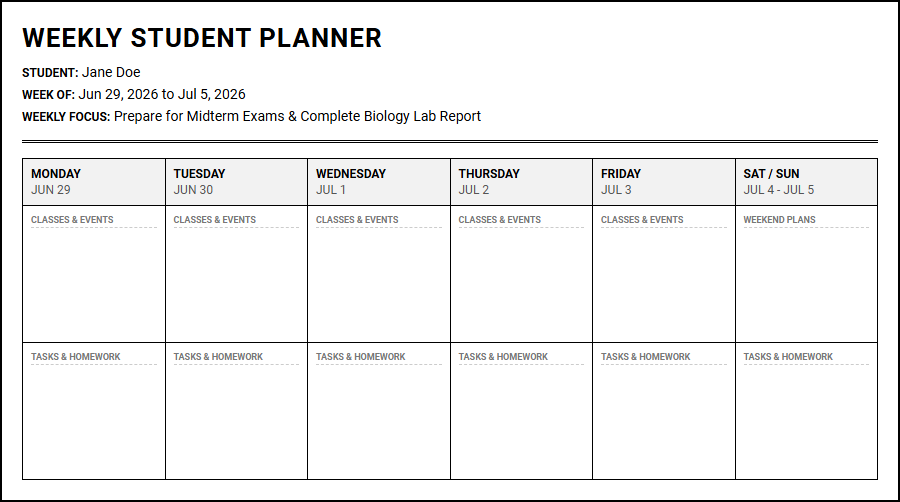
Balancing rigorous course loads often leaves students struggling to manage their weekly academic commitments. While schools traditionally rely on standard, district-funded agendas to address this, these rigid tools often fall short. Transitioning to custom printable calendars grants students the precise layout flexibility they need, provided they establish a consistent routine for updating them. Our downloadable 2024-2025 Weekly PDF template exemplifies this tailored approach. Below, we outline how to effectively leverage this tool for academic success.
Create Your Weekly Student Planner
| Monday - | Tuesday - | Wednesday - | Thursday - | Friday - | Sat / Sun - |
|---|---|---|---|---|---|
| Classes & Events | Classes & Events | Classes & Events | Classes & Events | Classes & Events | Weekend Plans |
| Tasks & Homework | Tasks & Homework | Tasks & Homework | Tasks & Homework | Tasks & Homework | Tasks & Homework |
Done customizing?
Weekly Student Planner - Good to Know
Time blocking
Time blocking is a highly structured productivity method where you divide your entire day into dedicated chunks of time. Instead of keeping an open-ended, overwhelming to-do list, you assign specific tasks to concrete time slots. This approach minimizes cognitive load, prevents decision fatigue, and guards against the constant temptation to multitask. By treating your schedule as a series of non-negotiable appointments with yourself, you can cultivate deep focus.
To implement this system effectively, consider the following structural strategies:
- Buffer Blocks: Allocate short windows of fifteen to thirty minutes between heavy study sessions to rest, stretch, or catch up on emails.
- Theme Days: Group similar academic tasks, such as dedicating Tuesdays entirely to research and Thursdays to writing assignments.
- Reactive Blocks: Create dedicated time slots for unexpected tasks, preventing your core schedule from falling apart when surprises arise.
Adopting this rigorous scheduling discipline transforms abstract goals into actionable daily milestones, paving a clear, organized path toward academic success.
Syllabus mapping
Syllabus mapping is the strategic process of dissecting your course outlines and translating them into a unified, master academic master plan. At the beginning of each semester, students often feel overwhelmed by disjointed deadlines scattered across multiple documents. By consolidating these dates, you gain a holistic view of your upcoming workload, allowing you to anticipate high-stress periods weeks before they arrive.
To successfully map your academic semester, follow these logical steps:
- Gather all syllabi and highlight every exam, quiz, essay, project, and reading assignment.
- Extract key grading weights to understand which assessments require the greatest allocation of your study hours.
- Plot these milestones chronologically onto a single digital or physical calendar to identify bottleneck weeks.
This proactive preparation prevents unexpected deadlines from blindsiding you, ensuring your study sessions remain calm, organized, and highly efficient throughout the academic term.
Assignment tracker
An assignment tracker acts as the central nervous system for your academic progress, offering a real-time status report on every deliverable. Relying purely on memory to track homework leads to missed deadlines and unnecessary stress. A centralized, dynamic table allows you to sort tasks by priority, subject, and status, ensuring that nothing slips through the cracks during busy midterms.
| Task Description | Course | Due Date | Priority Status |
|---|---|---|---|
| Literature Review Draft | ENG 102 | October 14 | High Priority |
| Physics Lab Report | PHY 201 | October 18 | Medium Priority |
| Calculus Problem Set | MAT 150 | October 22 | Low Priority |
Maintaining this granular level of organization empowers you to systematically tackle high-priority tasks first, converting abstract academic pressure into a series of highly manageable, sequential objectives.
GoodNotes digital planner
A GoodNotes digital planner merges the tactile benefits of traditional handwriting with the immense power of modern technology. Writing by hand has been shown to improve cognitive retention and comprehension, yet paper planners lack the flexibility of digital organization. Utilizing a stylus on a digital canvas allows you to search handwritten text, duplicate templates instantly, and sync your schedule across all your devices.
"The integration of digital handwriting tools bridges the gap between classic cognitive processing and modern organizational efficiency, creating a highly adaptable workspace."
Within your digital planner, you can import custom PDF templates, color-code your lecture notes, and crop diagrams directly into your daily schedule. This approach reduces physical clutter, keeping your backpack light. Embracing a paperless workflow streamlines your daily organization while maintaining a creative, hands-on connection to your academic planning process.
Spaced repetition tracker
A spaced repetition tracker is a powerful tool designed to optimize memory retention based on the psychological spacing effect. Instead of cramming information right before an exam, you review concepts at increasing intervals over time. This systematic process interrupts the natural forgetting curve, signaling to your brain that the information must be transferred from short-term to long-term memory.
A functional tracker monitors your mastery of specific topics using a structured review schedule:
- Immediate Review: Revisit lecture material exactly 24 hours after your initial exposure to consolidate the concepts.
- Intermediate Review: Test your active recall 7 days later to reinforce neural pathways and identify gaps.
- Delayed Review: Perform a comprehensive check at the 30-day mark to lock the information into your long-term memory.
Logging these study intervals ensures you study smarter, not harder, entering your exams with absolute confidence and deep conceptual understanding.
Eisenhower matrix
The Eisenhower matrix is a timeless, four-quadrant framework designed to help you prioritize tasks based on their urgency and importance. Students frequently fall into the trap of reacting to urgent but unimportant tasks, leaving crucial, long-term goals neglected. This system forces you to categorize your responsibilities, ensuring that your energy is always directed toward high-impact activities that truly matter.
The matrix divides your responsibilities into four distinct, actionable categories:
- Do First (Urgent & Important): High-stakes assignments or crises that require your immediate, focused attention.
- Schedule (Not Urgent & Important): Deep work, long-term planning, and studying that foster genuine growth.
- Delegate (Urgent & Not Important): Administrative chores or minor tasks that can be automated or shared.
- Eliminate (Not Urgent & Not Important): Time-wasting distractions and unproductive habits that yield no value.
Using this framework clarifies your daily focus, aligning your actions with your overarching academic ambitions.
Grade tracker
A grade tracker provides an objective, data-driven view of your academic performance throughout the semester. Waiting for final report cards creates anxiety, whereas tracking each quiz, participation mark, and essay score keeps you informed. Knowing your exact standing allows you to make strategic adjustments to your study habits, shifting focus to classes where your GPA needs a boost.
| Assessment Item | Weight | Score Achieved | Impact on Grade |
|---|---|---|---|
| Chemistry Midterm | 25% | 88% | Positive Trend |
| History Essay | 20% | 92% | Exceeding Target |
| Biology Quiz 1 | 10% | 75% | Requires Review |
This quantitative feedback loop eliminates guesswork, enabling you to consult professors early, adjust your study strategies, and take full control over your final academic outcomes.
Pomodoro technique log
A Pomodoro technique log is a simple yet highly effective way to track and optimize your focused work intervals. The Pomodoro technique breaks work into highly concentrated twenty-five-minute intervals, called Pomodoros, followed by five-minute breaks. Logging these sessions provides clear, visual proof of your productivity, helping you understand how long academic tasks actually take to complete.
To maximize this method, structure your study tracking session as follows:
- Define a single task and set a countdown timer for exactly twenty-five minutes of uninterrupted work.
- Work until the timer rings, then record a checkmark in your log to represent one completed Pomodoro.
- Take a brief, restorative break to rest your eyes, stretch, and step away from your digital screens.
After completing four consecutive Pomodoros, reward yourself with a longer, restorative break to maintain high cognitive stamina throughout the day.
Brain dump section
A brain dump section is a dedicated, unstructured space designed to clear mental clutter and restore cognitive clarity. When your mind is racing with random thoughts, administrative tasks, and personal worries, focusing on complex academic work becomes impossible. Writing everything down onto paper externalizes your mental load, immediately reducing anxiety and freeing up precious working memory for deep study.
"An unburdened mind is highly receptive to new information, making regular cognitive decluttering an essential practice for deep, focused academic engagement."
In this section, do not worry about neatness, organization, or grammar. Simply write down every passing thought, worry, or task that comes to mind until your brain feels completely clear. Once externalized, you can systematically sort these items into your structured calendar or planner, returning to your primary studies with a focused, peaceful, and fully present mind.
Habit tracker
A habit tracker is a powerful visual tool designed to build, monitor, and sustain positive routines over time. Academic success is not just about isolated study sessions; it is built on daily habits like healthy sleep, regular exercise, and consistent review. Tracking these habits provides an immediate sense of accomplishment, reinforcing your commitment to personal growth and self-discipline.
Consider monitoring these foundational habits to support your academic journey:
- Sleep Quality: Aiming for eight hours of rest to optimize memory consolidation and cognitive performance.
- Active Recall: Dedicating fifteen minutes daily to self-testing, ensuring your knowledge remains fresh.
- Hydration: Drinking sufficient water throughout the day to maintain focus, energy levels, and mental alertness.
Watching your unbroken chain of daily checkmarks grow creates powerful momentum, turning positive behaviors into automatic, effortless routines that support long-term success.
Leave a comment