
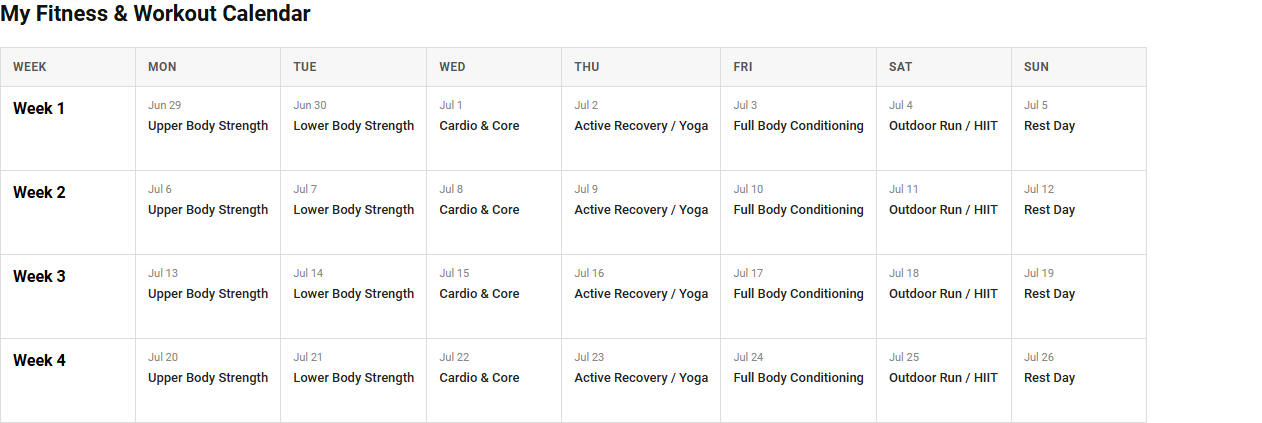
Staying consistent with fitness goals is a universal struggle, often leading to abandoned routines. While expensive gym memberships and complex apps offer tracking, they frequently fail to provide immediate, tangible visibility. A Yearly Calendars printable fitness calendar bridges this gap, giving you a powerful physical anchor for daily accountability. However, success requires realistic scheduling rather than over-ambitious planning. Whether tracking HIIT sessions, strength training, or marathon prep, this guide outlines how to utilize these templates effectively.
Create Your Fitness and Workout Calendar
Done customizing?
Fitness and Workout Calendar - Good to Know
Periodization
Periodization is the systematic planning of athletic or physical training. This structured approach aims to reach the best possible performance in the most important competition of the year. It involves progressive cycling of various aspects of a training program during a specific period. By dividing the training program into successive phases, athletes can target specific physiological adaptations. These phases typically range from high-volume, low-intensity work to low-volume, high-intensity training. Using this method helps prevent overtraining and optimizes recovery cycles. Most structured periodization models focus on three primary cycles:
- Macrocycle: An entire training year or season.
- Mesocycle: A specific block of training lasting several weeks.
- Microcycle: A short-term training plan, usually one week.
Adopting this structured framework allows fitness enthusiasts and competitive athletes alike to manage fatigue effectively while consistently driving positive adaptation and long-term performance gains.
Workout Split
A workout split refers to how you organize your training sessions throughout the week, categorizing exercises by muscle groups or movement patterns. Selecting the appropriate split is crucial for balancing training volume, frequency, and recovery. Different splits serve different fitness goals, lifestyles, and experience levels. Beginners often thrive on full-body routines, while advanced lifters frequently prefer targeted splits to maximize localized volume.
Common training splits include:
- Push/Pull/Legs (PPL): Splits training into pushing movements, pulling movements, and lower body work.
- Upper/Lower: Alternates between upper body training days and lower body training days.
- Bro Split: Focuses on a single major muscle group per training session.
Choosing the correct structure ensures that each muscle group receives adequate stimulus to grow while allowing sufficient recovery time before the next session. Your chosen split must align with your weekly schedule to remain sustainable over time.
Deload Week
A deload week is a planned reduction in training volume or intensity, designed to facilitate physiological and psychological recovery. During intense training, cumulative fatigue builds up in your muscles, joints, and central nervous system. A dedicated deload period allows your body to repair microtears, restore glycogen stores, and normalize hormone levels without losing hard-earned strength or cardiovascular fitness.
Implementing a successful deload typically involves:
- Reducing the total number of working sets by 30% to 50%.
- Decreasing the working weight to approximately 60% to 70% of your normal intensity.
- Prioritizing mobility work, stretching, and quality sleep.
Incorporating these scheduled breaks every six to twelve weeks is essential for preventing overuse injuries and mitigating chronic fatigue. This proactive recovery strategy ensures that you return to your regular training program stronger, re-energized, and fully prepared to tackle new performance goals.
Active Recovery Day
An active recovery day involves performing low-intensity, non-strenuous physical activity to promote blood flow and accelerate healing. Unlike passive rest, which involves minimal physical movement, active recovery stimulates circulation to deliver essential oxygen and nutrients to damaged muscle tissues. This process aids in flushing out metabolic waste products and reducing muscle soreness.
Excellent choices for active recovery activities include:
- Light walking, hiking, or casual cycling.
- Yin yoga and dedicated mobility flow routines.
- Swimming at an easy, relaxed pace.
Keeping your heart rate in a low, comfortable zone ensures that these activities do not add to your cumulative systemic fatigue. Integrating these restorative days into your weekly routine maintains joint mobility, relieves mental stress, and keeps you physically active without compromising the recovery process required for muscular adaptation.
Macrocycle
The macrocycle represents the largest block of time in a structured periodized training plan, typically spanning an entire year or an Olympic cycle. It provides the overarching framework for an athlete's development, outlining long-term goals and major milestones. By viewing training through this macro lens, coaches and athletes can plan preparation, competition, and transition phases strategically.
A typical macrocycle is divided into distinct phases:
- Preparatory Phase: Builds a solid foundation of general physical preparedness and aerobic base.
- Competitive Phase: Focuses on sport-specific skills, maximum power, and peak performance.
- Transition Phase: Facilitates active recovery, injury rehabilitation, and mental decompression.
Designing an effective macrocycle ensures that training volume and intensity fluctuate systematically throughout the year. This long-term perspective prevents burnout and aligns training stimuli with specific competitive timelines, ensuring peak physical condition when it matters most.
Progressive Overload
The principle of progressive overload states that in order for a muscle to grow, strength to increase, or athletic performance to improve, the human body must be forced to adapt to a tension or workload that is greater than what it has previously experienced. Without continuously challenging your physiological limits, physical adaptation will stall, resulting in a training plateau.
You can apply progressive overload using several methods:
- Resistance: Increasing the weight or resistance of the exercise.
- Volume: Adding more repetitions or total sets to a workout.
- Frequency: Increasing the number of training sessions per week.
- Density: Decreasing the rest time between sets.
Implementing these adjustments gradually is vital to avoid injury. Tracking your workouts meticulously allows you to systematically introduce small increments of stress, guaranteeing continuous, long-term improvement in your physical capabilities.
Habit Stacking
Habit stacking is a powerful behavioral psychology technique used to build new, positive routines by anchoring them to existing, well-established habits. Created by author James Clear, this strategy utilizes the strong neural pathways already built into your brain to make new behaviors easier to adopt. Instead of trying to remember a new fitness task out of thin air, you connect it directly to an action you perform daily without thinking.
The basic formula for habit stacking is:
"After I [Current Habit], I will [New Habit]."
Consider these practical fitness examples:
- After I pour my morning coffee, I will drink a large glass of water.
- After I take off my work shoes, I will put on my running sneakers.
This simple method eliminates decision fatigue and builds consistency, turning desirable physical fitness behaviors into automatic, effortless daily rituals.
Rate of Perceived Exertion
The Rate of Perceived Exertion (RPE) is a subjective scale used to measure the intensity of your physical activity. Commonly based on a scale of 1 to 10, RPE allows athletes to self-regulate their training based on how difficult an exercise feels in real-time. This method accounts for external lifestyle stressors, sleep quality, and nutrition levels that direct weight percentages fail to capture.
The standard RPE scale interprets intensity as follows:
- RPE 10: Maximal effort; no repetitions left in the tank.
- RPE 8: Heavy effort; precisely two repetitions remaining before failure.
- RPE 6: Moderate effort; four or more repetitions remaining.
Utilizing RPE fosters greater self-awareness and teaches you to listen to your body. By adjusting training loads dynamically, you protect your joints, manage central nervous system fatigue, and optimize muscle growth safely.
Mesocycle
A mesocycle represents a specific block of training within a larger macrocycle, typically lasting between three to six weeks. This medium-term cycle focuses on developing a particular physical attribute, such as hypertrophy, muscular strength, power, or cardiovascular endurance. Concentrating on one primary goal during this timeframe allows the body to make targeted physiological adaptations.
A well-planned mesocycle generally consists of:
- Three to five weeks of progressive, hard training where volume or intensity gradually increases.
- A final week dedicated to a planned deload to dissipate fatigue.
Structuring your fitness journey into distinct mesocycles ensures that you are not trying to improve every athletic metric simultaneously. This targeted approach maximizes adaptation efficiency, prevents chronic overtraining, and provides logical transition points to shift your training focus toward new athletic milestones.
Consistency Streak
A consistency streak represents the unbroken chain of days or weeks that you successfully adhere to your established fitness and nutrition routines. In physical development, daily commitment easily outperforms sporadic, high-intensity efforts. Maintaining a streak builds powerful momentum, transforming conscious effort into deeply ingrained, automatic lifestyle habits.
To build and maintain a successful consistency streak, focus on these strategies:
- Set realistic, achievable daily goals rather than overwhelming targets.
- Utilize visual trackers or mobile apps to monitor progress and celebrate small wins.
- Adopt a resilient mindset: never miss twice in a row.
The psychological boost of keeping a streak alive can be highly motivating on days when willpower is low. Over time, these continuous daily habits accumulate, resulting in profound transformations in health, physical strength, and overall well-being. Keeping the chain unbroken is your most effective tool for long-term athletic success.

Leave a comment