
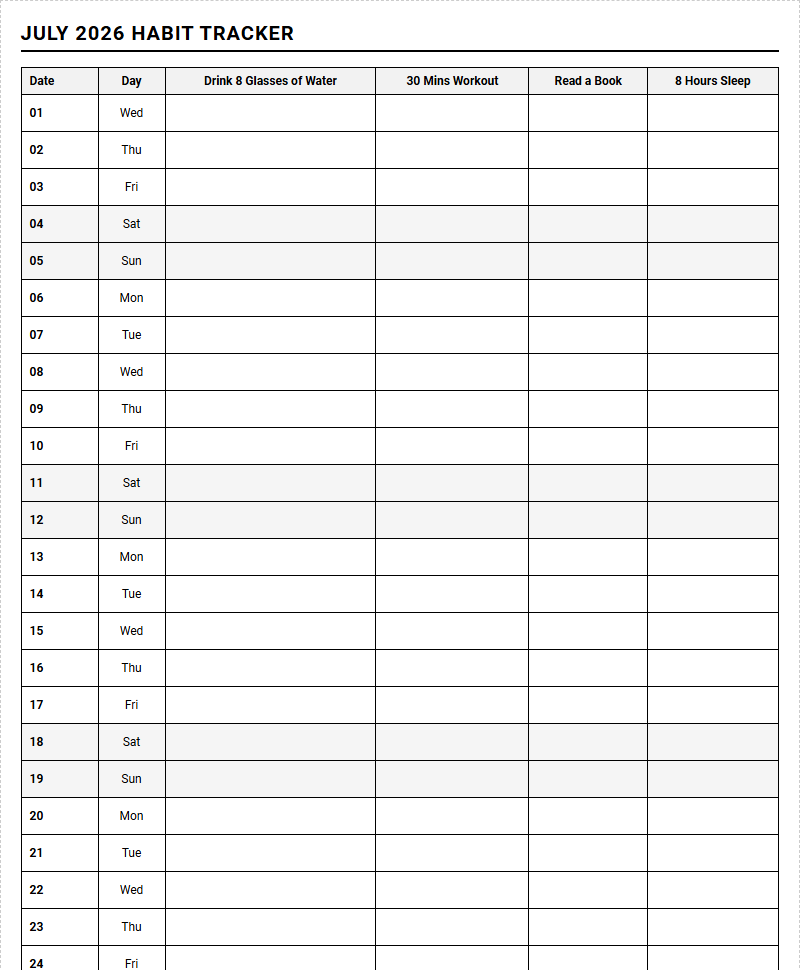
Staying consistent with personal wellness goals often feels like an uphill battle. While many rely on complex digital apps or mental checklists to stay on course, these methods frequently lack visibility. Our printable Daily Habit Tracker grants you immediate visual accountability, though its success stipulates your daily physical engagement. By tracking concrete metrics like hydration levels and morning workouts, you build sustainable momentum. Below, we explore how to effectively integrate this template into your daily routine.
Create Your Daily Habit Tracker
Done customizing?
Daily Habit Tracker - Good to Know
Habit stacking
Habit stacking is a highly effective behavioral design strategy that leverages your existing daily routines to build new, positive behaviors. Instead of trying to remember a new action based on a vague time of day, you anchor the new habit directly to an established, automatic trigger. This method utilizes the neural pathways already strengthened in your brain from years of repeating daily tasks.
To successfully implement this technique, you can use a simple, structured formula:
- The Formula: After [Current Habit], I will [New Habit].
- Morning Example: After I pour my morning coffee, I will meditate for two minutes.
- Evening Example: After I close my laptop for the work day, I will immediately change into my exercise clothes.
By chaining these behaviors together, you drastically reduce the cognitive load required to start a new task, making consistency far easier to achieve.
Streak freeze
Maintaining consistency is crucial for long-term behavioral change, but life often presents unpredictable disruptions. This is where the concept of a streak freeze becomes an invaluable tool. Originating from gamified language-learning apps, a streak freeze acts as a psychological safety net, allowing you to miss a single day of your habit without resetting your progress counter to zero.
"Perfection is the enemy of progress. A streak freeze protects your momentum when willpower fails."
This approach prevents the demoralizing "what the hell effect," where a single slip-up leads to complete abandonment of your goals. By intentionally designing a buffer day into your routine, you preserve your self-efficacy and psychological momentum. You acknowledge that flexibility is a strength, enabling you to bounce back quickly and sustain your habits over years rather than just weeks.
Keystone habits
Keystone habits are pivotal routines that naturally trigger a positive chain reaction throughout your entire life. When you focus on changing just one of these core behaviors, it automatically realigns and improves other seemingly unrelated areas of your daily routine. They do not just create a single victory; instead, they foster a new culture of personal growth and wellness.
Some of the most powerful keystone habits include:
- Regular Exercise: Frequently leads to better nutrition, improved sleep, and increased productivity.
- Daily Journaling: Enhances self-awareness, reduces stress levels, and improves emotional regulation.
- Consistent Sleep Patterns: Boosts decision-making skills, focus, and emotional resilience throughout the day.
By identifying and prioritizing these catalytic behaviors, you maximize your developmental ROI, creating systemic improvements with minimal conscious effort.
Micro-habits
Micro-habits are the practice of scaling down a desired behavior to its smallest, most effortless iteration. If you want to read more, your micro-habit is to read just one page per day. If you want to start flossing, you begin by flossing just one tooth. The primary objective is to overcome the initial friction of starting, which is often the hardest part of any routine.
By focusing on actions that take less than two minutes to complete, you remove all excuses related to time, energy, or motivation. You establish the neural pathway of the routine first, and only when the behavior becomes fully automated do you begin to scale it up. This strategy prioritizes the frequency of the action over its intensity, building a resilient foundation of consistency.
Identity-based habits
Many people fail to sustain new habits because they focus entirely on what they want to achieve rather than who they wish to become. Identity-based habits reverse this dynamic by shifting your focus inward. True behavior change is actually identity change; when your actions align with your core beliefs about yourself, maintaining those actions requires very little conscious effort.
"The goal is not to read a book, the goal is to become a reader."
To build these habits, you must continuously prove this new identity to yourself through small wins. Every time you write a page, you are a writer. Every time you choose a healthy meal, you are a healthy person. This internal alignment ensures that your behaviors are not temporary tasks, but natural expressions of your character.
Habit loop
Understanding the neurological feedback loop that governs every human habit is essential for intentional behavioral change. Science demonstrates that all habits are comprised of four distinct, sequential stages that form a continuous cycle. By identifying and manipulating each component of this loop, you can easily construct positive routines and dismantle destructive ones.
The four stages of the loop operate as follows:
- Cue: The trigger that predicts a reward, prompting your brain to initiate a behavior.
- Craving: The motivational force behind the habit, driven by the desire to change your internal state.
- Response: The actual thought or physical action you perform to satisfy the craving.
- Reward: The final outcome that satisfies your craving and teaches your brain to repeat the loop.
Gamified tracking
Gamified tracking applies game-design elements-such as points, badges, levels, and quest lines-to real-life habit formation. Traditional tracking can sometimes feel tedious and chore-like. By injecting elements of play and competition into your personal development journey, you tap into your brain's natural desire for achievement, status, and completion.
Effective gamification strategies often incorporate:
- Experience Points (XP): Earning points for every successfully completed daily habit.
- Visual Progress Bars: Watching a bar fill up as you get closer to your weekly milestones.
- Unlockable Rewards: Allowing yourself a specific treat only after reaching a certain streak level.
This playful framing transforms discipline into an engaging game, maintaining high engagement levels even during periods when your intrinsic motivation begins to wane.
Implementation intentions
Implementation intentions are pre-determined plans that specify exactly when, where, and how you will execute a target behavior. Most people fail to follow through on their goals not due to a lack of desire, but because of a lack of clarity. By removing ambiguity from your plans, you bypass the need for active decision-making in the moment.
This strategy relies heavily on a structured "If-Then" framework:
"If situation X arises, then I will perform response Y."
For example: "If it is Monday at 7:00 AM, then I will go to the gym." By linking environmental cues directly to your intended actions, you automate the decision-making process. When the cue occurs, your brain automatically initiates the planned response without hesitation.
Dopamine menu
A dopamine menu, or "dopa-menu," is a personalized, curated list of healthy, stimulating activities that you can turn to when you feel bored, distracted, or low on energy. In the digital age, we often default to quick, low-effort dopamine hits like doomscrolling on social media or binge-watching television, which frequently leave us feeling drained.
A well-structured menu organizes activities into clear categories:
- Appetizers: Quick 5-minute boosts, like stretching or stepping outside.
- Entrees: Deep, nourishing activities, like reading or practicing an instrument.
- Desserts: Indulgent activities to enjoy in moderation, like playing a video game.
Having this menu readily available prevents decision paralysis and helps you consciously select fulfilling activities that truly recharge your mind.
Habit bundling
Habit bundling is a powerful productivity technique that links an action you need to do with an action you want to do. This concept, also known as temptation bundling, pairs immediate gratification with long-term goals, making difficult tasks much more attractive. It allows you to utilize the anticipation of a reward to fuel the execution of a chore.
Consider the following practical applications of this method:
- Listening to your favorite podcast (want) only while folding the laundry (need).
- Walking on a treadmill (need) while watching your favorite television show (want).
- Sipping a specialty tea (want) while answering difficult work emails (need).
By restricting your favorite pleasures to those times when you are performing necessary habits, you build positive associations with challenging tasks.
Leave a comment