
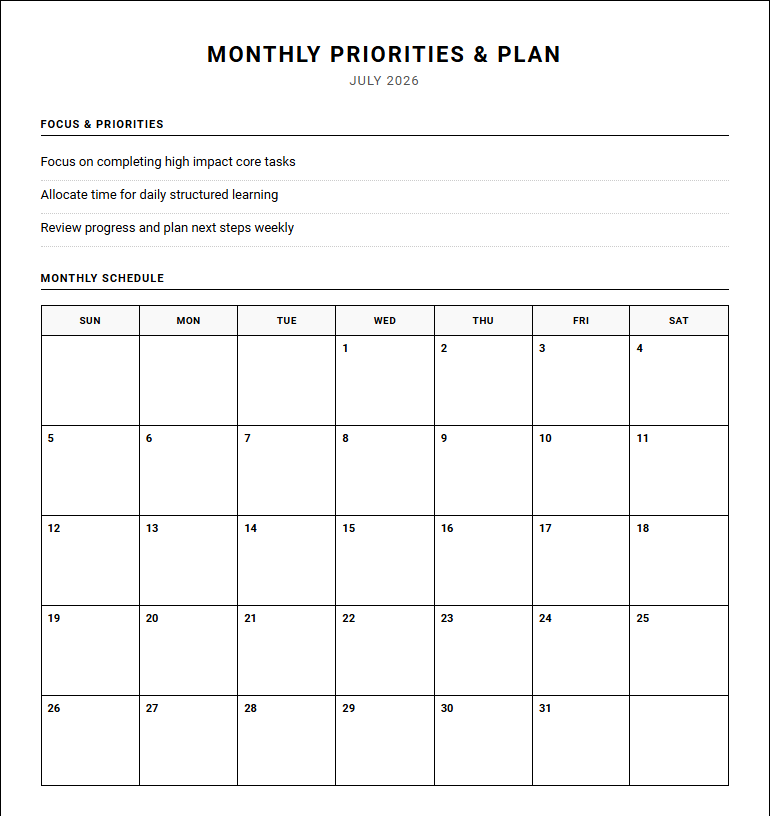
Staying organized is a constant struggle when daily tasks feel disconnected from long-term goals. While standard digital planners offer quick alerts, they often lack the big-picture perspective needed for true productivity. A printable yearly to-do list calendar bridges this gap, providing immediate visual continuity for mapping quarterly milestones. However, this system only succeeds if you maintain simplified, consistent categorization. Below, we explore how to utilize these printable layouts to streamline your workflow and master your annual agenda.
Create Your To-Do List Calendar
- Focus on completing high impact core tasks
- Allocate time for daily structured learning
- Review progress and plan next steps weekly
Done customizing?
To-Do List Calendar - Good to Know
Time blocking
Time blocking is a highly effective productivity technique where you divide your day into distinct blocks of time. Each block is dedicated to completing a specific task or group of tasks, rather than keeping an open-ended to-do list. By planning your day in advance, you eliminate decision fatigue and create a clear roadmap for your focus.
- Deep Work: Protects high-cognitive tasks from interruptions.
- Shallow Work: Clusters administrative chores like email.
This method forces you to confront the finite nature of your workday. When you assign a concrete duration to each objective, you become more realistic about what you can achieve. Consequently, this structured approach reduces multitasking and fosters deep focus, allowing you to produce higher-quality work in less time.
Timeboxing
Timeboxing differs from time blocking by setting a strict limit on how much time you allocate to an activity. Instead of working until a task is finished, you commit to stopping once the designated timebox expires. This approach is incredibly useful for overcoming perfectionism and beating procrastination on daunting projects.
Implementing this strategy involves a simple, three-step cycle:
- Define a clear, measurable goal for the timebox.
- Set a timer (typically 25 to 60 minutes).
- Work with absolute focus until the alarm sounds.
By treating time as a fixed resource, you leverage Parkinson's Law, which states that work expands to fill the time available for its completion. This constraint drives efficiency and encourages you to find the most direct path to progress.
Eisenhower Matrix
The Eisenhower Matrix is a prioritization framework that helps you categorize tasks based on their urgency and importance. Named after President Dwight D. Eisenhower, this method assists in filtering out distractions so you can focus on high-impact objectives. It divides your workload into four distinct quadrants:
- Do: Urgent and important tasks that require immediate action.
- Schedule: Important but not urgent tasks to plan for later.
- Delegate: Urgent but not important tasks to assign to others.
- Delete: Neither urgent nor important tasks to eliminate completely.
Using this systematic matrix ensures that you do not spend your entire day putting out immediate fires. By consciously scheduling time for non-urgent but important strategic work, you foster long-term personal and professional growth.
Task batching
Task batching is the practice of grouping similar, repetitive tasks together and completing them in a single, dedicated session. This strategy minimizes cognitive switching costs, which occur when your brain transitions between entirely different types of activities. When you switch context constantly, you drain mental energy and reduce overall efficiency.
Common examples of batching include:
- Answering all emails during a designated hour.
- Creating a week's worth of social media content at once.
- Conducting all phone calls back-to-back.
By streamlining your focus onto one specific cognitive modality, you enter a state of flow much faster. This sustained momentum allows you to complete tasks with greater speed and accuracy, freeing up valuable mental bandwidth for the rest of your day.
Zero-based calendar
A zero-based calendar is a meticulous planning system where every single minute of your workday is accounted for and assigned a specific purpose. Inspired by zero-based budgeting, this method requires you to start with a blank slate every morning and fill the entire schedule, leaving zero hours of unstructured time. This includes allocating slots for breaks, meals, and commute times.
Key benefits of this approach include:
- Total Awareness: You see exactly where your time goes.
- Mindful Pauses: Breaks are scheduled, preventing burnout.
- Realistic Goals: It discourages overcommitting to projects.
When you give every hour a job, you eliminate the idle gaps where distraction usually creeps in. This intentional mapping transforms your calendar into a realistic reflection of your energy, priorities, and daily capacity.
GTD method
The Getting Things Done (GTD) method, created by productivity expert David Allen, is a powerful framework designed to move tasks and ideas out of your head and into an external, organized system. The core philosophy is that your brain is for having ideas, not holding them. By capturing everything in a trusted system, you relieve mental stress and free up creative energy.
The GTD workflow operates through five essential phases:
- Capture: Collect everything that commands your attention.
- Clarify: Process what each item means and decide on next actions.
- Organize: Put actionable steps into appropriate categories.
- Reflect: Review your lists regularly to keep them updated.
- Engage: Simply do the tasks with confidence.
This comprehensive workflow ensures that nothing falls through the cracks, allowing you to maintain focus and execute tasks with absolute clarity.
Micro-scheduling
Micro-scheduling takes time blocking to an extreme level by breaking the workday down into incredibly small increments, often ranging from five to fifteen minutes. Popularized by highly busy executives, this hyper-granular approach ensures that no moment is wasted and that even the smallest tasks receive dedicated attention throughout a hectic schedule.
While it requires rigorous discipline, micro-scheduling offers significant advantages:
- Maximizes productivity within highly condensed windows.
- Instills an acute sense of urgency that prevents procrastination.
- Ensures rapid progression through diverse, fast-moving tasks.
This high-precision method is ideal for individuals managing high-volume, fast-paced roles where brief interruptions can derail entire projects. By structuring your day at the microscopic level, you maintain tight control over your output, keeping distraction entirely at bay.
Habit stacking
Habit stacking is an innovative behavior-change strategy popularized by James Clear in his book Atomic Habits. The method involves pairing a new habit you want to build with an existing, well-established daily routine. By leveraging the strong neural pathways of your current habits, you make the adoption of new, productive behaviors feel almost effortless.
The formula for this technique is straightforward and easy to implement:
"After I [Current Habit], I will [New Habit]."
For example, you might decide that after you pour your morning coffee, you will write down three strategic goals for the day. This simple association anchors your new productivity habits to reliable daily triggers, creating a seamless chain of positive behaviors that steadily enhances your daily efficiency.
Chronotype scheduling
Chronotype scheduling is a modern productivity approach that aligns your work hours with your body's natural circadian rhythms. Based on sleep science, individuals fall into distinct chronotypes-such as lions, bears, wolves, or dolphins-which dictate when they feel most alert or naturally fatigued throughout the day.
By understanding your biological peak times, you can organize your tasks strategically:
- Peak Alertness: Reserve for complex problem-solving and deep focus.
- Trough Energy: Assign to admin tasks, emails, and meetings.
- Rebound: Use for creative brainstorming or collaborative work.
Instead of forcing yourself into a rigid, traditional nine-to-five schedule, this personalized method optimizes your biological peaks. Designing your day around your body clock maximizes natural output and sustains long-term energy levels.
Asynchronous planning
Asynchronous planning is a modern workspace methodology where collaboration, task delegation, and strategic planning occur without the requirement of real-time communication. This approach is highly essential for distributed, remote teams operating across various global time zones, where constant synchronous meetings are impractical and highly disruptive to deep work.
Key pillars of this planning style include:
- Detailed Documentation: Writing clear instructions to avoid back-and-forth.
- Flexible Response Times: Allowing team members to respond when focused.
- Centralized Tools: Using collaborative platforms for transparent tracking.
By decoupling communication from immediate, real-time responses, asynchronous planning respects individual focus time. It empowers professionals to design productive, uninterrupted schedules while maintaining alignment, ensuring projects progress steadily without constant interruption.
Leave a comment