
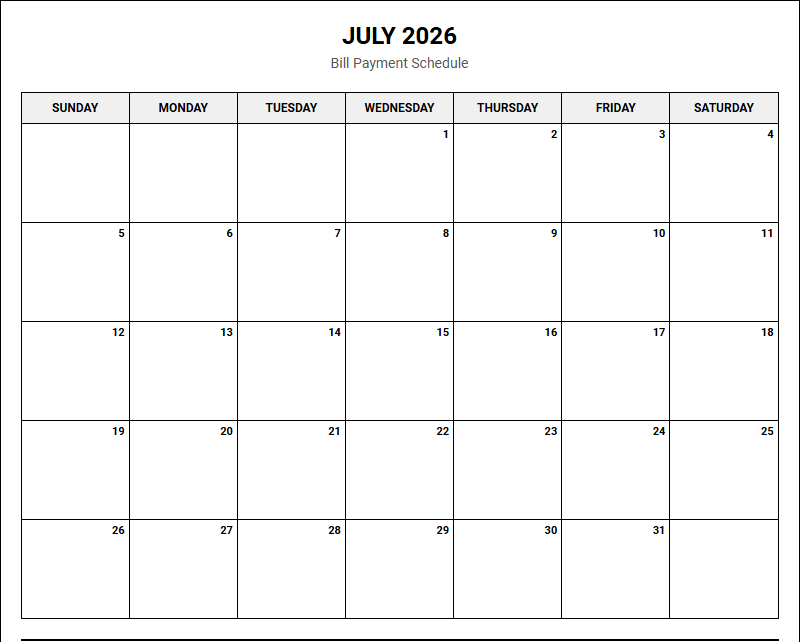
Managing multiple monthly due dates often leads to costly missed payments and financial stress. While aligning your billing cycle with standard funding sources like bi-weekly paychecks provides a baseline, complete control requires visualization. Utilizing our blank and custom printable calendar templates grants you immediate mastery over your cash flow. Please note that while these tools organize recurring obligations like utilities and mortgage payments, they rely on consistent user updates. Below, we outline how to effectively structure your personalized bill payment calendar.
Create Your Bill Payment Calendar
Done customizing?
Bill Payment Calendar - Good to Know
Autopay schedule
Managing your recurring expenses requires a structured autopay schedule to ensure no transaction is left to chance. By automating your recurring transfers, you align your outgoing payments directly with your income streams. This systematic approach minimizes the manual labor involved in monthly financial maintenance, allowing you to focus on wealth accumulation rather than administrative tasks.
An optimized automated payment timeline provides several distinct advantages for modern household management:
- Consistency: Establishes a predictable pattern of withdrawals that align with your banking institution's processing cycles.
- Peace of Mind: Eradicates the anxiety associated with remembering multiple monthly transfer deadlines.
- Credit Health: Sustains a flawless payment history, which acts as a primary pillar for your overall credit evaluation.
Integrating these schedules into your primary checking account creates a hands-off environment where cash moves efficiently to creditors, utility providers, and savings vehicles without requiring constant oversight or manual authorization.
Cash flow forecasting
Predicting your financial future requires sophisticated cash flow forecasting to map out income versus expenditures over a rolling twelve-month period. This practice transcends basic bookkeeping by transforming historical transaction data into actionable future insights. By analyzing past spending behaviors, you can project precisely when your liquid assets will peak and when they will contract throughout the fiscal year.
To construct an accurate projection model, financial planners emphasize evaluating three primary areas:
- Fixed Inflows: Regular salary payments, investment dividends, and reliable side-income deposits.
- Variable Outflows: Seasonal utility spikes, quarterly tax liabilities, and discretionary holiday spending.
- Discretionary reserves: Capital allocated for emergencies or sudden market opportunities.
Maintaining a dynamic forecast prevents overdrafts and ensures that your investment strategies remain fully funded. This forward-looking approach empowers you to make strategic purchasing decisions based on actual future availability rather than temporary current balances.
Subscription tracker
In the modern digital economy, micro-transactions can silently drain your resources unless you employ a dedicated subscription tracker. Hidden monthly renewals for streaming services, software licenses, and fitness memberships frequently slip through the cracks of traditional bank statements. A centralized tracking system shines a spotlight on these passive drains, forcing you to consciously evaluate the utility of every recurring charge.
Implementing a rigorous audit process helps reclaim wasted capital by categorizing subscriptions into distinct priority levels:
- Essential Services: Utility-linked subscriptions, critical professional software, and primary communication tools.
- Value-Add entertainment: Platforms utilized weekly that contribute directly to personal well-being or education.
- Redundant Trials: Forgotten services that should be immediately expunged to protect your bottom line.
Consolidating these commitments into a single view assists in identifying redundant services, allowing you to reallocate those funds toward high-yield savings or debt reduction.
Due date alerts
Timely communication is paramount when managing complex liabilities, making due date alerts an indispensable component of personal financial architecture. Relying solely on memory invites human error, particularly when balancing multiple utility bills, credit cards, and insurance premiums. Setting up multi-layered notification protocols ensures you remain informed of upcoming obligations well before capital leaves your custody.
Effective alert strategies utilize diverse communication channels to guarantee visibility in a crowded digital landscape:
- Push Notifications: Real-time alerts delivered straight to your mobile device five days prior to the transaction.
- SMS Reminders: Direct text messages that serve as urgent secondary indicators for high-priority bills.
- Email Integration: Detailed summaries detailing the exact balance due, minimum payment thresholds, and processing times.
Using these proactive mechanisms creates a safety net that protects your accounts from unexpected liquidity shortages and ensures consistent financial compliance.
Paycheck cycle budgeting
Traditional monthly planning often fails because it ignores the natural rhythm of your income, which is why paycheck cycle budgeting is so effective. Rather than treating the calendar month as a single block, this methodology segments your financial plan into smaller, more manageable increments based on when you are actually paid. Whether you receive compensation weekly, bi-weekly, or semi-monthly, matching specific bills to specific paychecks optimizes your cash reserves.
This tactical allocation model operates through a structured sequence of steps:
- Identify the exact net income deposited during a specific pay period.
- Allocate immediate funds to obligations maturing before the subsequent pay date.
- Distribute remaining balances between savings goals, daily living expenses, and discretionary reserves.
This harmonious synchronization prevents the common "feast or famine" cycle, ensuring that your liquid assets are evenly distributed and readily available when major expenses fall due.
Recurring payment tracker
A comprehensive recurring payment tracker offers a bird's-eye view of your ongoing financial commitments, capturing everything from annual insurance premiums to weekly organic grocery deliveries. Unlike static spreadsheets, a dynamic tracking utility monitors the frequency, amount, and fluctuating nature of your non-discretionary spending. This comprehensive visibility is essential for distinguishing between fixed contracts and variable utility invoices.
When constructing this database, it is beneficial to record key data points for every recurring item:
- Billing Frequency: Clearly designating whether an item is billed weekly, monthly, quarterly, or annually.
- Payment Method: Identifying which specific credit card or bank account is linked to the transaction.
- Variability Indicator: Marking bills that fluctuate based on seasonal consumption or usage metrics.
This disciplined logging practice ensures that you are never surprised by an annual renewal or a sudden rate increase from a service provider.
Fintech bill organizer
Embracing a modern fintech bill organizer allows you to leverage advanced technology to streamline your personal accounts. Modern financial technology applications integrate directly with your bank portals, pulling real-time data and compiling all outstanding liabilities into a single, intuitive interface. This automation eliminates the need to log into dozen of separate websites just to verify balances or confirm payment completions.
These sophisticated platforms offer unique digital capabilities designed to optimize asset management:
- Automated Aggregation: Centralizes balances, statement histories, and due dates from various external creditors.
- Smart Categorization: Uses machine learning to classify expenditures, highlighting areas where you can negotiate better rates.
- Secure API Integration: Utilizes bank-grade encryption protocols to protect your sensitive financial credentials.
Transitioning to a dedicated fintech organizer replaces chaotic paperwork with a streamlined, secure digital command center for all household liabilities.
Billing cycle synchronization
One of the most powerful strategies for simplifying personal finance is billing cycle synchronization. Many creditors and utility providers allow you to custom-select your monthly payment dates. By contacting these institutions and requesting that your due dates be moved to align with your primary income schedules, you can create a streamlined, predictable outflow pattern that simplifies cash management.
Aligning these dates delivers immediate structural improvements to your cash management system:
- Consolidated Processing: Allows you to address all major liabilities during one or two designated days per month.
- Clearer Balances: Simplifies the calculation of remaining discretionary income for the rest of the cycle.
- Reduced Admin Time: Minimizes the time spent logging into accounts and initiating manual transactions.
Harmonizing your billing cycles transforms a chaotic stream of random monthly invoices into a highly coordinated, predictable financial operation.
Late fee prevention
Proactive late fee prevention is vital for preserving your hard-earned capital and maintaining an excellent credit score. Penalties for delayed payments are non-productive expenses that offer zero return on investment. By implementing a multi-layered defensive strategy that combines automated alerts, buffer balances, and smart scheduling, you can eliminate these unnecessary costs from your household balance sheet.
Safeguarding your accounts against avoidable penalties involves several practical steps:
- Buffer Balances: Maintaining a permanent cash cushion in your checking account to cover unexpected processing delays.
- Grace Period Awareness: Knowing the exact rules regarding penalty free windows for each of your service providers.
- Overdraft Protection: Linking your checking account to a secondary savings account as an emergency backstop.
Eliminating late penalties keeps your money where it belongs, compound-growing in your investment portfolios rather than lining the pockets of creditors.
Multi-account payment calendar
For individuals managing multiple banking relationships, a multi-account payment calendar is the cornerstone of effective cash management. Modern wealth structures often span several checking, savings, and investment platforms. A unified visual calendar tracks not only when bills are due, but also indicates exactly which account will fund each transaction, preventing accidental overdrafts and optimizing liquidity across your entire portfolio.
A well-maintained financial calendar serves as a master blueprint for your cash movements:
- Visualize the timing of incoming paychecks and outgoing expenses across all connected institutions.
- Schedule internal transfers between different banks to fund specific upcoming bills.
- Identify potential cash shortages in specific accounts well before transactions are initiated.
This holistic visual tool ensures that every account remains perfectly balanced, properly funded, and aligned with your overarching financial objectives.
Leave a comment