
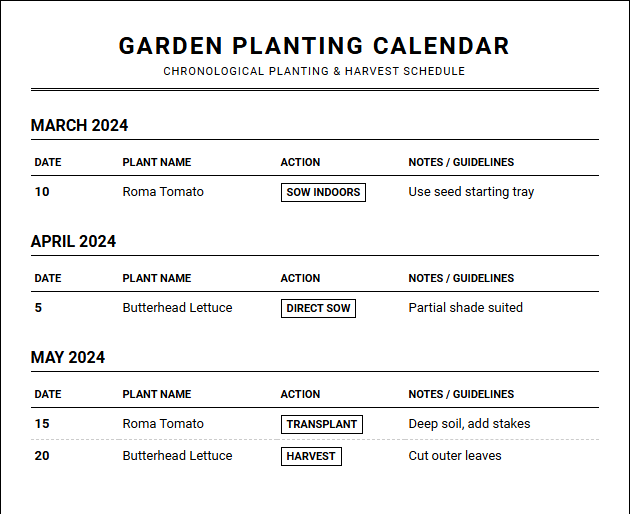
Managing chaotic sowing schedules often leaves gardeners missing critical planting windows. While standard USDA zone charts provide generic timelines, they lack local precision. Our blank and custom template printable calendars grant growers the absolute control needed to design a tailored horticultural roadmap. Naturally, success stipulates adjusting these layouts for your specific local frost dates. Whether tracking when to start heirloom tomatoes indoors or direct-sowing spring spinach, these tools optimize your timing. Below, we outline how to effectively structure your personalized garden planting calendar for maximum yield.
Create Your Garden Planting Calendar
Done customizing?
Garden Planting Calendar - Good to Know
USDA Hardiness Zone
The USDA Hardiness Zone Map serves as the fundamental standard for gardeners and growers to determine which plants are most likely to thrive at a location. Defined by the United States Department of Agriculture, the map divides North America into 13 distinct zones based on the average annual extreme minimum winter temperature. Each zone represents a 10-degree Fahrenheit difference, further subdivided into "a" and "b" half-zones for greater precision.
Understanding your specific zone is crucial when selecting perennial plants, shrubs, and trees, as it dictates their ability to survive the coldest months of the year. However, local microclimates can vary significantly due to factors such as:
- Elevation and slope aspect
- Urban heat island effects
- Proximity to large bodies of water
- Wind exposure and soil moisture retention
By identifying your hardiness zone, you establish a reliable baseline for plant survival, ensuring that your investment in landscaping and perennial agriculture yields long-term success year after year.
Last Frost Date
The last frost date is a pivotal calendar milestone that dictates the spring planting schedule for annual crops, tender herbs, and delicate flowers. This date represents the average final day of spring when a killing frost (32°F or 0°C) is likely to occur in your specific region. Because this is a statistical average based on historical weather data, it carries a degree of unpredictability, meaning gardeners must remain vigilant.
Sowing seeds or transplanting warm-season crops too early can lead to stunted growth, cellular damage, or complete crop loss. To mitigate these risks, experienced horticulturists categorize frost sensitivity into distinct groups:
- Hardy crops: Can tolerate light frosts (e.g., spinach, kale, radishes).
- Half-hardy crops: Can withstand cool weather but suffer in deep freezes (e.g., lettuce, chard).
- Tender crops: Easily killed by even a light frost (e.g., tomatoes, peppers, basil).
Tracking this date allows you to calculate backward to plan indoor seed starting and forward to schedule safe outdoor transplanting.
Succession Planting Schedule
To maximize backyard harvests and maintain a continuous supply of fresh produce, gardeners employ a succession planting schedule. Instead of planting an entire crop at once and facing an overwhelming single harvest followed by weeks of empty beds, succession planting staggers sowing dates. This method optimizes garden space and ensures that crops reach maturity in waves throughout the active growing season.
| Crop Type | Interval Frequency | Harvest Window |
|---|---|---|
| Leafy Greens (Lettuce, Spinach) | Every 10 to 14 days | Continuous spring through autumn |
| Root Vegetables (Radishes, Carrots) | Every 3 weeks | Early summer to late fall |
| Bush Beans | Every 2 to 3 weeks | Mid-summer to first frost |
By utilizing this structured rotation, you minimize waste, keep your soil constantly covered to suppress weeds, and maintain a highly productive and efficient kitchen garden.
Moon Phase Gardening
Moon phase gardening is an ancient, organic agricultural practice that aligns sowing, cultivating, and harvesting schedules with the lunar cycle. Proponents of this method believe that the gravitational pull of the moon influences soil moisture levels, pulling water upward during certain phases just as it affects ocean tides. This increased moisture availability at the soil surface is thought to accelerate seed germination and promote stronger root development.
The lunar cycle is divided into four primary quarters, each suited for specific gardening tasks:
- New Moon (Waxing)
- Ideal for planting leafy, above-ground annuals like spinach, cabbage, and celery, as light increases and sap rises.
- Full Moon (Waning)
- The energy shifts downward, making this the perfect time to plant root crops like carrots, potatoes, and bulbs.
- Dark Moon (Fourth Quarter)
- A resting phase suitable for weeding, pruning, tilling, and managing pests.
Biodynamic Calendar
Originating from the agricultural philosophy of Rudolf Steiner in the early 20th century, the biodynamic calendar views the farm or garden as a self-sustaining, holistic organism. This advanced planting guide goes beyond basic lunar cycles, incorporating the positioning of the moon relative to the twelve zodiac constellations. These constellations are associated with the four classical elements-earth, water, air, and fire-which correspond to specific parts of the plant.
- Root Days (Earth): Best for sowing and harvesting root crops like beets, garlic, and onions.
- Leaf Days (Water): Excellent for leafy vegetables, herbs, and structural brassicas.
- Flower Days (Air/Light): Ideal for companion flowers, broccoli, and harvesting cut blooms.
- Fruit Days (Fire): Prefect for planting and harvesting fruiting crops like tomatoes, squash, and apples.
By aligning agricultural activities with these cosmic rhythms, biodynamic gardeners aim to enhance the vitality, flavor, and shelf-life of their yields while enriching the soil naturally.
Phenology Triggers
While calendars provide static dates, nature offers dynamic, real-time indicators through phenology-the study of cyclic biological events in nature. Phenology triggers rely on the flowering of specific indicator plants or the emergence of insects to signal when local microclimates are truly ready for specific gardening actions. This observational approach adapts to the unique weather shifts of any given year, bypassing the inaccuracies of fixed calendar dates.
"Nature is the most accurate weather station. By observing the wild plants around us, we can read the soil's temperature and readiness with incredible accuracy."
For example, when the bright yellow blossoms of the Forsythia bush begin to drop, it signals that the soil has warmed sufficiently to plant crabgrass preventers or sow hardy greens. When lilac leaves are the size of a mouse's ear, it is time to plant potatoes. Observing when dandelions bloom tells you it is safe to plant beets and carrots directly into the earth.
Direct Sowing Window
The direct sowing window represents the optimal timeframe to plant seeds directly into their permanent outdoor garden beds, bypassing the transplant stage. Many crops perform significantly better when direct-sowed because they possess delicate taproots that resent being disturbed, or they mature rapidly enough that indoor starting is unnecessary. Successful direct sowing requires careful attention to soil moisture, seed depth, and local weather patterns to prevent seeds from rotting or drying out.
To achieve high germination rates, ensure your garden bed is raked smooth, free of debris, and consistently damp. Standard crops for direct sowing include:
- Root crops: Carrots, parsnips, radishes, and turnips.
- Legumes: Peas, pole beans, and bush beans.
- Large-seeded crops: Corn, squash, pumpkins, and sunflowers.
Protecting these areas with row covers can shield young seedlings from birds and harsh winds during this critical developmental window.
Companion Planting Guide
Companion planting is the practice of growing different plants in close proximity to benefit one another. This natural gardening strategy maximizes space, improves soil nutrition, deters destructive pests, and enhances crop pollination. By mimicking natural ecosystems, companion planting reduces the need for synthetic chemical pesticides and fertilizers, fostering a balanced, biodiverse garden environment that thrives on symbiotic relationships.
A classic example is the traditional Native American "Three Sisters" planting method:
- Corn: Provides a natural, sturdy trellis for climbing beans.
- Beans: Fix nitrogen from the air into the soil, feeding the corn and squash.
- Squash: Grows large leaves that shade the soil, conserving moisture and suppressing weeds.
Additionally, planting aromatic herbs like basil near tomatoes can repel insects, while bright marigolds deter soil nematodes, protecting vulnerable root systems naturally.
Indoor Seed Starting Timeline
For regions with short growing seasons, establishing an indoor seed starting timeline is essential to get a head start on spring. By sowing seeds indoors under controlled temperatures and artificial grow lights, gardeners can nurture strong, healthy seedlings weeks before outdoor conditions become hospitable. This timeline is calculated by counting backward from your projected last frost date, using the specific germination and growth rates of each plant species.
- 10-12 Weeks Before Frost: Start slow-growing, cold-hardy plants like celery, onions, and leeks.
- 6-8 Weeks Before Frost: Start nightshades such as tomatoes, peppers, and eggplants, which require warm soil.
- 3-4 Weeks Before Frost: Start fast-growing curcurbits like melons, squash, and cucumbers in biodegradable pots.
Before moving these indoor-grown plants directly into the garden, they must undergo a "hardening off" process, gradually acclimating to wind, direct sunlight, and temperature fluctuations over several days.
Soil Temperature Guidelines
While air temperature influences plant foliage, the critical factor for seed germination is soil temperature. Seeds require a specific thermal range to activate enzymes, break dormancy, and push roots downward. Planting in soil that is too cold can cause seeds to sit dormant and rot, while soil that is too hot can dry out delicate embryos. Utilizing a soil thermometer inserted three inches deep provides the accurate data needed for planting success.
| Crop Type | Minimum Soil Temp | Optimum Germination Temp |
|---|---|---|
| Spinach & Peas | 35°F (2°C) | 70°F (21°C) |
| Lettuce & Brassicas | 45°F (7°C) | 75°F (24°C) |
| Tomatoes & Peppers | 60°F (16°C) | 80°F (27°C) |
| Melons & Squash | 65°F (18°C) | 85°F (29°C) |
Investing in a simple soil probe ensures you plant with scientific precision, maximizing germination efficiency and avoiding wasted seed stock.
Leave a comment