
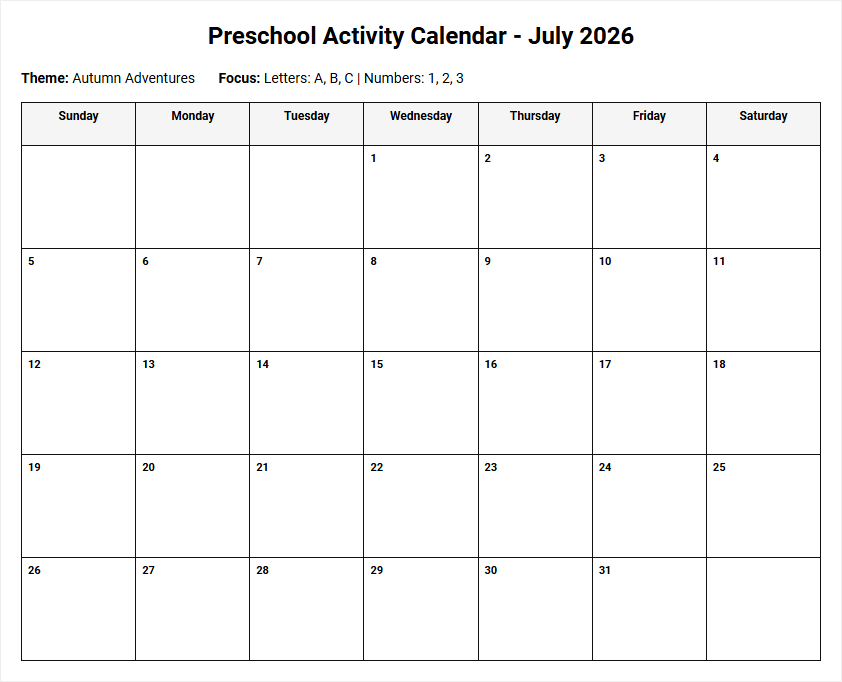
Preschool educators constantly struggle to maintain structured, age-appropriate engagement without burning out. While state education grants and PTA funds typically cover core curricula, daily supplemental planning remains an obstacle. Fortunately, printable activity calendars grant teachers the flexibility to integrate daily themes effortlessly. Although these tools stipulate active adult facilitation to succeed, proven resources like the "Sensory-Math Daily Tracker" showcase their immense value. Below, we outline the best printable layouts to streamline your classroom year.
Create Your Preschool Activity Calendar
Done customizing?
Preschool Activity Calendar - Good to Know
Sensory play schedule
Implementing a structured sensory play schedule stimulates cognitive development and aids sensory integration in early childhood. By dedicating specific blocks of time to sensory exploration, educators and parents can ensure children receive balanced tactile, vestibular, and proprioceptive input daily.
A well-rounded weekly plan balances different mediums to keep children engaged while preventing sensory overload:
- Monday (Tactile): Colored rice bins with hidden plastic dinosaurs and scoops.
- Tuesday (Water): Warm soapy water play with whisks, sponges, and squeeze bottles.
- Wednesday (Olfactory & Texture): Scented lavender playdough with natural rolling pins.
- Thursday (Visual & Auditory): Sound shaker bottles filled with metal bells, beads, and dry beans.
- Friday (Messy Play): Shaving cream marbling or cornstarch oobleck exploration.
Consistently scheduling these activities helps children self-regulate, improves their fine motor control, and encourages cooperative peer language development during collaborative play sessions.
Theme-based learning
Integrating theme-based learning into the preschool curriculum bridges disparate subjects like math, literacy, and science under one cohesive umbrella. When children explore a singular concept through multiple lenses, their conceptual understanding deepens, and memory retention increases significantly.
Consider a unit on "The Forest Ecosystem". Instead of teaching math in isolation, children count pinecones and categorize leaves by shape. For literacy, they read stories about woodland creatures, prompting vocabulary acquisition of words like hibernate, canopy, and forage. This holistic approach caters to diverse learning styles by offering auditory, visual, and kinesthetic pathways to the same core information.
Effective theme selection is driven by child interest and seasonal relevance. Rotating themes every two to three weeks maintains high engagement while providing ample time to thoroughly investigate, document, and celebrate learning achievements across all developmental domains.
Circle time routine
An intentional circle time routine fosters a sense of community, builds essential listening skills, and prepares young learners transitionally for the day's academic schedule. This structured group gathering serves as the social anchor of the preschool morning.
A highly effective 15-minute circle time sequence generally includes:
- Welcome Song: Acknowledging each child by name to promote belonging.
- Calendar & Weather: Tracking patterns, learning days of the week, and observing outdoor conditions.
- Interactive Story: Reading a book aligned with the current weekly theme, stopping to ask predictive questions.
- Movement Break: A brief fingerplay or stretching song to release physical energy.
To keep toddlers and preschoolers focused, educators should keep circle time highly interactive, utilizing visual props, physical movements, and vocal variations to maintain interest and manage classroom behavior naturally.
Fine motor activities
Developing fine motor strength is crucial for future writing, self-care tasks, and spatial reasoning. Fine motor activities target the intrinsic muscles of the fingers, hands, and wrists through precise, repetitive movements.
"The hands are the instruments of man's intelligence." - Maria Montessori
Educators can easily integrate these activities using common household items:
- Beading and Threading: Stringing dry penne pasta onto pipe cleaners.
- Squeeze and Pinch: Transferring pom-poms into ice cube trays using child-friendly tweezers.
- Tearing and Pasting: Rip scrap construction paper to create mosaic artwork, strengthening the pincer grasp.
Regular practice with scissors, clay, and buttoning boards refines hand-eye coordination. Providing diverse materials ensures children develop the stamina required for pencil grip and independent dressing.
Daily rhythm chart
A visual daily rhythm chart replaces rigid schedules with a predictable flow of events, reducing anxiety and promoting autonomy in young children. Unlike strict time-bound schedules, a rhythm chart relies on sequential milestones, allowing activities to expand or contract based on engagement levels.
Below is a typical balanced daily sequence designed for early childhood environments:
Arrival & Morning Greeting → Self-Selected Free Play → Circle Time → Outdoor Exploration → Shared Mealtime → Rest & Quiet Reading
Displaying this progression using simple illustrations alongside text helps non-readers understand what comes next. Children gain confidence when they can anticipate transitions, leading to smoother handovers and a more peaceful classroom atmosphere. Flexibility within this structured framework honors the natural energy levels of growing children.
Process art prompts
Unlike product-oriented crafts, process art focuses entirely on the creative journey and sensory exploration of materials. There is no right or wrong outcome, which eliminates performance anxiety and fosters authentic self-expression in young artists.
To facilitate process-oriented creativity, try offering these open-ended prompts:
- Paint with nature: Trade traditional brushes for evergreen branches, dandelions, and feathers.
- Gravity painting: Water down tempera paint, drip it onto cardstock, and tilt the paper to watch the colors run and mix.
- Textured collages: Provide cardboard bases with glue, burlap scraps, yarn, sand, and wood shavings.
By shifting the adult feedback from "What is it?" to "I notice you used long blue brushstrokes," we validate the child's efforts and encourage deep critical thinking and creative problem-solving skills.
Loose parts play
The concept of loose parts play revolves around providing children with open-ended materials that can be moved, combined, redesigned, lined up, and taken apart. These materials carry no specific set of instructions, sparking limitless imaginative play.
Common loose parts can be categorized into natural and manufactured objects:
- Natural Parts: River stones, acorns, seashells, pinecones, twigs, and seed pods.
- Manufactured Parts: Cardboard tubes, metal washers, wooden rings, glass gems, and corks.
When children manipulate these items, they naturally explore mathematical concepts like sorting, classifying, and patterning. They practice engineering skills as they construct towers and bridges, developing spatial awareness and hypothesis-testing through hands-on, self-directed exploration of physical materials.
STEM preschool ideas
Introducing STEM concepts in early childhood builds a foundation for scientific inquiry and critical thinking. Preschool STEM is not about complex equations; it is about nurturing natural curiosity through hands-on, playful experiments.
Simple yet highly effective classroom STEM invitations include:
- Ramp Explorations: Altering the height of wooden planks to see how it affects the speed of toy cars.
- Sink or Float: Hypothesizing whether various natural items will float in a tub of water, then testing the theories.
- Wind Tunnel: Using a box fan to test which classroom objects fly, hover, or drop instantly to the ground.
Using open-ended questions like "What do you think will happen if...?" encourages preschoolers to think like scientists, building confidence in their investigative and reasoning abilities.
Gross motor challenges
Developing large muscle groups is essential for physical health, balance, and spatial orientation. Gross motor challenges encourage active play, strengthening the core, arms, and legs while refining bilateral coordination.
To keep physical play exciting, set up structured challenges that require minimal equipment:
- Balance Beam Walk: Taping a straight painter's tape line on the carpet to practice heel-to-toe walking.
- Floor is Lava: Placing foam cushions spaced apart across the floor for safe jumping practice.
- Animal Walks: Encouraging children to crab walk, frog hop, or bear crawl across a designated space.
These exercises build core stability, which directly impacts a child's ability to sit attentively at a table. Active movement also releases endorphins, improving mood and focus throughout the rest of the school day.
Nature study prompts
A weekly nature study connects children to the rhythm of the seasons and fosters environmental stewardship. Stepping outside the classroom allows preschoolers to engage all their senses while making scientific observations of the living world.
Use these observational prompts during outdoor excursions:
- Micro-Hike: Lay a loop of yarn on the grass and ask children to observe everything inside it using magnifying glasses.
- Texture Scavenger Hunt: Search for objects that feel rough, smooth, bumpy, prickly, or wet.
- Sound Mapping: Sit silently for one minute, close your eyes, and point in the direction of every bird chirp, leaf rustle, or distant engine.
Documenting these findings in a collective outdoor journal with sketches and pressed leaves reinforces scientific recording methods, teaching kids that learning happens everywhere, not just indoors.
Leave a comment