
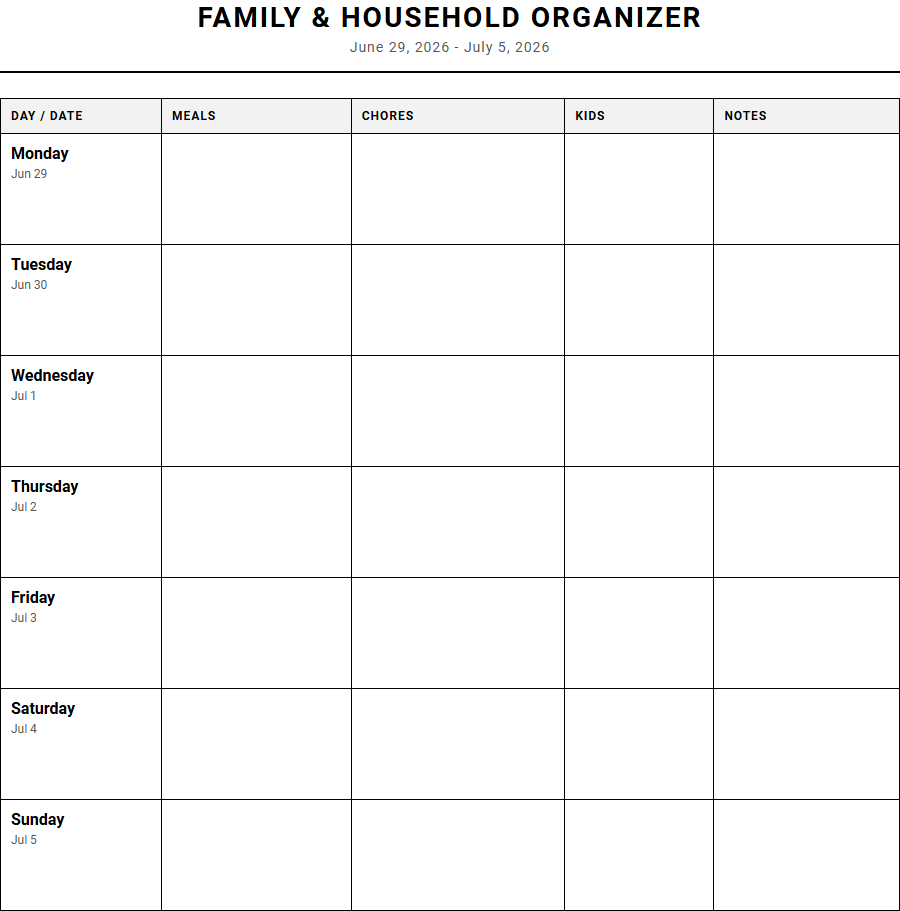
Managing a modern household often feels like coordinating chaos, leaving busy families overwhelmed. While standard digital calendars provide basic scheduling, they frequently lack centralized visibility. A dedicated printable weekly planner grants immediate spatial clarity and collective accountability, provided it is kept in a high-traffic area. Utilizing these layouts for meal tracking and chore rotation ensures seamless coordination. Below, we review the best printable organizers to streamline your family's routine.
Create Your Family and Household Weekly Organizer
Done customizing?
Family and Household Weekly Organizer - Good to Know
Family Command Center
A centralized Family Command Center serves as the physical anchor for household organization. Located in a high-traffic area like the kitchen or entryway, this dedicated hub consolidates vital information into one accessible location. By integrating various tools, family members can quickly align their daily expectations without digital distractions.
To build an effective command center, consider incorporating these essential elements:
- Magnetic Whiteboard: Perfect for quick daily updates, urgent reminders, and phone messages.
- Mail Sorters: Labeled bins for incoming letters, school permission slips, and bills to prevent paper clutter.
- Key Hooks and Charging Station: A designated drop zone for essentials, ensuring school bags and devices are ready for the morning rush.
By establishing this physical workspace, families foster a collaborative environment where responsibilities are transparent, reducing morning chaos and improving overall daily efficiency.
Chore Rotation Chart
Managing a household requires teamwork, and a structured Chore Rotation Chart ensures that daily maintenance is equitably distributed. Rather than relying on constant reminders, a visual chart clearly outlines who is responsible for specific tasks each week, eliminating ambiguity and resentment among family members.
An effective rotation system operates on three core principles:
- Age-Appropriate Assignments: Tasks must match each individual's developmental capability, ensuring safety and confidence.
- Consistent Rotation Cycles: Switching tasks weekly prevents chore fatigue and ensures everyone learns diverse life skills.
- Visual Accountability: Utilizing color-coded cards or magnet sliders provides satisfying visual confirmation of completed tasks.
Implementing this structured approach cultivates a strong sense of shared ownership and personal accountability, transforming daily cleaning tasks from individual burdens into cooperative achievements.
Meal Prep Planner
Dinnertime often introduces unnecessary stress into the evening routine. A systematic Meal Prep Planner alleviates this daily friction by streamlining grocery shopping, reducing food waste, and saving valuable time during busy weeknights. Mapping out meals in advance ensures nutritional balance and financial efficiency.
To successfully integrate a meal planning routine, follow this simple structured workflow:
- Inventory Check: Inspect the pantry, refrigerator, and freezer to utilize existing ingredients first.
- Theme Nights: Assign predictable themes, such as Taco Tuesday or Pasta Thursday, to simplify decision-making.
- Batch Prep: Chop vegetables and portion proteins during the weekend to accelerate weeknight cooking times.
By adopting this organized method, families can transform meal preparation from a chaotic, last-minute decision into a calm, predictable, and even enjoyable culinary routine.
Mental Load Checklist
The invisible labor of managing a household-ranging from scheduling doctor appointments to remembering shoe sizes-often falls disproportionately on one person. A comprehensive Mental Load Checklist externalizes these cognitive demands, making invisible responsibilities visible and manageable for all partners.
This checklist divides cognitive tasks into distinct, actionable categories:
- Seasonal Planning: Coordinating summer camps, purchasing school supplies, and organizing holiday travel schedules.
- Household Operations: Scheduling routine HVAC maintenance, renewing vehicle registrations, and tracking insurance policies.
- Social and Emotional Care: Purchasing birthday gifts, arranging playdates, and maintaining family traditions.
Documenting these tasks allows partners to divide cognitive responsibilities equitably, reducing stress, preventing burnout, and fostering mutual appreciation through transparent operational sharing.
Shared Family Calendar
With sports practices, music lessons, and professional commitments pulling everyone in different directions, a Shared Family Calendar is indispensable. Whether physical or digital, a single source of truth ensures that scheduling conflicts are identified and resolved before they disrupt daily life.
To maximize the utility of your shared calendar system, implement these strategies:
- Color-Coding: Assign a unique color to each family member to enable quick visual scanning of the weekly schedule.
- Real-Time Updates: Utilize mobile synchronization to ensure schedule changes are immediately visible to all active users.
- Travel Time Buffers: Explicitly block out transit times between events to prevent unrealistic back-to-back commitments.
Maintaining synchronization through a unified calendar prevents over-scheduling, ensures timely arrivals, and carves out crucial, undisturbed blocks of quality family time.
Habit Loop Tracker
Fostering positive personal habits in children and adults requires consistency and reinforcement. A Habit Loop Tracker leverages behavioral science by visualizing the three-step loop of cue, routine, and reward, helping family members establish healthy routines that stick long-term.
Building an effective tracking loop involves setting up these basic structures:
- The Cue: Establish a consistent trigger, such as placing a book on the pillow to prompt reading before sleep.
- The Routine: Track the execution of the desired habit daily using clean checkmarks or stars.
- The Reward: Celebrate milestones with non-material incentives, like a family game night or choosing the weekend movie.
Tracking progress visually helps internalize positive behaviors, transforming daily chores and hygiene practices into automatic, self-directed routines over time.
Family Meeting Agenda
Open communication is the cornerstone of a harmonious home. A structured Family Meeting Agenda prevents these gatherings from devolving into chaotic grievance sessions, transforming them instead into productive, collaborative forums where every voice is heard and valued.
Keep your weekly family meetings focused, positive, and productive by utilizing this outline:
- Appreciations and Highlights: Begin by sharing compliments and recognizing achievements from the past week.
- Calendar and Logistics: Review the upcoming week's schedule, transport needs, and potential conflicts.
- Problem Solving: Address household issues collectively, encouraging kids to suggest creative compromises.
Regularly holding these meetings fosters emotional intelligence, teaches conflict resolution skills, and reinforces the core values of cooperation and mutual respect within the household.
Zone Cleaning Schedule
Deep cleaning an entire house can feel overwhelming, often leading to procrastination or exhausting marathon cleaning weekends. A Zone Cleaning Schedule breaks the home down into manageable physical sectors, distributing deep-cleaning tasks systematically throughout the entire month.
Consider dividing your home into these standard rotational zones:
- Zone 1: Entryway and Living Spaces: Dusting, vacuuming upholstery, and cleaning glass surfaces.
- Zone 2: Kitchen and Pantry: Wiping down appliance interiors, sanitizing countertops, and purging expired food items.
- Zone 3: Bathrooms and Laundry Room: Deep scrubbing tile surfaces, washing bath mats, and sanitizing washing machines.
By focusing cleaning efforts on just one specific zone per week, the home remains consistently pristine without requiring exhausting, all-day cleaning sessions over the weekend.
Kids Responsibility Board
Encouraging self-reliance in children requires clear boundaries and tangible markers of progress. A customized Kids Responsibility Board empowers children by visualising their daily expectations, shifting the parental role from nagging manager to encouraging supportive coach.
Design a highly functional responsibility board with these key attributes:
- Interactive Elements: Use slide-to-complete tabs or velcro stars that children can manipulate themselves.
- Clear Separation: Differentiate clearly between personal hygiene duties and cooperative household contributions.
- Visual Prompts: Use simple icons or photos for younger children who are still developing reading skills.
This visual system builds childhood independence, boosts self-esteem upon task completion, and establishes healthy daily patterns of personal care and household participation.
Co-parenting Schedule
Navigating dual-household family dynamics requires exceptional clarity and organization. A structured Co-parenting Schedule minimizes uncertainty for both parents and children, establishing a predictable routine that fosters security, reduces transitions stress, and keeps everyone aligned.
A successful schedule prioritizes transparency and stability through these guidelines:
- Transition Protocols: Clearly define drop-off times, pick-up locations, and responsibilities for transporting school gear.
- Shared Document Storage: Keep medical records, school report cards, and emergency contact lists in a shared digital folder.
- Consistent Household Rules: Align basic expectations regarding screen time, bedtime, and homework to maintain continuity.
Creating a highly detailed, accessible co-parenting agreement reduces potential friction, ensures clear boundaries, and provides children with the vital stability they need to thrive across both homes.
Leave a comment