
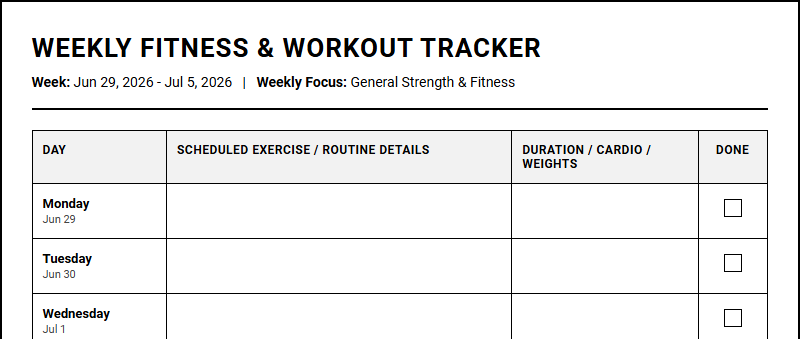
Staying consistent with fitness goals is a notorious struggle, often leading to abandoned routines. While costly gym memberships and complex tracking apps offer data, they frequently lack a clear, daily roadmap. A structured Weekly Planners printable calendar grants immediate visual accountability, bridging this organizational gap. To succeed, however, users must commit to realistic daily logging. Tracking specific metrics, like progressive overload weights or cardio durations, turns effort into tangible progress. Below, we explore how to optimize this printable tracker for your routine.
Create Your Fitness and Workout Weekly Tracker
Done customizing?
Fitness and Workout Weekly Tracker - Good to Know
Progressive overload
Progressive overload is the foundational cornerstone of athletic development and muscular hypertrophy. To force an adaptive response from musculoskeletal tissues, you must subject them to a stimulus that exceeds their current capacity. This does not merely imply lifting heavier weights; instead, athletes can manipulate various training variables to achieve tension. For instance, you might increase the total number of repetitions, perform additional sets, or decrease the rest intervals between sets to heighten metabolic stress.
Implementing this principle systematically ensures continuous physiological adaptations while preventing training plateaus. Consider the following methods to safely introduce this concept into your current routine:
- Mechanical Tension: Gradually increasing the load on the barbell while maintaining strict, biomechanically sound form.
- Metabolic Stress: Extending the time under tension or utilizing drop-sets to pool blood in the target muscle groups.
- Volume Accumulation: Raising the total work completed per week through additional target exercises.
Rate of Perceived Exertion
The Rate of Perceived Exertion (RPE) scale is an invaluable subjective measurement tool used to gauge the intensity of physical activity. Primarily based on a 1-to-10 scale, RPE allows athletes to practice auto-regulation, adjusting daily training loads based on current physiological readiness rather than rigidly adhering to predetermined percentages. A rating of 10 represents a maximal effort where no further repetitions are possible, whereas an RPE of 8 indicates that the athlete could have completed exactly two more repetitions before failure.
By shifting focus to how a weight feels, lifters can protect themselves from overtraining and injury during high-stress periods. To apply this effectively, familiarize yourself with the standard RPE designations:
- RPE 10: Maximal effort; absolutely zero repetitions left in the tank.
- RPE 9: Extremely heavy; only one repetition could have been completed.
- RPE 8: Moderately heavy; precisely two repetitions remain possible.
- RPE 7: Solid working weight; three repetitions left, ideal for speed and power.
Training split
A training split refers to the organizational design of a weekly workout routine, dividing targeted muscle groups or movement patterns across specific days. Choosing an optimal split requires balancing individual recovery capabilities, lifestyle constraints, and personal fitness objectives. Without a structured split, lifters risk overworking specific muscle groups while neglecting others, leading to structural imbalances and potential overuse injuries over time.
Depending on your weekly availability, several standard configurations can optimize your training frequency:
- Push-Pull-Legs (PPL): Groups movements by function, separating upper body pushing, upper body pulling, and lower body exercises.
- Upper-Lower Split: Alternates days between the upper torso and the lower body, allowing for high frequency and balance.
- Full Body Split: Targets every major muscle group in a single session, ideal for beginners or those with limited weekly schedules.
Deload week
A deload week is a planned, temporary reduction in training volume and intensity designed to facilitate systemic recovery. High-intensity resistance training places immense stress not only on skeletal muscles but also on the central nervous system, connective tissues, and endocrine system. Continually pushing without structured rest eventually yields diminishing returns, characterized by chronic fatigue, stagnant strength gains, and persistent joint pain.
During a typical deload phase, you should decrease your overall working volume by 30% to 50% while reducing working weights to approximately 60% of your normal intensity. This strategic retreat allows micro-tears in the muscles to fully heal, restores glycogen stores, and rejuvenates mental focus. Consequently, you return to the gym the following week stronger, highly motivated, and fully prepared to tackle heavier loads with renewed vigor.
Active recovery
Active recovery involves performing low-intensity, non-strenuous physical activity on scheduled rest days to accelerate the healing process. Unlike passive recovery, which entails complete physical inactivity, gentle movement stimulates blood flow to fatigued tissues without causing additional muscular damage. This increased circulation delivers essential oxygen and nutrients to damaged fibers while assisting in the clearance of metabolic byproducts accumulated during intense training sessions.
The key to successful active recovery is keeping the heart rate within a light, aerobic zone. Effective modalities include the following options:
- Low-Impact Walking: A gentle 30-minute outdoor stroll that mobilizes joints and relaxes the mind.
- Mobility and Yoga: Dynamic stretching routines that restore optimal range of motion and reduce muscle tightness.
- Leisurely Swimming: Hydrostatic pressure from water supports the joints while facilitating full-body movement.
Body recomposition
Body recomposition is the challenging process of simultaneously losing adipose tissue while building skeletal muscle mass. Historically, fitness paradigms suggested that individuals must alternate between dedicated bulking and cutting phases; however, science demonstrates that recomposition is highly achievable under the right conditions. This process requires a precise combination of resistance training, structured nutrition, and adequate sleep to shift the body's metabolic priorities toward utilizing stored fat for energy while synthesizing new protein.
To optimize body recomposition, one should aim for a minor caloric deficit or maintain energy balance near maintenance levels. Protein intake must remain consistently high-typically around 1.6 to 2.2 grams per kilogram of body weight-to support muscle protein synthesis. Progressive resistance training serves as the vital stimulus that signals the body to preserve lean mass despite energy restriction.
Macro tracking
Macro tracking involves monitoring the daily intake of the three primary macronutrients: proteins, carbohydrates, and fats. While monitoring total caloric intake is vital for weight management, tracking macronutrients ensures that those calories actively support optimal performance, recovery, and body composition. Each macronutrient plays a distinct physiological role, and altering their ratios can dramatically impact energy levels and physique outcomes.
Understanding the caloric value and functional purpose of each macro is essential for dietary success:
- Protein: Yields 4 calories per gram; essential for muscle repair, cellular synthesis, and maintaining satiety.
- Carbohydrates: Yields 4 calories per gram; serves as the primary and most efficient energy source for high-intensity training.
- Fats: Yields 9 calories per gram; crucial for hormone regulation, brain function, and the absorption of fat-soluble vitamins.
Non-exercise activity thermogenesis
Non-exercise activity thermogenesis, commonly abbreviated as NEAT, represents the energy expended during daily spontaneous activities that are not structured exercise. This includes everything from walking to work, typing, cleaning, gardening, and even simple fidgeting. NEAT is a highly variable component of total daily energy expenditure (TDEE) and can account for a difference of up to several hundred calories burned each day between active and sedentary individuals.
When individuals enter a caloric deficit, their bodies often unconsciously decrease NEAT to conserve energy, resulting in weight loss plateaus. Consciously maintaining high NEAT levels-such as utilizing a standing desk, taking regular movement breaks, or tracking daily steps-is a powerful strategy to sustain a healthy metabolism. Prioritizing these unstructured movements ensures consistent energy expenditure without adding unnecessary physical stress to the body.
Volume load
Volume load is a quantitative metric used to measure the total work performed during a training session or over a training cycle. It is calculated using the following mathematical formula: Volume Load = Sets × Repetitions × Weight. By tracking this metric, athletes and coaches can accurately monitor the progression of physical stress over time, ensuring that the body is systematically exposed to greater demands to drive adaptation.
Relying solely on intensity or repetition ranges can provide an incomplete picture of a workout program. By calculating volume load, you can ensure that changes to your program are progressive and structured. For example:
- Session A: 3 sets of 10 reps at 100 lbs yields a volume load of 3,000 lbs.
- Session B: 4 sets of 8 reps at 100 lbs yields a volume load of 3,200 lbs, indicating progression.
Habit stacking
Habit stacking is an elegant behavioral psychology strategy designed to build new, healthy routines by anchoring them to established daily patterns. Coined by habits expert James Clear, this method utilizes the neural pathways already hardwired into your brain from existing behaviors to make new actions easier to adopt. Instead of trying to manifest motivation out of thin air, you simply insert a new desired habit immediately before or after a behavior you already perform without thinking.
This formulation operates on a simple, predictable structure: "After [Current Habit], I will [New Habit]." For fitness enthusiasts, this could look like stretching for five minutes immediately after brewing morning coffee, or preparing a gym bag right after brushing teeth at night. Over time, these stacked behaviors fuse together, creating seamless, low-friction routines that support long-term athletic success.
Leave a comment