
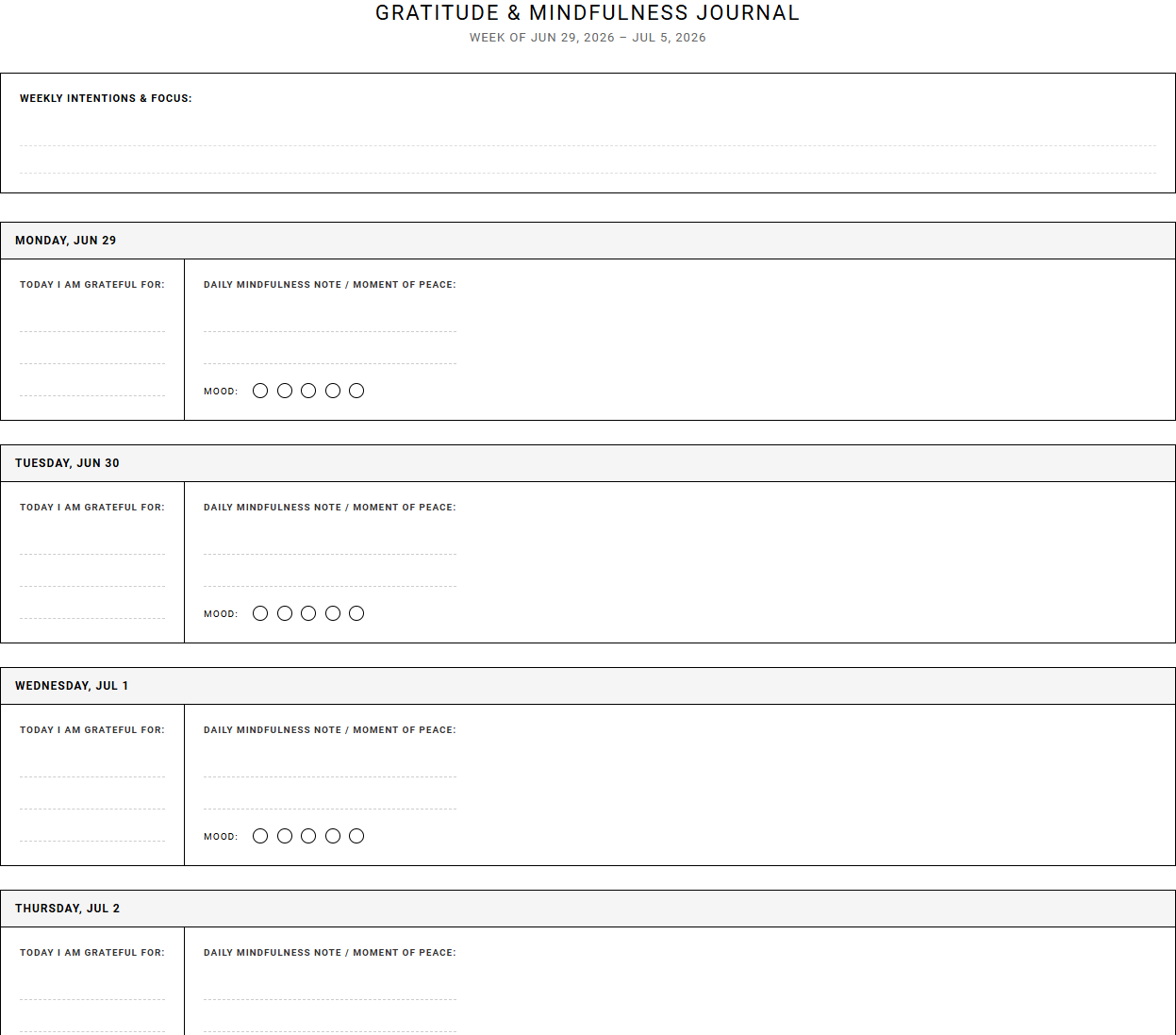
Maintaining a meaningful daily reflection practice is challenging amidst demanding schedules. While digital journaling apps offer convenience, they often introduce screen distractions. A printable weekly planner calendar grants a dedicated, tactile space that fosters psychological grounding, provided individuals commit to consistent, three-minute daily entries. Utilizing structured frameworks, such as the Weekly Intention Tracker, yields measurable mental clarity. Below, we examine the optimal layouts and daily prompts to maximize your mindfulness journey.
Create Your Gratitude and Mindfulness Weekly Journal
Done customizing?
Gratitude and Mindfulness Weekly Journal - Good to Know
Intentional living
Intentional living is the conscious practice of aligning your daily actions with your core values and long-term beliefs. Instead of navigating life on autopilot, you actively choose where to direct your energy, time, and attention. This mindful approach transforms routine habits into meaningful rituals, helping you cultivate a deeply satisfying lifestyle. By defining what truly matters, you can eliminate external clutter, reduce societal pressures, and focus on personal fulfillment.
To begin cultivating an intentional lifestyle, consider these foundational pillars:
- Clarity of Values: Identifying what brings genuine joy and purpose to your existence.
- Conscious Consumption: Being selective about the media, products, and relationships you allow into your space.
- Purposeful Action: Ensuring that your daily schedule reflects your long-term personal growth goals.
Embracing this philosophy allows you to build a life designed by choice, rather than one shaped by sheer accident or external expectations.
Micro-gratitude practice
While traditional gratitude encourages appreciation for major milestones, micro-gratitude invites you to find profound joy in the smallest, most fleeting moments of the day. This practice trains your brain to scan your environment for tiny glimmers of beauty and comfort, shifting your perspective from scarcity to abundance. By focusing on the micro-level, you build resilience against daily stressors and foster a sustained sense of quiet contentment.
Try identifying three micro-moments today, such as:
- The comforting warmth of your morning coffee mug resting against your palms.
- The soft, rhythmic sound of rain tapping against a nearby window pane.
- A unexpected smile or polite nod from a stranger passing by on the street.
Documenting these subtle instances prevents them from slipping away unnoticed. Over time, these brief moments of recognition accumulate, forming a sturdy foundation of mental well-being and emotional balance.
Somatic mindfulness journaling
Somatic mindfulness journaling bridges the gap between cognitive thoughts and physical sensations. Often, our bodies register emotional stress long before our logical minds process it. By checking in with your physical form and translating those somatic signals into written words, you unlock a deeper layer of self-awareness. This practice helps release stored tension and promotes healing by validating your body's unique emotional vocabulary.
"The body remembers what the mind tries to forget. Listen to its whispers before they turn into screams."
When you sit down to write, scan your body from head to toe. Notice areas of tightness, warmth, emptiness, or ease. Describe these physical sensations using descriptive, non-judgmental language. By giving your physical experiences a voice, you facilitate a holistic release, allowing emotional blockages to gently dissolve through the simple act of written expression.
Habit and mood tracker
A habit and mood tracker serves as an objective mirror, reflecting the direct relationship between your daily routines and your emotional landscape. By documenting your behaviors alongside your fluctuating moods, you gather valuable, personalized data. This visual tool helps you identify patterns, recognize hidden triggers, and celebrate the small victories of consistency that might otherwise go unnoticed during a busy week.
To maximize the efficacy of your tracker, focus on key indicators:
- Physical Inputs: Tracking sleep duration, hydration levels, and daily physical movement.
- Daily Routines: Monitoring screen time, outdoor exposure, and creative outlets.
- Emotional Outputs: Rating your baseline mood, anxiety levels, and overall energy from morning to evening.
Analyzing this data empowers you to make proactive adjustments, ensuring your habits actively support your mental health and cognitive vitality.
Self-care weekly reflection
A self-care weekly reflection is a dedicated pause in your busy schedule, designed to evaluate how well you nurtured your mind, body, and spirit over the past seven days. Rather than treating self-care as a superficial checklist, this reflective practice encourages you to assess your energetic boundaries and emotional reserves. It provides a structured opportunity to celebrate your self-compassion while identifying areas that require extra gentleness in the upcoming week.
Consider these reflective inquiries during your weekend wind-down:
- Which activities left me feeling genuinely restored, and which ones drained my battery?
- Did I honor my personal boundaries, or did I overcommit to satisfy others?
- How can I adjust my schedule next week to invite more peace and spaciousness?
This consistent feedback loop ensures that your wellness practices remain dynamic, adaptive, and deeply aligned with your evolving personal needs.
Shadow work prompts
Shadow work involves exploring the hidden, repressed, or unacknowledged parts of your psyche. Rooted in Jungian psychology, this profound self-exploration helps you integrate your "shadow" self-the traits you might hide, deny, or project onto others. By confronting these aspects with radical honesty and deep self-compassion, you heal old wounds, break self-sabotaging patterns, and cultivate an authentic sense of wholeness.
Begin your journey of inner exploration using these gentle prompts:
- Triggers: What personality traits in others irritate me the most, and what does that reveal about my own suppressed traits?
- Childhood: What emotional needs did I feel forced to hide as a child to keep the peace or receive love?
- Fear: What is a truth about myself that I am currently afraid to admit out loud, and why does it frighten me?
Approaching these prompts without judgment fosters profound self-acceptance and emotional liberation.
Digital wellness planner
In our hyper-connected world, a digital wellness planner is essential for maintaining mental clarity and preventing cognitive fatigue. Constant notifications, mindless scrolling, and information overload can disrupt your nervous system and diminish your focus. By intentionally scheduling digital boundaries, you reclaim control over your attention span, allowing your mind to rest, wander, and engage deeply with the physical world around you.
Create a balanced digital ecosystem by implementing these structured boundaries:
- Tech-Free Zones: Keeping screens entirely out of the bedroom and dining areas to protect sleep and connection.
- Digital Detox blocks: Dedicating specific weekend hours to offline hobbies, nature immersion, or reading.
- Notification Audit: Disabling non-essential alerts to minimize constant psychological interruptions.
Prioritizing digital wellness cultivates a calmer mind, improves attention span, and fosters deeper real-world relationships.
Emotional regulation exercises
Emotional regulation is the ability to monitor, manage, and adapt your emotional states to match your environment and goals. When stress triggers a fight-or-flight response, practicing targeted regulation exercises can soothe your nervous system and restore cognitive balance. These somatic and cognitive tools empower you to pause before reacting, transforming impulsive impulses into thoughtful, measured responses.
Incorporate these quick, highly effective exercises into your daily routine:
- Box Breathing: Inhale for four seconds, hold for four, exhale for four, and hold empty for four.
- 5-4-3-2-1 Grounding: Identify five things you see, four you feel, three you hear, two you smell, and one you taste.
- Physiological Sigh: Take two quick inhales through the nose, followed by one long, slow sigh out through the mouth.
These simple physiological interventions act as an immediate circuit breaker for acute stress and anxiety.
Aesthetic goal setting
Aesthetic goal setting elevates traditional goal-setting methods by infusing them with sensory details, visual inspiration, and emotional resonance. Rather than focusing solely on dry, quantitative targets, this method encourages you to visualize how your achievements will look, feel, smell, and sound. By romanticizing your personal growth journey, you build a deeper emotional connection to your aspirations, which sustains motivation and sparks creativity.
To design an aesthetic blueprint for your future self, explore these dimensions:
- Visual Identity: Curating a cohesive color palette, vision board, or clean environment that embodies your goals.
- Sensory Details: Describing the cozy ambient lighting, calming music, or fresh scents that accompany your ideal routine.
- Embodied Feelings: Imagining the physical sensation of ease, confidence, and peace once your goals are realized.
This artistic approach transforms self-improvement into a beautiful, inspiring lifestyle edit that you actively look forward to living.
Brain dump page
A brain dump page is a simple yet incredibly powerful cognitive offloading tool designed to declutter a crowded, overwhelmed mind. When mental to-do lists, anxieties, and random ideas compete for space, your cognitive load increases, leading to mental fatigue and procrastination. By externalizing everything bouncing around your head onto paper, you free up vital mental bandwidth, allowing you to organize, prioritize, and breathe easier.
To perform an effective brain dump, write without filter using these categories:
- Immediate Tasks: Pressing errands, emails, and chores that require quick action.
- Anxieties & Worries: Lingering thoughts, stressors, or nagging feelings that are draining your emotional energy.
- Creative Ideas: Half-baked projects, sudden inspirations, or exciting future plans to explore later.
Once your mind is fully cleared, you can systematically sort through the mess, transforming chaotic thoughts into an organized, actionable plan.
Leave a comment