
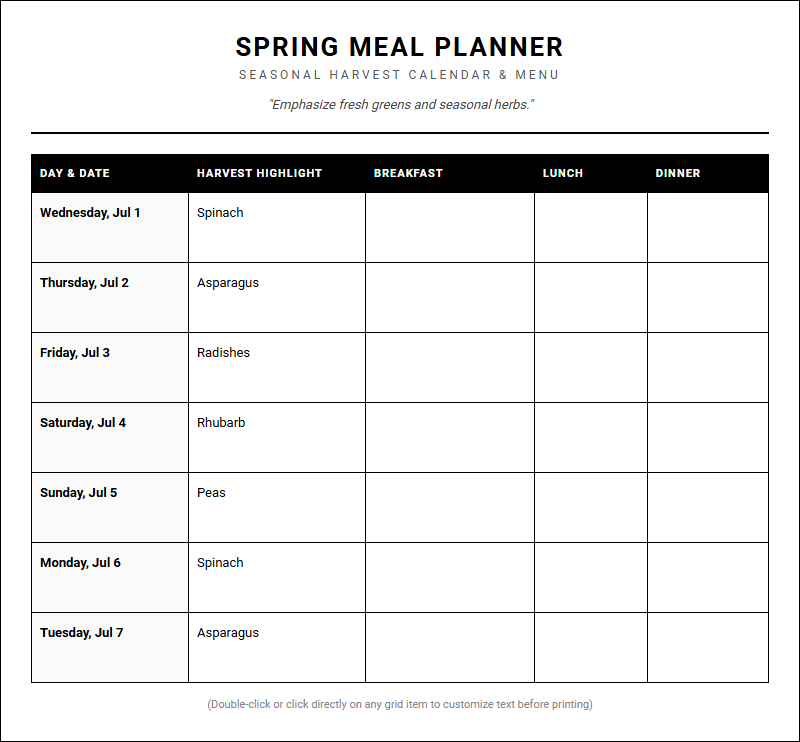
Managing family dinner schedules while incorporating fresh produce often feels overwhelming and wasteful. While households typically rely on standard grocery budgeting sources to manage food costs, these static tools overlook seasonal fluctuations.
Our printable Seasonal Meal Planner and Harvest Calendar grants busy families a streamlined blueprint that simplifies prep. Please note, successful implementation stipulates active tracking of local crop availability. For instance, aligning autumn squash purchases with regional peak harvests optimizes both nutrition and budget. Below, we explore how this resource systematically transforms your kitchen routine.
Create Your Seasonal Meal Planner and Harvest Calendar
Done customizing?
Seasonal Meal Planner and Harvest Calendar - Good to Know
Farm-to-table meal prep
Embracing a farm-to-table meal prep routine elevates your kitchen from a simple cooking space to an active extension of the local agricultural ecosystem. By sourcing ingredients directly from nearby growers, you bypass the lengthy transportation loops that deplete both flavor and nutrients. This methodology requires a shift in how we plan meals; instead of starting with a static recipe, you design your menu around the freshest items pulled from the soil each week.
To successfully integrate this practice into your busy lifestyle, consider these foundational steps:
- Assess your local yield: Visit farmers' markets mid-week to identify peak crops.
- Prep with intent: Wash, dry, and store delicate greens immediately to extend their shelf life.
- Build adaptable bases: Cook versatile grains and roast hardy root vegetables that pair easily with shifting seasonal proteins.
Prioritizing direct-from-farm ingredients fosters a deep culinary connection to your region, ensuring every plate serves optimal flavor and vitality.
Micro-season eating
While traditional seasonal eating divides the year into four broad blocks, micro-season eating recognizes that nature shifts in much subtler, weekly increments. Drawing inspiration from ancient calendars that identify dozens of distinct ecological micro-seasons, this culinary practice focuses on capturing ingredients at their absolute zenith-a window that often lasts only a few days.
During these brief transitions, specific plants exhibit extraordinary characteristics. For instance, the fleeting appearance of wild ramps in early spring or the brief, ultra-sweet window of late-summer figs demand immediate attention. To fully appreciate these nuances, cooks must adopt a highly flexible kitchen mindset:
- Observe the subtle changes in your immediate environment and local farm stalls.
- Simplify your preparations to allow the natural, fleeting flavors of the ingredient to shine.
- Document these brief culinary moments to anticipate their return in the coming year.
Aligning your palate with these rapid ecological pulses transforms ordinary dining into an exquisite celebration of the present moment.
CSA share optimization
Receiving a Community Supported Agriculture (CSA) box is an exciting culinary adventure, yet it can quickly become overwhelming without strategic planning. Optimizing your CSA share requires a systematic approach to inventory management and preservation. The goal is to eliminate waste while celebrating the diverse, sometimes unusual produce selected by your local farmer.
"The secret to mastering your weekly CSA delivery lies in triaging your vegetables by their perishability index."
As soon as your box arrives, categorize your haul into immediate-use items, such as tender spinach and heirloom berries, and long-storage champions, like winter squash and storage onions. Utilize the stems, leaves, and bruised portions for immediate pestos, stocks, or ferments. By establishing a structured rotation system, you ensure that every leafy green, root, and nightshade is utilized at its nutritional peak, maximizing both your financial investment and your regional culinary experience.
Hyper-local food calendar
A hyper-local food calendar is an indispensable tool for the conscientious home cook. Unlike generic national produce charts, a localized calendar maps the exact harvest windows within your specific zip code or microclimate. This specialized knowledge allows you to anticipate the precise arrival of regional delicacies, from the first crisp heirloom apples of autumn to the tender asparagus spears of early spring.
Creating this custom map involves tracking regional frost dates, attending community agricultural events, and talking directly with local growers. When you synchronize your pantry with a hyper-local timeline, you reduce your reliance on long-distance imports and enjoy produce that has traveled mere miles from soil to plate. This intentional alignment minimizes your environmental footprint while delivering unparalleled freshness, texture, and taste to every single dish you prepare.
Root-to-stem cooking
The philosophy of root-to-stem cooking is a culinary art form that challenges the modern habit of discarding valuable plant parts. By utilizing the entire vegetable-from the vibrant green tops of carrots to the fibrous outer skins of onions-you unlock unique textures, deep flavors, and concentrated nutrients that are typically tossed into the compost bin.
Integrating this sustainable approach into your kitchen requires curiosity and a few simple techniques:
- Herb stems: Mince cilantro and parsley stems finely to add intense flavor bases to curries and stir-fries.
- Peels and ends: Collect clean vegetable scraps in the freezer to simmer into rich, aromatic savory broths.
- Leafy tops: Transform radish and turnip greens into peppery pestos or quick, garlic-infused sautés.
Expanding your culinary boundaries to include these overlooked elements yields innovative dishes while honoring the complete life cycle of the plant.
Forager harvest schedule
Integrating wild edibles into your seasonal menu requires a disciplined forager harvest schedule. Nature's pantry operates outside the bounds of commercial farming, offering brief, unscheduled windows of abundance that require keen observation and deep ecological respect. From early spring dandelions and morels to autumn acorns and wild blackberries, foraging connects you directly to the untamed landscape.
Safety and ethics are paramount when maintaining a foraging calendar. It is crucial to harvest only what you can positively identify and to leave behind enough of the plant population to ensure future regeneration. Keeping a detailed field journal allows you to note soil moisture, temperature fluctuations, and canopy changes, helping you predict exactly when wild delicacies will emerge. Incorporating these resilient, nutrient-dense wild foods adds unmatched complexity, terroir, and historical depth to your contemporary home-cooked meals.
Biodynamic kitchen calendar
A biodynamic kitchen calendar goes beyond conventional scheduling by aligning food preparation, preservation, and consumption with cosmological and lunar rhythms. Rooted in holistic agricultural principles, this method suggests that different days are optimized for specific plant parts-roots, leaves, flowers, or fruits-and certain culinary actions, such as fermenting, baking, or storing root crops.
For example, "leaf days" are considered ideal for harvesting and consuming fresh salads, while "root days" enhance the earthy flavors of carrots and beets. Implementing this system in your kitchen encourages a mindful, rhythmic approach to daily nourishment. Whether you are timing the start of a wild sourdough culture or seal-canning summer tomatoes, consulting these celestial patterns fosters a deeper, meditative connection to the natural forces that govern plant growth and organic decomposition.
Zero-waste seasonal prep
Achieving a zero-waste kitchen is entirely possible when you pair modern preservation techniques with the natural flow of the seasons. Zero-waste seasonal prep focuses on intercepting food waste before it begins, transforming potential organic waste into shelf-stable culinary assets. When seasonal abundance peaks, your prep space should hum with activities designed to capture every ounce of biological energy.
Implementing a successful zero-waste protocol involves a three-tier kitchen strategy:
- Dehydrate: Turn excess herbs and tomato skins into vibrant seasoning powders.
- Ferment: Submerge surplus cabbage, carrots, and radishes in simple brines for probiotic-rich condiments.
- Infuse: Submerge citrus peels and herb woody stems in vinegar or quality oils for custom dressings.
By viewing every scrap as an ingredient in waiting, you build a resilient, circular kitchen ecosystem that respects both your budget and the planet.
Preservation and canning rotation
An organized preservation and canning rotation ensures that the vibrant bounty of summer and autumn sustains you through the lean winter months. This practice requires a structured inventory system, tracking batch dates, flavor profiles, and acidity levels to guarantee safety and optimal taste. Without a proper rotation plan, beautiful jars of pickled ramp bulbs or heirloom tomato jam can easily sit forgotten at the back of the pantry.
Establish a clear "first-in, first-out" protocol in your larder. Label every jar with the exact harvest date, ingredients, and preservation method used. Plan your winter menus to actively incorporate these preserved elements, pairing bright pickled red onions with hearty winter stews, or using sweet fruit preserves to glaze roasted root vegetables. This continuous cycle of preserving and consuming ensures your pantry remains a dynamic, living archive of the year's harvests.
Phenological food tracking
Phenological food tracking is the practice of observing seasonal biological signs to guide your kitchen decisions rather than relying on a calendar date. By watching for specific natural milestones-such as the blooming of local lilacs, the arrival of migratory birds, or the falling of oak leaves-you can precisely gauge the progress of local crop developments and wild harvests.
This ancient, observation-based approach allows cooks to adapt seamlessly to changing climate patterns and erratic weather cycles. For instance, a warm late-winter might trigger early sap flows for maple syrup, a shift easily caught by an observant phenological tracker. By tuning your kitchen calendar to the physical signs of the Earth, you develop an intuitive, highly responsive relationship with your food supply, ensuring you harvest, cook, and preserve at the absolute peak of ecological perfection.
Leave a comment