
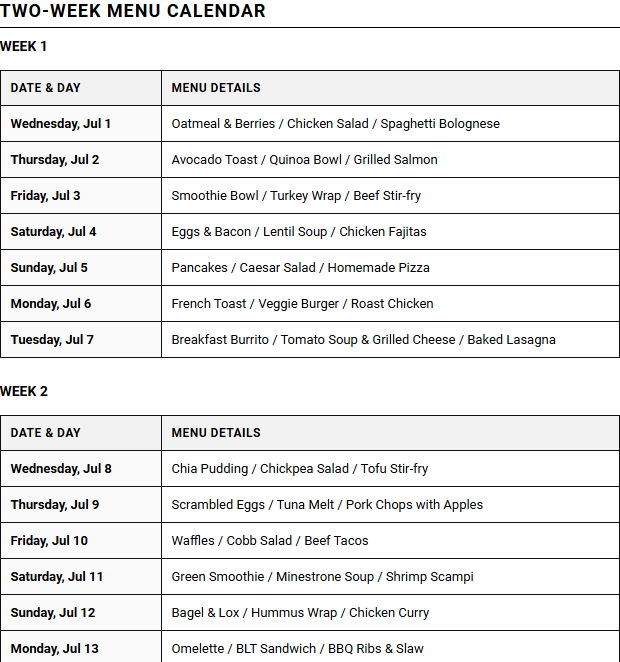
Managing daily dinner decisions often leads to chronic family decision fatigue. While digital grocery apps and standard weekly templates offer basic scheduling, they fail to prevent repetitive planning stress. A structured Two-Week Rotating Menu Calendar grants families long-term predictability and culinary variety. Successfully implementing this system requires a brief, one-time setup of family favorites-such as alternating Taco Tuesdays and pasta nights-to manage expectations. Below, we outline how to leverage this printable framework to streamline your kitchen routine.
Create Your Two-Week Rotating Menu Calendar
Done customizing?
Two-Week Rotating Menu Calendar - Good to Know
Biweekly meal planner
An efficient biweekly meal planner bridges the gap between daily decision fatigue and monthly planning overwhelm. By mapping out exactly fourteen days of breakfasts, lunches, dinners, and snacks, you can streamline your grocery shopping and significantly reduce food waste. This method allows households to purchase bulk ingredients confidently, knowing every item has an assigned purpose over the next fortnight.
To implement this system successfully, consider structuring your two-week horizon with the following steps:
- Inventory check: Audit your fridge, freezer, and pantry before writing the plan.
- Recipe selection: Choose a mix of quick weeknight dinners and more elaborate weekend meals.
- Batch mapping: Align days of high activity with pre-made freezer meals.
By organizing your nutrition in two-week blocks, you secure a predictable rhythm that saves both money and mental energy, ensuring diverse and healthy eating habits for the entire household.
Rotational menu cycle
A rotational menu cycle is a structured system where a specific set of meals repeats over a predetermined timeframe. This approach is highly favored by professional kitchens and meal preppers alike because it standardizes grocery lists and cooking techniques. Instead of inventing new recipes weekly, you rotate through a curated gallery of family favorites that guarantee nutritional balance and culinary satisfaction.
When constructing your rotational loop, it is helpful to categorize your dishes by protein source or preparation style. For example, a standard cycle might look like this:
- Week 1, Day 1: Roasted chicken and root vegetables.
- Week 1, Day 2: Vegetarian lentil dahl with basmati rice.
- Week 2, Day 1: Pan-seared salmon with quinoa and asparagus.
- Week 2, Day 2: Slow-cooker beef stew with crusty bread.
This systematic rotation keeps your dining experience fresh without requiring constant creative brainstorming.
Fortnightly meal prep
Executing a fortnightly meal prep strategy means dedicating one or two afternoons a month to intensive ingredient preparation. Instead of cooking from scratch every single night, you chop, marinate, portion, and pre-cook essential components for the upcoming fourteen days. This method maximizes kitchen efficiency, as you only clean food processors, cutting boards, and heavy pots once rather than daily.
"By investing three hours on a Sunday, you buy back hours of free time during the hectic workweek."
Successful fortnightly preparation relies heavily on proper storage solutions. Utilizing airtight glass containers, vacuum-sealed bags, and a well-organized freezer ensures that ingredients prepared on day one taste just as fresh when consumed on day twelve. This proactive approach eliminates the temptation of ordering last-minute takeout when energy levels run low.
Cyclical menu planning
At its core, cyclical menu planning is the practice of designing a repeating schedule of meals that aligns with seasonal availability, budgetary constraints, and lifestyle demands. This method is highly sustainable because it respects the natural ebb and flow of the seasons. In the winter, your cycle may lean heavily on comforting stews and roasted meats, while the summer cycle shifts toward crisp salads and grilled proteins.
Implementing a cyclical framework offers several distinct advantages for modern households:
- Financial predictability: Grocery costs become highly stable and easy to forecast.
- Skill mastery: Cooking the same dishes periodically refines your culinary techniques.
- Minimized waste: Leftover ingredients from one meal are easily integrated into the next scheduled dish.
Adopting this framework allows you to cultivate a harmonious relationship with your kitchen, making wholesome eating an effortless, automated habit.
Two-week menu rotation
The two-week menu rotation strikes the perfect balance between variety and simplicity. A seven-day rotation can quickly feel repetitive, whereas a monthly schedule can be daunting to coordinate. A fourteen-day window provides enough variety to prevent palate fatigue while remaining incredibly manageable to organize, shop for, and execute.
- The First Week
- Focuses on fresh, highly perishable ingredients like leafy greens, berries, and fresh seafood.
- The Second Week
- Utilizes hearty vegetables, frozen proteins, and pantry staples like grains, beans, and canned goods.
By splitting your rotation this way, you naturally optimize your ingredient shelf life. You enjoy fresh, vibrant produce early in the cycle, then seamlessly transition to nourishing, shelf-stable meals later on without needing extra trips to the grocery store.
Batch cooking schedule
A disciplined batch cooking schedule is the engine that drives any successful long-term meal plan. Rather than preparing single-portion meals, you intentionally cook large volumes of versatile base ingredients-such as shredded chicken, brown rice, roasted vegetables, or marinara sauce-that can be transformed into multiple distinct dishes throughout the weeks ahead.
To keep your kitchen operating at peak efficiency, establish a structured schedule:
- Hour 1: Boil grains, roast trays of vegetables, and simmer large pots of beans or sauces.
- Hour 2: Bake or slow-cook your primary proteins and allow them to cool completely.
- Hour 3: Portion the cooked items into meal-sized containers and label them with dates.
This systematic approach ensures your refrigerator and freezer are always stocked with ready-to-assemble building blocks for rapid, nutritious meals.
Theme night rotation
Integrating a theme night rotation into your household schedule injects fun and structure into the kitchen. Assigning a culinary theme to specific days of the week simplifies the decision-making process enormously. When everyone knows what style of food to expect, planning individual recipes within those boundaries becomes an enjoyable creative exercise.
Consider this engaging biweekly theme structure to satisfy different cravings:
- Monday: Mediterranean bowls with chickpeas and tzatziki.
- Tuesday: Street taco night with assorted salsas.
- Wednesday: Mid-week breakfast-for-dinner skillet.
- Thursday: Stir-fry night using up remaining vegetables.
This playful framework keeps family members looking forward to dinner, turning everyday routine cooking into a series of mini-celebrations.
Perpetual meal calendar
A perpetual meal calendar is a dynamic, living document that coordinates your eating habits year-round. Unlike static calendars that require constant updates, a perpetual system uses sliding cards, digital templates, or magnetic boards that allow you to shift meal blocks effortlessly. When a week concludes, those meals simply slide to the back of the queue, creating a self-sustaining loop.
This high-level organization tool offers exceptional benefits:
- It reduces the cognitive load of wondering "what's for dinner" to absolute zero.
- It accommodates spontaneous dining out or social events without disrupting the master schedule.
- It tracks historical meal success, helping you permanently retire unpopular recipes.
With a perpetual calendar running in the background of your home, meal planning transitions from a weekly chore into a seamless, automated background utility.
Rolling pantry menu
The rolling pantry menu is an ingenious strategy designed to prioritize ingredients you already own. Instead of building a menu based entirely on cravings or grocery store flyers, you design your two-week cycle around utilizing the oldest items in your pantry, freezer, and larder first. This ensures a constant product rotation, preventing canned goods, grains, and frozen meats from expiring.
To master this rolling system, focus on these core pillars:
- FIFO Method: Practice "First In, First Out" by pulling older pantry items to the front of the shelf.
- Protein Anchors: Base your main dishes on frozen proteins that need to be used soon.
- Dry-Goods Base: Pair those proteins with dry goods like pasta, lentils, or quinoa.
This sustainable habit minimizes kitchen waste, maximizes your grocery budget, and keeps your food supply fresh and culinary-ready.
Micro-menu cycling
For those who crave extreme efficiency and minimal decision-making, micro-menu cycling offers the perfect solution. This technique involves repeating a highly condensed, hyper-optimized menu of just three to five days of meals. While this level of repetition may not appeal to culinary adventurers, it is incredibly popular among busy professionals, athletes, and individuals targeting specific health goals.
This streamlined approach to daily nutrition provides unique benefits:
- Calorie precision: Tracking exact macronutrients becomes incredibly simple and consistent.
- Unmatched speed: Grocery shopping takes less than fifteen minutes since the list never changes.
- Minimal waste: Zero unused ingredients are left behind to spoil in the refrigerator.
By embracing micro-menu cycling, you can put your daily nutrition on autopilot, freeing up precious mental bandwidth to focus entirely on your busy lifestyle.
Leave a comment