
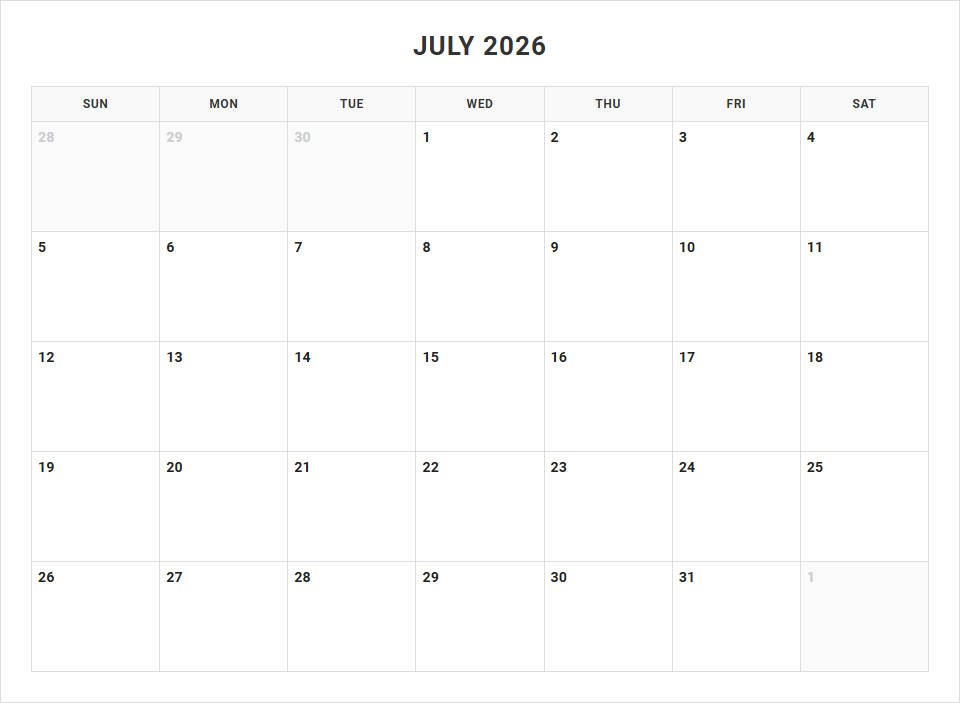
Managing diverse global schedules often leads to overlooked observances. While standard corporate planners capture federal holidays, they frequently omit critical religious dates. Our printable Religious and Cultural Holiday Calendar grants teams the foresight needed to foster inclusivity, though users should note that local lunar variations may apply. By clearly marking major observances like Yom Kippur and Diwali, this tool ensures respect. Below, we explore how this printable calendar streamlines inclusive scheduling for your organization.
Create Your Religious and Cultural Holiday Calendar
Done customizing?
Religious and Cultural Holiday Calendar - Good to Know
Interfaith Calendar
An interfaith calendar serves as an essential tool for fostering global religious literacy and mutual respect across diverse communities. By mapping out the primary holy days, fasts, and festivals of the world's major religions-including Christianity, Islam, Judaism, Hinduism, Buddhism, and Sikhism-it allows organizations to avoid scheduling conflicts and promote inclusive environments.
Using an interfaith scheduling system helps community leaders, educators, and employers recognize the sacred times of various traditions. This recognition goes beyond mere compliance; it actively cultivates a culture of belonging. Integrating these dates into organizational planning ensures that individuals do not have to choose between their career or academic responsibilities and their deeply held spiritual practices.
- Promotes inclusivity: Acknowledges minority faith traditions alongside mainstream holidays.
- Enhances planning: Prevents scheduling critical events on major holy days.
- Educational value: Explains the significance of diverse spiritual observances.
Lunisolar Calendar
A lunisolar calendar harmonizes the cycles of both the Moon and the Sun, making it one of the most complex timekeeping systems in human history. Unlike purely solar calendars like the Gregorian system, or purely lunar calendars like the Hijri system, lunisolar frameworks track the lunar phases while periodically adding an intercalary month to keep the calendar aligned with the solar year and the changing seasons.
Many traditional cultures rely on these calculations to determine agricultural cycles and major cultural festivals. Prominent examples include the Chinese, Hebrew, and Hindu calendars. Through sophisticated mathematical adjustments, these systems ensure that seasonal festivals, such as the Lunar New Year or Passover, always fall within their correct ecological context, preserving the ancient connection between celestial movements, farming, and community celebrations.
This dual alignment requires continuous observation and calculation, reflecting humanity's historical quest to synchronize earthly activities with the grand rhythms of the cosmos.
DEI Calendar
A modern DEI (Diversity, Equity, and Inclusion) calendar is an indispensable resource for contemporary workplaces, educational institutions, and civic organizations. It expands beyond traditional religious observances to encompass a broad spectrum of human diversity, including awareness months, disability visibility days, neurodiversity celebrations, and LGBTQ+ pride events.
By systematically tracking these dates, leadership teams can proactively design cultural programming, educational workshops, and communication strategies that honor the intersecting identities of their workforce. Utilizing a DEI calendar demonstrates a structural commitment to equity, helping to dismantle systemic exclusion by actively recognizing historically marginalized groups.
Integrating these observances into the corporate workflow encourages continuous learning and empathy. It prompts employees to engage in meaningful dialogue, challenge unconscious biases, and celebrate the rich tapestry of backgrounds that drive innovation and collaboration in the modern global economy.
Moveable Feasts
The term moveable feasts refers to holy days in the Christian liturgical calendar that do not occur on a fixed calendar date but instead shift annually. The calculation of these feasts is primarily anchored to the date of Easter, which is traditionally determined by the phase of the moon and the vernal equinox, blending astronomical observation with theological tradition.
Once the date of Easter is established, a cascade of other significant religious observances shifts accordingly. These include Ash Wednesday, Palm Sunday, Ascension Day, and Pentecost. The fluid nature of these dates requires churches and secular institutions alike to consult specialized calendars each year to plan liturgies, vacations, and community events.
This dynamic system of timekeeping connects modern worshipers to ancient Judeo-Christian lunar cycles, serving as a bridge between astronomical reality, historical tradition, and active liturgical practice across the globe.
Liturgical Cycle
The liturgical cycle, also known as the church year, is the rhythmic sequence of seasons and feasts observed by Christian denominations. This cycle structures time not merely as a linear sequence of days, but as a spiritual journey that systematically retells the life, ministry, death, and resurrection of Jesus Christ over the course of a single year.
The cycle is divided into distinct seasons, each characterized by specific theological themes, liturgical colors, and spiritual practices:
- Advent: A time of expectant waiting and preparation.
- Christmastide: The celebration of the Nativity.
- Lent: A forty-day period of fasting, repentance, and reflection.
- Eastertide: Joyous celebration of the Resurrection.
- Ordinary Time: Focus on discipleship and daily Christian living.
By living through this recurring cycle, believers deepen their faith and find spiritual renewal within a structured, communal framework.
Cultural Heritage Months
Cultural heritage months are designated periods throughout the year dedicated to celebrating the history, achievements, and contributions of specific demographic groups. These observances, often officially recognized by governments and educational institutions, play a crucial role in public education and national identity formation.
In the United States, well-known examples include Black History Month, Hispanic Heritage Month, and Asian American and Pacific Islander (AAPI) Heritage Month. These designated times provide a platform for cultural institutions, museums, and schools to highlight stories that have historically been minimized or omitted from mainstream historical narratives.
Engaging with heritage months fosters cross-cultural understanding and social cohesion. It encourages individuals to reflect on the diverse cultural threads that weave the fabric of society, promoting systemic equity and honoring the struggles and triumphs of diverse populations.
High Holy Days
In the Jewish tradition, the High Holy Days, or Yamim Noraim (Days of Awe), represent the most sacred and introspective period of the Jewish calendar. This ten-day period begins with Rosh Hashanah, the Jewish New Year, and culminates with Yom Kippur, the Day of Atonement, demanding profound spiritual reflection and moral self-examination.
During this solemn season, individuals are called to engage in teshuvah (repentance), seeking forgiveness from God and reconciling with their fellow human beings for wrongs committed over the past year. The sounding of the shofar (ram's horn) serves as a spiritual wake-up call, urging the community to awaken from spiritual slumber.
These observances emphasize personal accountability, communal solidarity, and the hope for renewal. They highlight the enduring human capacity for change, transformation, and reconciliation, anchoring the Jewish year in deep ethical and spiritual reflection.
Astral Holiday Alignment
Throughout human history, cultures across the globe have practiced astral holiday alignment, designing festivals, monuments, and calendars around celestial events. This practice connects human cultural activities directly to the cosmos by celebrating holidays during specific planetary alignments, lunar phases, or stellar positions.
Ancient civilizations, such as the Maya, Egyptians, and Druids, constructed architectural wonders like El Castillo or Stonehenge to align precisely with astronomical events. Today, many modern spiritual traditions and neo-pagan paths continue this legacy by observing holidays that coincide with the position of the Sun in the zodiac or the rising of specific constellations.
Aligning holidays with the stars serves as a powerful reminder of humanity's intrinsic connection to the universe. It encourages a perspective of deep ecological awareness, rooting human celebration in the grand, predictable, yet awe-inspiring movements of the cosmos.
Hijri Calendar
The Hijri calendar, or Islamic calendar, is a purely lunar timekeeping system used by Muslims worldwide to determine the dates of religious observances. Established during the reign of the second Caliph, Umar ibn al-Khattab, the calendar begins its epoch with the Hijra-the historic migration of the Prophet Muhammad from Mecca to Medina in 622 CE.
Because the Hijri year is approximately eleven days shorter than the solar year, its months migrate through all four seasons over a cycle of about thirty-three years. This dynamic movement means that holy periods, such as the fasting month of Ramadan and the annual pilgrimage of Hajj, are experienced in different seasonal climates over a believer's lifetime.
Determining the start of each month relies on the traditional sighting of the crescent moon (hilal), uniting the global Muslim community in a shared, nature-focused rhythm of worship, reflection, and celebration.
Solstice Observances
Solstice observances mark the two pivotal points in the Earth's annual orbit where the sun reaches its highest or lowest point in the sky relative to the celestial equator. Occurring annually in June and December, these events trigger the longest and shortest days of the year, signaling profound seasonal transitions.
For millennia, indigenous populations and agrarian societies have celebrated these celestial turning points. Winter solstice festivals, such as Yule, Dongzhi, or Shab-e Yalda, focus on themes of rebirth, hope, and the gradual return of light during the darkest time of the year. Conversely, summer solstice celebrations, like Midsummer or Kupala Night, honor abundance, fertility, and the peak of solar energy.
These celebrations transcend geographical and cultural boundaries, highlighting a shared human reverence for the natural cycles of light and dark, warmth and cold, that govern life on Earth.
Leave a comment