
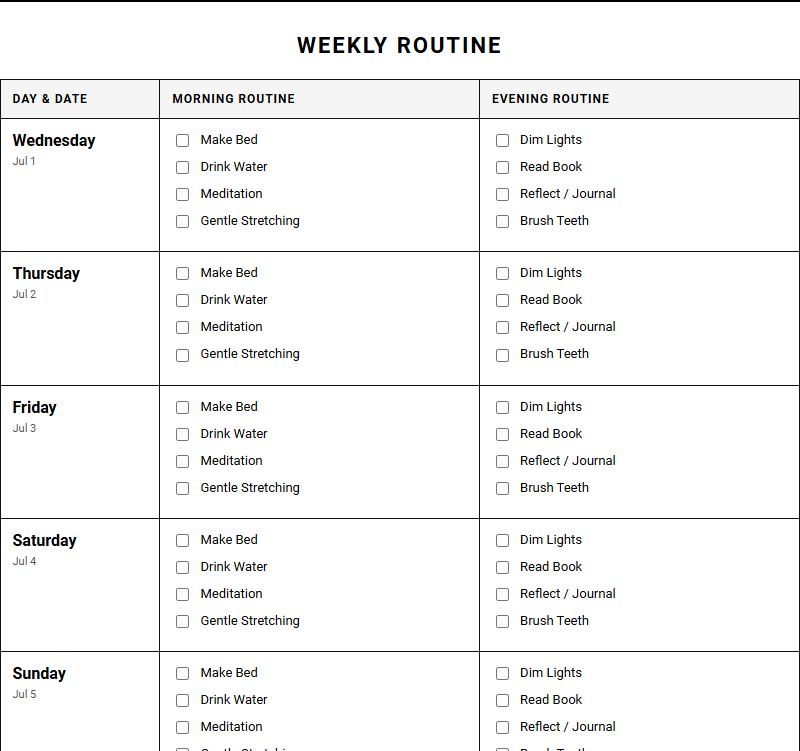
Many professionals struggle to maintain consistent daily habits, starting mornings in chaos and ending nights exhausted. While standard digital calendars track meetings, they neglect these critical daily bookends. A printable Morning and Evening Routine Calendar grants you immediate, tactile control. However, effective use stipulates scheduling realistic time blocks rather than over-scheduling. Integrating concrete practices, like a "15-minute screen-free wind-down," ensures sustainable habits. Below, we outline how to leverage this tool for peak productivity.
Create Your Morning and Evening Routine Calendar
Done customizing?
Morning and Evening Routine Calendar - Good to Know
Habit stacking
Habit stacking is a highly effective behavioral design method that anchors new, positive routines to well-established daily habits. By leveraging existing neural pathways, you eliminate the cognitive load associated with decision-making and motivation. For instance, immediately after brewing your morning coffee (the established anchor), you can practice five minutes of mindful breathing (the new behavior). This creates a seamless, low-resistance transition between tasks, utilizing the brain's natural association patterns. To implement this strategy effectively, identify highly consistent anchors in your daily routine:
- Brushing your teeth in the morning.
- Opening your laptop to start work.
- Pouring your first glass of water.
Once identified, map your desired habits directly onto these triggers. Over time, these linked sequences become automatic, reinforcing positive behavioral loops without relying on raw willpower. By building a structured chain of sequential actions, you cultivate sustainable, compounding routines that enhance productivity.
Low-dopamine morning
Starting your day with a low-dopamine morning prevents early-morning overstimulation and preserves cognitive focus. Instead of instantly reaching for your smartphone to check notifications, news feeds, or social media, opt for high-yield, calming activities. This deliberate delay in dopamine spikes helps maintain a steady, resilient baseline of attention throughout the afternoon. Consider integrating peaceful practices into your initial waking hours:
- Reading a physical book or journaling daily intentions.
- Hydrating with water and stretching your body gently.
- Enjoying a quiet breakfast without digital distractions.
By protecting your brain from instant digital gratification, you cultivate a grounded mental state. This practice prevents the cognitive fragmentation associated with rapid context-switching. Practicing this mindful delay allows you to approach your primary professional tasks with deep, sustained concentration and significantly reduced anxiety levels.
Wind-down ritual
A structured wind-down ritual signals to your nervous system that it is safe to transition from active performance to restorative rest. As evening approaches, shifting from analytical thinking to active relaxation prepares the brain for deep, recuperative sleep. This physiological process involves consciously lowering sensory inputs and dimming overhead household lights to stimulate natural melatonin production. Engaging in tactile, offline activities-such as progressive muscle relaxation, light reading, or listening to calming ambient soundscapes-helps ease residual physical tension.
"An intentional evening routine acts as a critical psychological bridge between the intense chaos of the day and the peaceful tranquility of deep sleep." - Sleep Science Weekly
By consistently executing a evening sequence, you train your body to recognize these environmental cues, dramatically reducing sleep latency. This deliberate decompression period clears cognitive residue, ensuring you wake up refreshed and fully prepared for the next day's demands.
Circadian rhythm alignment
Aligning with your natural circadian rhythm is essential for optimizing daily energy, metabolic health, and cognitive function. Our internal master clock, located in the hypothalamus, coordinates vital biological processes based on environmental light cues. To optimize this cycle, view natural sunlight within one hour of waking. This exposure suppresses melatonin and boosts morning cortisol, enhancing alertness. Conversely, minimize exposure to artificial blue light after dusk. Maintaining consistent wake and sleep times-even on weekends-strengthens this endogenous cycle. When your daily schedule matches your biological clock, you experience improved mood stability, better digestive health, and higher sleep efficiency. Implementing this alignment ensures that your body processes nutrients and repairs cellular damage at the ideal physiological times, yielding sustained vitality.
Bookending the day
Bookending the day involves establishing rigid, intentional routines at both sunrise and sunset. While the middle of the day is often dictated by external demands, sudden meetings, and unpredictable events, your morning and evening remain under your direct control. By securing these two critical periods, you create a sense of stability and agency. A strong morning bookend focuses on preparation, goal setting, and physical activation, while a solid evening bookend prioritizes reflection, gratitude, and physical restoration. This structured approach prevents daily chaos from bleeding into your personal time, providing a reliable framework for consistent personal growth. Safeguarding these transition periods ensures that no matter how chaotic the afternoon becomes, your day begins and ends with deliberate, mindful actions that align with your long-term vision.
Chronotype scheduling
Chronotype scheduling is the practice of aligning your daily workload with your biological peak performance windows. Whether you are a morning-oriented "lion," a versatile "bear," or a nocturnal "wolf," understanding your genetic predisposition allows you to work with your biology rather than against it. Schedule high-cognition tasks-such as strategic planning, complex coding, or creative writing-during your peak alertness hours. Conversely, allocate low-energy administrative tasks, email management, and routine scheduling to your natural post-lunch dip or evening wind-down. This strategic adjustment increases overall efficiency and reduces burnout. Embracing your chronotype transforms how you perceive time, shifting the focus from working longer hours to working during highly optimal physiological states. Designing your day around internal rhythms maximizes output while conserving mental energy.
Digital detox window
Establishing a daily digital detox window is critical for reclaiming attention spans and reducing cognitive fatigue. During these dedicated periods, disconnect from all screens, including phones, tablets, and televisions. This screen-free time allows your prefrontal cortex to recover from constant sensory overload.
- Unplug during the first hour of the day to build focus.
- Implement a screen-free dinner to foster genuine connection.
- Power down all electronic devices ninety minutes before sleep.
Using this offline time for physical hobbies, light exercise, or face-to-face interactions helps restore neural balance. By creating physical distance from digital notifications, you break the dopamine-driven compulsion loop. This practice fosters deep mindfulness and allows your mind space to wander, reflect, and cultivate deeper creative thoughts throughout the week.
Time blocking
Time blocking is a highly effective productivity framework that treats time as a finite, precious resource. Instead of working from an open-ended to-do list, allocate specific blocks of hours to dedicated tasks. This method eliminates multitasking, which drains cognitive resources and lowers output quality. To implement time blocking:
- Identify your top priority tasks for the day.
- Estimate the realistic duration required for each task.
- Assign distinct, non-overlapping blocks in your calendar.
Include buffer blocks to accommodate unexpected interruptions or administrative tasks. By creating clear boundaries around your work, you develop a deep focus environment. This disciplined time management approach ensures that critical projects receive uninterrupted attention, significantly accelerating your output and boosting creative performance.
Sleep hygiene protocol
A robust sleep hygiene protocol involves optimizing your environment and behaviors to maximize sleep quality. Sleep is not merely passive downtime; it is an active phase of cellular repair and memory consolidation. To facilitate deep rest, maintain a cool bedroom temperature, ideally around 65°F (18°C). Ensure total darkness by using blackout curtains or an eye mask, which signals the brain to produce melatonin. Additionally, minimize ambient noise with earplugs or a white noise machine. Avoid consuming heavy meals, alcohol, and caffeine in the hours leading to bedtime, as these substances disrupt natural sleep architecture. Prioritizing these physical environmental factors ensures that you cycle smoothly through essential REM and deep sleep phases, allowing you to wake up fully restored and energized.
Micro-habits
Micro-habits are the foundational building blocks of significant life transformations. By scaling down ambitious goals into tiny, easily achievable actions, you bypass the brain's natural resistance to change. For example, rather than committing to a strenuous one-hour workout, start with a micro-habit of doing five pushups daily. The primary objective is to build consistency and reinforce a new identity rather than achieving immediate, massive results. Once the small behavior is securely integrated into your daily routine, you can gradually increase its scale and intensity. This incremental approach prevents burnout and builds sustainable momentum over time. Embracing these tiny changes shows that small, consistent steps generate a powerful compounding effect, leading to profound long-term personal and professional growth.

Leave a comment