
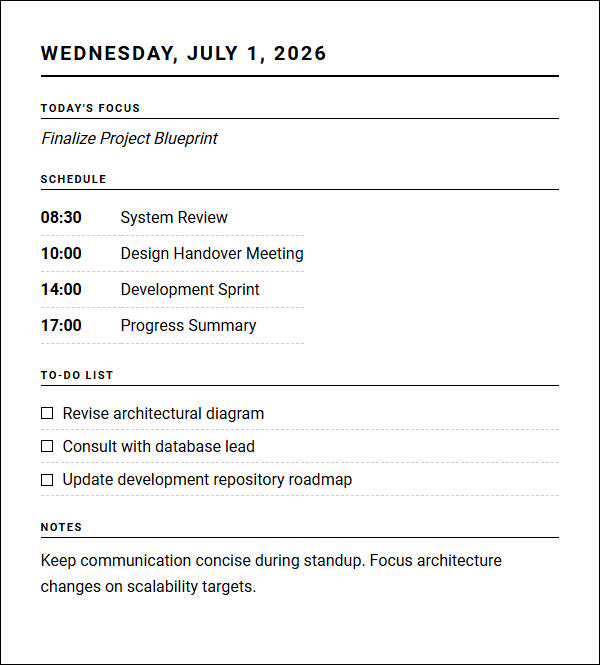
Staying organized amidst constant digital distraction is increasingly difficult. While complex calendar apps and bulky planner books are standard organizational tools, they often exacerbate mental clutter. A streamlined Daily Agendas printable calendar, however, grants users instant cognitive clarity by stripping away unnecessary noise. Successfully adopting this method stipulates a commitment to ruthlessly prioritizing key tasks. By utilizing a clean framework like the Minimalist Daily Agenda, you can anchor your daily focus. Below, we outline how to effectively integrate this template into your routine.
Create Your Minimalist Daily Agenda
Done customizing?
Minimalist Daily Agenda - Good to Know
Time blocking
Time blocking is a highly effective productivity technique where you divide your day into distinct, dedicated blocks of time. Each specific block is reserved exclusively for completing a designated task or a set of similar activities. Unlike a generic, endless to-do list, this structured method forces you to commit to when you will execute your work, drastically reducing decision fatigue throughout the day.
Key advantages of implementing this time management strategy include:
- Minimizing daily distractions by dedicating deep focus to a single objective.
- Developing a highly realistic understanding of your actual daily capacity.
- Creating clear, unbreakable boundaries between deep creative work and administrative tasks.
By conducting a regular audit of your scheduled blocks, you regain complete control over your daily calendar. This systematic approach ensures that your precious time is protected from external interruptions, allowing you to prioritize high-impact projects.
Rapid logging
Rapid logging serves as the functional backbone of efficient journaling and modern note-taking systems. This method relies on a quick, bulleted notation style to capture fleeting thoughts, urgent tasks, and notable events without wasting valuable time. Instead of writing long, narrative paragraphs, you utilize short sentences combined with distinct, intuitive symbols to categorize information instantly.
Standard symbols often utilize the following structured format:
- Simple dots for actionable tasks that require completion.
- Dashes for quick notes, immediate observations, or random ideas.
- Open circles for scheduled events, deadlines, and critical meetings.
This highly streamlined approach ensures that you document your daily life and professional work in real-time without interrupting your natural mental flow. It keeps your written records incredibly concise, organized, and exceptionally easy to review and migrate during your weekly planning sessions.
Undated layout
An undated layout offers unparalleled flexibility for planners who refuse to be constrained by rigid, pre-printed calendar structures. Without the pressure of pre-assigned dates, you can start, pause, and resume your planning journey at any point of the year without wasting valuable paper. This freedom is particularly beneficial for project-based professionals, freelancers, or seasonal planners.
The inherent freedom of an undated format encourages a completely guilt-free relationship with personal organization. If you happen to skip a busy week or take a well-deserved vacation, your planner remains fully functional whenever you return to it. It gracefully adapts to the natural rhythm of your life, rather than forcing your life to conform to a strict, pre-determined template. This design choice empowers you to customize your temporal boundaries, making organization feel like an empowering tool rather than a daily chore.
Brain dump
A brain dump is a therapeutic and highly practical cognitive decluttering exercise. When your mind is completely overwhelmed with competing ideas, lingering anxieties, and pending tasks, writing everything down on paper provides immediate mental relief. It acts as a reliable external hard drive for your working memory, transferring overwhelming mental noise into a tangible, physical format.
"Getting things out of your head and onto paper is the first step toward mental clarity and actionable focus."
Once your thoughts are safely captured on the page, you can easily sort, categorize, and prioritize them into structured action steps. This simple yet profound practice reduces chronic anxiety and clears the necessary cognitive runway for creative thinking, logical problem-solving, and efficient execution. Regularly unloading your thoughts prevents mental burnout and keeps your daily goals clear.
Monotasking
Monotasking, otherwise known as single-tasking, is the intentional practice of focusing your undivided attention on one specific activity at a time. In a fast-paced digital world that constantly celebrates multitasking, shifting your energy back to a single objective can dramatically improve your overall work quality and cognitive performance. Multitasking is often an illusion that dilutes your focus.
Embracing a dedicated monotasking workflow yields several key benefits:
- Deepening your daily focus and facilitating entry into a highly productive flow state.
- Significantly reducing error rates and producing far superior output.
- Lowering psychological stress levels caused by constant, frantic task-switching.
By dedicating your entire cognitive capacity to one solitary task, you complete it much faster and with greater precision. This deliberate methodology allows you to produce meaningful work that reflects your true capabilities.
Habit tracker
A habit tracker is a powerful visual tool designed to monitor consistency and build positive, lasting routines over time. By logging your daily habits, you create a tangible, historical record of your progress that naturally fuels long-term motivation. This continuous visual reinforcement leverages the psychological desire to keep a successful streak alive, turning abstract goals into concrete actions.
To maximize the overall effectiveness of your tracking system, consider the following steps:
- Identify key daily habits that align directly with your long-term personal goals.
- Keep your tracker manageable by focusing on a select few habits at once.
- Review your historical trends weekly to analyze patterns and adjust routines.
Consistently checking off your completed habits builds incredible momentum, converting minor daily actions into permanent, life-changing routines that support your personal evolution.
Daily reflection
Daily reflection is the intentional practice of reviewing your day to assess key achievements, identify underlying challenges, and cultivate deep gratitude. This quiet, mindful moment at the end of the day helps you close the loop on your daily activities, successfully transitioning your active mind from stressful work to restorative personal rest.
Incorporating specific, thoughtful prompts into your nightly routine can guide your thoughts:
- What specific tasks went well today, and what factors contributed to that success?
- What friction did I encounter, and how can I actively resolve it tomorrow?
- What positive interactions or moments am I most genuinely grateful for today?
Engaging in this structured daily review fosters profound self-awareness. It ensures that you extract valuable lessons from every experience, converting daily challenges into stepping stones for continuous personal growth.
Intentional planning
Intentional planning goes far beyond simply filling a calendar with random appointments and superficial to-do lists; it is the conscious practice of aligning your daily schedule with your deepest values and long-term aspirations. It requires you to ask why you are committing to specific goals before deciding how you will execute them.
"Productivity is never about doing more things; it is about doing the right things with absolute purpose."
By planning your weeks with high intentionality, you design a beautiful life of active creation rather than one of passive, chaotic reaction. This mindful approach ensures that your limited energy is consistently directed toward projects that truly matter. It empowers you to confidently say no to distractions, keeping your daily actions in perfect harmony with your authentic vision of success.
Task prioritization
Task prioritization is the critical process of systematically determining which items on your agenda require immediate attention and which can be safely deferred. Without a clear prioritization system, you run the constant risk of spending your prime energy on low-value tasks while your most critical projects languish in the background.
A highly disciplined prioritization framework involves several essential steps:
- Distinguishing urgent demands from truly important, long-term strategic goals.
- Identifying your top three needle-moving priorities at the start of each morning.
- Delegating or ruthlessly eliminating non-essential tasks that drain your creative energy.
Mastering the delicate art of task prioritization ensures that your daily efforts produce maximum results, allowing you to move closer to your goals with absolute clarity and structured efficiency.
Clean aesthetic
A clean aesthetic in your planning system is not merely a superficial design choice; it is a fundamental driver of true mental clarity. Minimalism in planner design-characterized by abundant white space, clean lines, simple typography, and structured layouts-actively reduces sensory overload and allows your mind to focus entirely on your content.
When your planning pages are completely free from unnecessary visual clutter and distracting decorations, your brain can process and organize information much more efficiently. A clean, minimalist layout creates a peaceful, inviting workspace that naturally encourages focus. By stripping away the visual noise, you transform the daily process of planning and organization into a calming, meditative ritual that reduces stress and enhances your daily productivity.
Leave a comment