
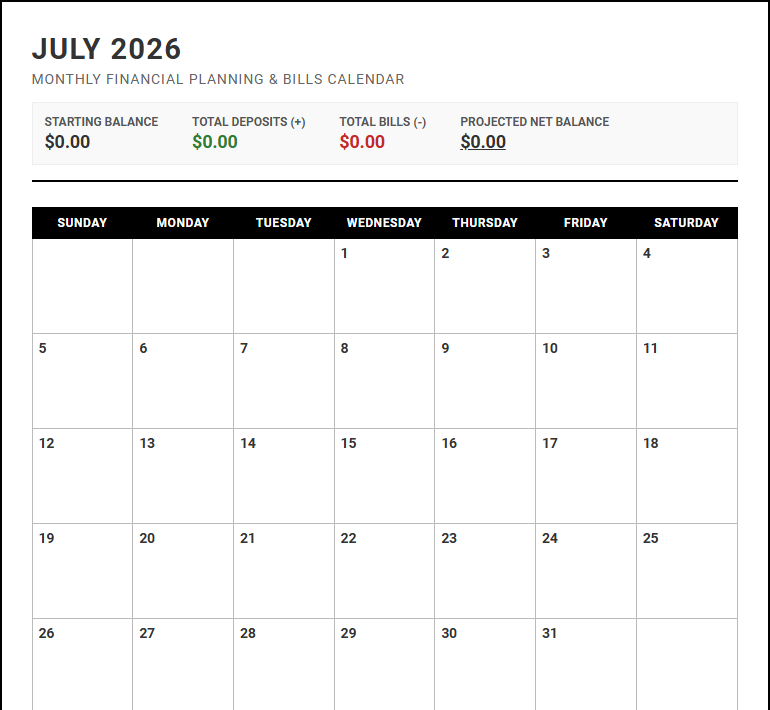
Keeping track of varying due dates can make household financial management feel overwhelming. While aligning these obligations with standard funding sources-like bi-weekly paychecks or freelance income-provides a baseline, tracking gaps often persist.
A printable yearly budget calendar grants complete visibility over your annual cash flow. Although manual tracking requires disciplined upkeep, it prevents missed deadlines for critical expenses like quarterly tax payments. Below, we examine how to format your calendar for optimal financial control.
Create Your Budget and Bill Calendar
| Type | Description | Date | Amount | Action |
|---|---|---|---|---|
| No transactions logged yet. | ||||
Done customizing?
Budget and Bill Calendar - Good to Know
Cash flow forecasting
Predicting your financial future requires a clear view of incoming and outgoing resources. Cash flow forecasting allows you to project your bank balance weeks or months in advance by mapping out scheduled income against anticipated expenses. This proactive strategy helps individuals and businesses identify potential shortfalls before they occur, enabling timely adjustments to spending habits.
To implement an effective forecasting model, consider tracking the following elements:
- Guaranteed income: Regular salary payments, dividend distributions, or retainer fees.
- Fixed outlays: Rent, mortgage payments, insurance premiums, and loan obligations.
- Discretionary estimates: Seasonal spending, utility fluctuations, and emergency reserves.
By analyzing these variables, you transform historical data into actionable insights. This continuous oversight ensures you maintain sufficient liquidity to seize new opportunities and navigate unexpected financial downturns with confidence, establishing a resilient foundation for long-term wealth accumulation.
Bill payment tracker
Keeping pace with monthly obligations can quickly become overwhelming without a centralized system. A structured bill payment tracker serves as your financial control center, consolidating due dates, payment methods, and historical amounts into a single, accessible ledger. This methodical organization eliminates the anxiety of misplaced paper invoices and ensures you never incur costly late fees.
Utilizing a dedicated tracker offers several distinct advantages:
- Improved credit health by maintaining a flawless history of on-time payments.
- Enhanced visibility into monthly recurring costs, highlighting areas for optimization.
- Reduced mental load through systematic organization of financial obligations.
Whether you choose a digital spreadsheet, a specialized mobile application, or a physical planner, consistency remains paramount. Regularly updating your tracker creates a reliable record that supports accurate budgeting and fosters disciplined financial behavior month after month.
Zero-based budgeting calendar
The core philosophy of zero-based budgeting is simple yet powerful: every single dollar earns a specific job. Integrating this concept with a calendar interface elevates your financial control by aligning your allocations with the precise days your funds are spent. Instead of viewing your monthly income as a vague pool of resources, you map assignments directly to the calendar dates when expenses actually occur.
This granular approach ensures your checking account balance remains perfectly synchronized with your upcoming obligations. When you receive a paycheck, you immediately distribute those funds across your calendar until your unallocated balance reaches exactly zero. This rigorous methodology prevents passive overspending, forces conscious decision-making, and guarantees that savings goals, debt repayments, and daily expenses are fully funded before any discretionary spending takes place.
Auto-pay scheduling
Embracing automation is one of the most effective steps toward achieving financial peace of mind. Auto-pay scheduling streamlines your monthly routine by authorizing service providers and financial institutions to withdraw due amounts directly from your account on specified dates. This approach minimizes human error and guarantees that critical bills are settled promptly without manual intervention.
However, successful automation requires strategic planning. To avoid overdraft fees and maintain control, implement these practices:
- Align with paydays: Schedule withdrawals to occur shortly after your income is deposited.
- Establish a buffer: Keep a designated cash reserve in your checking account to absorb timing discrepancies.
- Monitor regularly: Review statements monthly to detect unauthorized rate increases or billing errors.
When managed carefully, automated scheduling frees up valuable mental energy, allowing you to focus on strategic long-term goals rather than administrative details.
Due date alerts
In a fast-paced world, even the most organized individuals can occasionally overlook a payment deadline. Due date alerts act as a vital safety net, providing automated reminders via text message, email, or push notifications before funds are withdrawn or payments are due. These timely prompts offer a final opportunity to review your account balances and ensure sufficient liquidity is available.
Setting up multi-tiered reminders can significantly optimize your system. For example, configure an initial alert five days prior to the due date to allow for manual fund transfers, followed by a secondary alert one day before payment processing. This double-layer security protocol protects your credit score, prevents costly service interruptions, and reinforces positive financial habits with minimal ongoing effort on your part.
Payday cycle planning
Not everyone receives compensation on a traditional monthly schedule. Bi-weekly, weekly, or irregular income streams require a customized approach known as payday cycle planning. This method involves mapping your recurring expenses directly to your specific pay frequency, ensuring that the bills due during any given period do not exceed the income received in that same timeframe.
To master this cycle, categorize your bills based on the specific week of the month they fall due. Then, assign each paycheck to cover the immediate expenses of the upcoming period. If certain weeks are disproportionately expensive, you can strategically shift due dates or accumulate a small reserve during lower-cost pay periods. This customized alignment balances your cash flow, removes the stress of dry spells, and guarantees steady progress toward your objectives.
Sinking funds tracker
Irregular expenses, such as annual car insurance premiums, holiday shopping, or home maintenance, can easily disrupt a standard monthly budget. A sinking funds tracker addresses this vulnerability by breaking down large, anticipated future costs into manageable monthly savings targets. By setting aside small increments over time, you build dedicated reserves that absorb these financial impacts without relying on high-interest credit cards.
Consider establishing distinct sinking funds for common life events:
- Vehicle care: Routine oil changes, tire replacements, and unexpected repairs.
- Leisure: Planned vacations, hobby equipment, and seasonal celebrations.
- Wellness: Annual medical deductibles, dental checkups, and optical expenses.
Tracking these balances visually keeps you motivated and ensures that when the inevitable bill arrives, the cash is already waiting in your account.
Subscription management
The modern digital economy thrives on recurring subscription models, making it incredibly easy to accumulate silent financial leaks. From streaming platforms and cloud storage to fitness memberships and meal kits, these micro-transactions can quickly erode your disposable income. Subscription management is the active practice of auditing, tracking, and optimizing these recurring commitments to ensure you only pay for services that deliver genuine value.
Conducting a quarterly audit is highly effective. List every active subscription, its cost, and the frequency of use. If a service has not been accessed within the past thirty days, cancel it immediately. For services you wish to keep, explore annual payment options, which often offer significant discounts compared to standard monthly billing cycles, thereby keeping your fixed costs lean and efficient.
Variable expense mapping
While fixed bills are easy to predict, fluctuating costs like groceries, dining out, and fuel require a different analytical approach. Variable expense mapping involves tracking and categorizing these flexible spending areas over time to identify seasonal trends and average consumption patterns. This historical data allows you to establish realistic spending limits rather than relying on arbitrary estimates.
To implement this, group your fluid expenses into clear categories and track them weekly. You will quickly notice patterns, such as increased utility costs during summer or elevated entertainment spending on weekends. Mapping these fluctuations empowers you to adjust your budget dynamically, allowing for higher spending in certain months while consciously scaling back in others to maintain your overall financial trajectory.
Calendar-based budgeting
Traditional budget sheets present a static list of numbers, but money flows through time. Calendar-based budgeting bridges this gap by overlaying your financial plan onto a monthly calendar layout. This visual representation allows you to see exactly when income arrives and when expenses depart, highlighting the critical valleys and peaks in your account balance throughout the month.
Seeing your financial landscape mapped out day-by-day dramatically improves decision-making. You can instantly identify cash flow "dry spells" where multiple bills cluster together, enabling you to proactively reschedule payments or adjust discretionary spending. This intuitive method transforms budgeting from a retrospective mathematical exercise into an active, visual navigation tool that aligns perfectly with your daily routine and long-term financial aspirations.
Leave a comment