
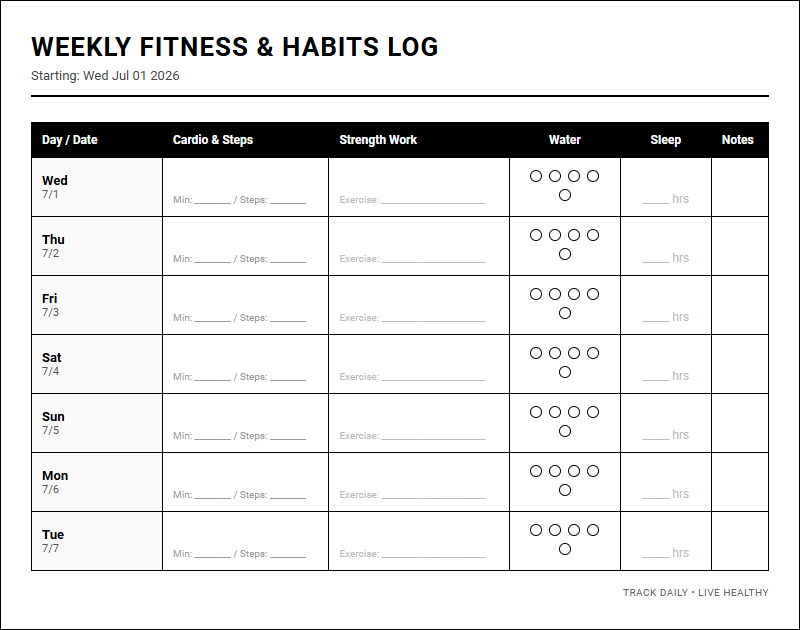
Maintaining consistent workout habits remains a chronic challenge for individuals struggling to see measurable progress. While standard wellness funding and gym memberships provide access, they often lack personal accountability. This printable calendar grants immediate visual structure to your routine, stipulating that true progress requires honest, daily participation. Utilizing tools like the Daily Fitness Log to record daily metrics provides the reliable framework needed for change. Below, we outline how to effectively implement this tracking system.
Create Your Daily Fitness Log
Done customizing?
Daily Fitness Log - Good to Know
Progressive overload
Progressive overload is the foundation of athletic adaptation and muscle growth. To force the human body to adapt, you must gradually increase the stress placed upon it during exercise. This systematic approach prevents performance plateaus and stimulates continuous physiological improvements. You can achieve this through several training variables:
- Increasing the total resistance or weight lifted.
- Adding more repetitions or sets to your training session.
- Decreasing rest intervals between sets to increase training density.
- Improving execution form and maximizing range of motion.
By consistently challenging your muscular and nervous systems, you trigger myofibrillar hypertrophy and strengthen connective tissues. Implementing progressive overload requires meticulous logging of your workouts, ensuring that each week demands slightly more than the previous one, thus driving sustainable, long-term athletic progression safely. This methodical progression ensures that the physical stimulus constantly outpaces your body's current capabilities, forcing permanent adaptation.
Rate of perceived exertion
The Rate of Perceived Exertion (RPE) is a subjective measurement of exercise intensity, typically quantified on a scale from 1 to 10. Originally developed by Gunnar Borg, modern strength training utilizes a modified RPE scale based on repetitions in reserve (RIR). This scale allows athletes to auto-regulate their training based on daily physiological readiness rather than strictly adhering to rigid percentage-based programs.
- RPE 10: Maximum effort, zero repetitions remaining.
- RPE 9: Heavy effort, exactly one repetition left in the tank.
- RPE 8: Moderate-high effort, two repetitions remaining.
By tuning into subjective physical sensations, such as muscular burn, respiration rate, and neuromuscular fatigue, you can adjust training loads on the fly. This prevents overtraining on low-energy days and capitalizes on high-performance days, optimizing your overall training stimulus while mitigating injury risks.
Heart rate variability
Heart rate variability (HRV) measures the specific time variation between consecutive heartbeats, serving as a powerful window into your autonomic nervous system (ANS). A high HRV indicates a dominant parasympathetic state, meaning your body is in a state of rest, recovery, and high adaptability. Conversely, a depressed HRV signals sympathetic dominance, reflecting systemic stress, inadequate recovery, or impending overtraining.
By tracking HRV daily using wearable technology, athletes gain real-time insights into their physiological readiness. If your HRV drops significantly, it suggests your body is struggling to recover from previous stressors, indicating that a lighter training day is warranted. Integrating HRV monitoring into your routine enables precise, data-driven decisions regarding training intensity and recovery protocols, ensuring you train hard only when your body is fully prepared to absorb the stress. This biometric marker serves as an essential tool for balancing the delicate relationship between training load and systemic physical recovery.
Macro tracking
Macro tracking, or flexible dieting, involves monitoring the daily intake of the three primary macronutrients: proteins, carbohydrates, and fats. Each macronutrient plays a distinct and vital role in optimizing body composition, athletic performance, and hormonal health:
- Proteins: Essential for repairing muscle tissue and promoting lean mass retention.
- Carbohydrates: The primary fuel source for high-intensity training and glycogen replenishment.
- Fats: Crucial for hormone production, cellular health, and nutrient absorption.
By calculating your specific caloric requirements and distributing them across these macronutrients, you can precisely manipulate your body composition. Whether your goal is fat loss, muscle hypertrophy, or athletic endurance, tracking macros provides a granular level of dietary control that simple calorie counting cannot match, ensuring your body receives the exact fuel required to perform and recover. This structured dietary strategy empowers individuals to enjoy food flexibility while achieving consistent, measurable physical results.
Active recovery
Active recovery involves performing low-intensity, non-strenuous physical activity on rest days to facilitate the healing process. Unlike passive recovery, which involves complete rest, light movement stimulates blood flow to fatigued muscles without introducing additional micro-tears or systemic fatigue. This enhanced circulation delivers oxygen and vital nutrients directly to damaged tissues while accelerating the removal of metabolic waste products like lactate.
Excellent examples of active recovery include leisurely walking, yoga, mobility work, and light cycling. Keeping your heart rate within a relaxed zone ensures that you stimulate the lymphatic system without triggering a stress response. Engaging in structured active recovery sessions not only alleviates delayed onset muscle soreness (DOMS) but also maintains joint mobility and supports mental well-being, allowing you to return to high-intensity training sessions feeling fully rejuvenated and prepared for peak performance. Consistent movement on off-days keeps the body primed and responsive.
Non-exercise activity thermogenesis
Non-Exercise Activity Thermogenesis (NEAT) represents the energy expended for everything we do that is not sleeping, eating, or sports-like exercise. It encompasses simple daily activities such as walking to work, typing, gardening, cleaning, and even fidgeting. Although often overlooked, NEAT plays a massive role in determining your total daily energy expenditure (TDEE), frequently accounting for a larger percentage of caloric burn than structured workout sessions.
To maximize NEAT, consider implementing these simple habits:
- Using a standing desk during working hours.
- Taking short walking breaks every hour.
- Choosing the stairs instead of the elevator.
Maintaining high levels of NEAT is a highly effective, low-stress strategy for weight management and metabolic health. By unconsciously burning extra calories throughout the day, you prevent metabolic adaptation, support cardiovascular health, and make body composition goals far easier to achieve without adding training stress.
Deload week
A deload week is a planned reduction in training volume or intensity, typically scheduled every four to eight weeks. Even with proper nutrition and sleep, the cumulative stress of intense training eventually outpaces your body's ability to recover. Implementing a structured deload allows your nervous system, joints, and connective tissues to fully heal, preventing chronic injuries and chronic overtraining syndrome.
A successful deload week can be executed using several strategies:
- Keeping the weight constant but reducing total sets and repetitions by fifty percent.
- Maintaining the training volume while reducing the working weights to sixty percent of your maximum.
- Swapping intense compound movements for light, mobility-focused exercises.
Temporarily stepping back from heavy loads facilitates complete physical and mental supercompensation. When you return to your regular training program, you will often find yourself stronger, more explosive, and mentally refreshed. This planned phase is a fundamental tool for long-term athletic longevity.
Zone 2 cardio
Zone 2 cardio refers to low-intensity aerobic training performed at roughly sixty to seventy percent of your maximum heart rate. At this intensity, you should be able to maintain a conversation, though with some effort. This specific zone primarily targets mitochondrial density and efficiency, training your body to utilize fat as its primary fuel source rather than relying heavily on glucose.
Engaging in regular Zone 2 sessions builds a robust aerobic base, which dramatically improves your recovery times between high-intensity intervals and heavy lifting sets. By increasing stroke volume, your heart pumps more blood per beat, lowering your resting heart rate and reducing cardiovascular strain. Consistently performing Zone 2 aerobic work not only enhances endurance performance but also acts as a powerful counterweight to high-intensity training, strengthening your cardiovascular foundation without overtaxing your central nervous system or joints. This makes it an indispensable component of any holistic, long-term athletic routine.
Volume load
Volume load is a quantitative metric used to track the total work performed during a training session or over an entire training block. Calculated using the formula Weight x Repetitions x Sets, volume load provides a far more accurate representation of muscular work than simply tracking sets or reps alone. Monitoring this metric allows athletes to ensure they are applying the principles of progressive overload over time.
For example, if you lift one hundred pounds for three sets of ten repetitions, your volume load is three thousand pounds. Tracking these metrics across different muscle groups ensures balanced development and prevents under-training or excessive fatigue accumulation. By managing your weekly volume load, you can strategically structure your programming to maximize hypertrophy and strength, adjusting the variables of load and reps to stimulate muscle fibers while keeping fatigue within manageable, recoverable limits. This precise tracking is essential for optimizing performance outcomes.
Hydration tracking
Hydration tracking is the systematic monitoring of daily fluid intake to support cellular function, cognitive clarity, and physical performance. Water makes up about sixty percent of the human body and is vital for lubricating joints, transporting nutrients, and regulating body temperature. Even mild dehydration, representing a mere two percent loss of body weight in water, can severely impair athletic performance, decrease strength, and accelerate physical fatigue.
Effective hydration tracking strategies include:
- Monitoring the color of your urine, aiming for a pale, straw-like yellow.
- Weighing yourself before and after workouts to calculate fluid loss.
- Consistently utilizing a marked water bottle throughout the day.
- Replenishing lost electrolytes, specifically sodium and potassium, during long workouts.
By ensuring your body remains optimally hydrated, you maximize blood volume, which improves cardiovascular efficiency, oxygen delivery to working muscles, and overall athletic recovery. Prioritizing fluid balance ensures your body functions at its peak athletic potential daily.

Leave a comment