
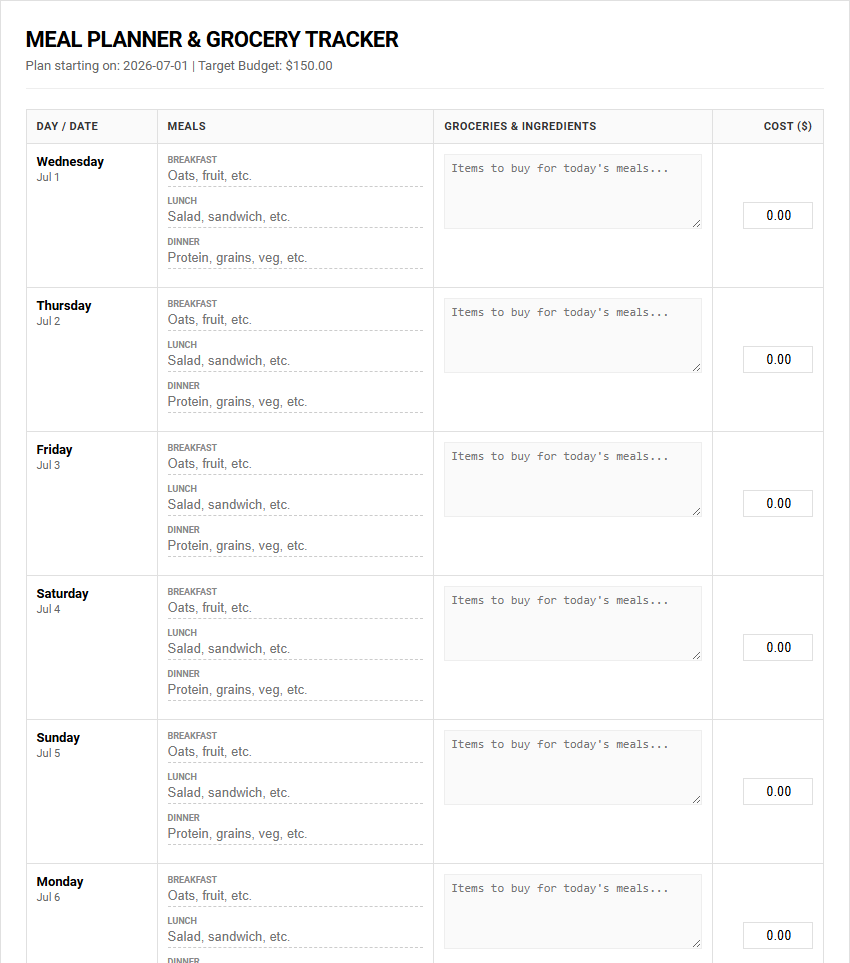
Managing escalating household grocery costs often feels like an uphill battle for busy families. While standard monthly budget allocations provide a baseline, they rarely prevent impulse spending. This is where our printable Budget Meal Planner and Grocery Tracker grants you complete control over your food expenditures. Note that sustainable savings require consistent weekly tracking, a method proven by families who cut their food waste using these structured templates. Below, we explore how to implement this tool to optimize your kitchen and finances.
Create Your Budget Meal Planner and Grocery Tracker
Done customizing?
Budget Meal Planner and Grocery Tracker - Good to Know
Cost per serving
Calculating the cost per serving is a fundamental practice for anyone looking to optimize their food budget. Instead of focusing solely on the total grocery bill, this metric breaks down the financial investment of individual meals. To calculate this, divide the total cost of all ingredients used in a recipe by the number of portions yielded. Mastering this approach allows household chefs to compare the true value of home-cooked meals against restaurant alternatives. By analyzing costs at this granular level, you quickly discover that homemade staples, such as lentil soups or pasta dishes, often cost mere pennies per portion. This financial visibility empowers you to make informed decisions about your weekly menu, guiding you to prioritize high-nutrient, low-cost ingredients like legumes, grains, and seasonal vegetables. Consequently, your meal planning becomes an exercise in financial efficiency, transforming the way you view ingredient selection and portion control.
Pantry inventory tracker
A pantry inventory tracker serves as the central database of your home kitchen, preventing duplicate purchases and reducing food spoilage. Keeping an accurate, real-time log of your dry goods, canned items, and spices ensures you always know what resources are at your disposal. Modern trackers can be maintained via digital spreadsheets, dedicated mobile applications, or a simple dry-erase board mounted on the pantry door.
- Grains & Pastas: Rice, quinoa, oats, and spaghetti are tracked by weight.
- Canned Goods: Beans, tomatoes, coconut milk, and tuna logged with expiration dates.
- Baking Staples: Flour, sugar, yeast, and essential spices updated after use.
By maintaining this organizational system, you eliminate the guesswork of grocery shopping. You will no longer find yourself buying a third jar of paprika because you forgot one was hiding in the back. This simple organizational habit streamlines meal prep, saves cupboard space, and keeps your ingredients fresh.
Smart grocery list
Transforming your shopping habits begins with a smart grocery list that acts as a dynamic bridge between your meal plan and the supermarket aisles. Unlike a traditional scribbled scrap of paper, a smart list is systematically categorized by store layout, grouping produce, dairy, and pantry items together to minimize backtracking.
- Analyze your current inventory to identify missing ingredients.
- Align list items directly with your planned weekly recipes.
- Incorporate flexible substitutes for seasonal or high-priced items.
Integrating technology into this process allows for shared lists among household members, ensuring real-time updates and preventing accidental duplicate purchases. This structured approach to grocery shopping curtails impulse buys, dramatically speeds up your supermarket runs, and ensures that every single item placed in your cart has a designated purpose in your upcoming weekly menu.
Zero-waste meal planning
Zero-waste meal planning is an eco-friendly culinary strategy designed to maximize the utility of every ingredient purchased. This practice requires a paradigm shift from shopping for specific recipes to designing recipes around your existing ingredients, particularly perishables.
"True kitchen sustainability is achieved when we view food scraps not as waste, but as the foundation for our next culinary creation."
To implement this, prioritize cooking highly perishable items like leafy greens and fresh berries early in the week, leaving durable root vegetables and frozen items for later. Leftover vegetable scraps, herb stems, and meat bones can be collected in a freezer bag and simmered into nutrient-rich stocks. By treating food preservation as a creative challenge, you drastically reduce your environmental footprint, conserve valuable resources, and extract maximum financial value from your weekly grocery investment.
Batch cooking
Batch cooking is the ultimate time-saving strategy for busy households, involving the preparation of large quantities of food at a single time to be consumed throughout the week. By dedicating a few hours on the weekend to cooking versatile base ingredients-such as roasting a large tray of vegetables, simmering a massive pot of grains, or braising a family-sized portion of protein-you set yourself up for effortless weekday meals. This method dramatically reduces daily cooking stress and minimizes clean-up time, as pots and pans are utilized just once. Portioning these batches into airtight containers and freezing them ensures you always have a healthy, homemade alternative to expensive takeout options. Over time, batch cooking transforms your kitchen workflow, making healthy eating a convenient, default choice while significantly lowering your household's overall energy consumption and food prep fatigue.
Price book
A price book is a powerful, personalized tool used to track the fluctuating prices of your most frequently purchased grocery items across different local retailers. By documenting the cost of staples over several weeks or months, you quickly identify the cyclical nature of supermarket sales and recognize a genuine bargain.
| Item Category | Standard Price | Sale Price Target |
|---|---|---|
| Olive Oil (1L) | $14.99 | $10.99 |
| Greek Yogurt (32oz) | $5.49 | $3.99 |
Armed with this historical pricing data, you can strategically stock up on non-perishable essentials when they hit their absolute lowest price points. This proactive strategy protects your budget from inflation, removes the guesswork from shopping, and ensures you never overpay for your household staples again.
Pantry challenge
Embracing a pantry challenge is an excellent way to reset your household budget, clear out accumulated food stocks, and spark culinary creativity. The objective is simple: suspend regular grocery shopping for a designated period, such as a week or a month, and subsist entirely on the food already residing in your pantry, freezer, and refrigerator.
- Take a complete inventory of your current food supplies.
- Identify expiring perishables and prioritize them for immediate consumption.
- Combine disparate dry goods, like grains and beans, into creative new meals.
This exercise forces you to look at overlooked ingredients with fresh eyes, discovering unexpected flavor combinations. In addition to saving money, a pantry challenge minimizes food waste by ensuring older items are rotated and consumed before their expiration dates pass.
Recipe scraper
A digital recipe scraper is an invaluable technological asset for modern meal planners looking to streamline their culinary collections. These software tools automatically extract clean, concise recipe instructions and ingredient lists from cluttered food blogs, removing lengthy narratives, ads, and pop-ups.
By saving only the essential data, you can import clean recipes directly into your personalized digital cookbook or meal-planning application. This organized repository allows you to easily scale ingredient quantities, generate instant shopping lists, and quickly search your collection by specific ingredients or cooking times.
Using a scraper saves significant digital clutter and mental energy. It allows you to build a highly curated, easily accessible database of family favorites, ensuring that your meal preparation process is focused entirely on cooking rather than navigating distracting web pages.
Leftover rotation
Establishing a systematic leftover rotation protocol is essential for reducing domestic food waste and lowering your weekly grocery expenditures. Too often, perfectly good meals are pushed to the back of the refrigerator and forgotten until they spoil.
"An organized refrigerator is a household's best defense against unnecessary food waste and budget inflation."
To combat this, implement a strict "first in, first out" policy, labeling containers with dates and storing them at eye level. Dedicate one night a week as a "smorgasbord night" to clear out accumulated small portions, or intentionally transform leftovers into entirely new dishes. For example, yesterday's roasted chicken can easily be repurposed into today's chicken tacos or tomorrow's savory soup. This active rotation strategy keeps your meals varied and exciting.
Unit pricing
Understanding unit pricing is the secret weapon of savvy shoppers looking to extract maximum value from every dollar spent at the supermarket. While the retail price tells you how much a package costs, the unit price reveals how much you are paying per standard measure, such as per ounce, pound, or gram.
- Retail Price
- The total cost you pay at checkout for a specific packaged item.
- Unit Price
- The cost of the item calculated by a standard unit of measurement, printed on shelf tags.
Supermarkets often place unit prices in small print on the shelf tags. Comparing these numbers allows you to easily identify whether a bulk package is truly a better deal than its smaller counterpart, or if a generic brand offers genuine savings. Utilizing unit pricing prevents deceptive packaging from tricking you, ensuring your grocery decisions are based on cold, hard data.
Leave a comment