
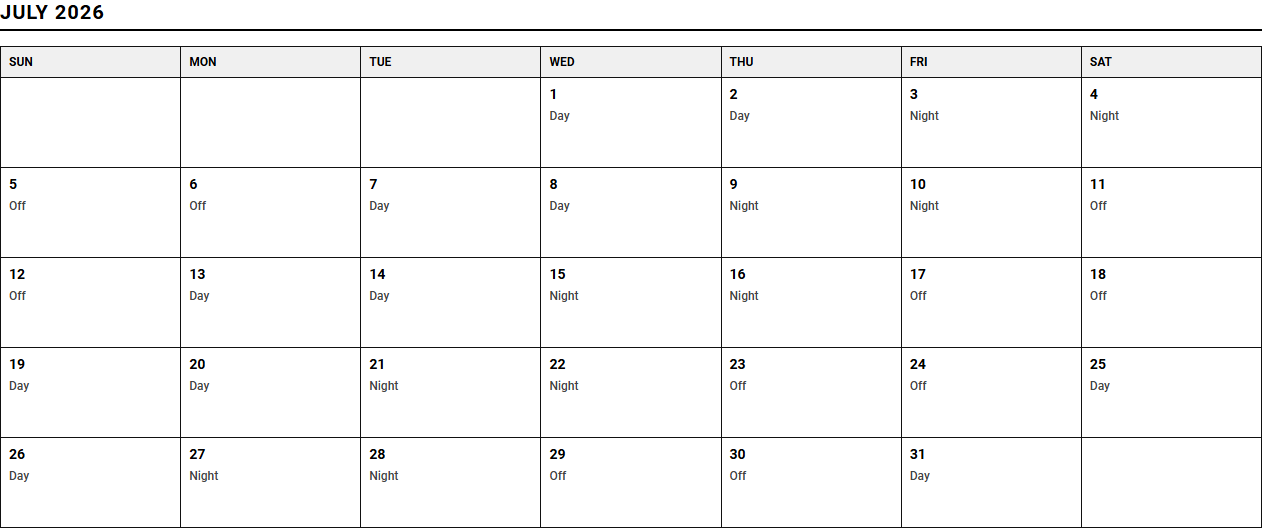
Managing erratic shift patterns often leaves workforce managers struggling with coverage gaps. While standard corporate scheduling software offers a basic framework, transitioning to a dedicated Yearly Calendars printable calendar grants teams immediate operational predictability. However, utilizing these tools effectively stipulates that managers align templates with specific labor regulations. For instance, mapping out a complex 2-2-3 rotating shift becomes seamless with the right physical layout. Below, we examine how to select, customize, and implement these printable schedules for maximum efficiency.
Create Your Shift Work Schedule Calendar
Done customizing?
Shift Work Schedule Calendar - Good to Know
Rotational Shift Pattern
A rotational shift pattern is a systematic approach to workforce management where employees cycle through different shifts-typically day, evening, and night-over a set period. This methodology ensures continuous 24/7 operational coverage, which is vital for industries like healthcare, emergency services, and manufacturing. By rotating schedules, organizations prevent employee burnout associated with permanent night shifts and distribute the physical demands of non-traditional hours more equitably across the entire team.
To implement this successfully, managers must construct predictable rotation cycles, such as weekly or bi-weekly changes. This predictability allows employees to plan their personal lives around their work schedules. Additionally, providing sufficient transition periods between different shifts is crucial to mitigate fatigue and maintain high safety standards. When managed with clear communication and fair distribution, rotational shifts maximize labor efficiency while maintaining high morale.
DuPont Schedule
The DuPont schedule is a 12-hour rotating shift system that utilizes a 4-week cycle to provide continuous 24/7 coverage using four separate teams. Named after the chemical company where it originated, this pattern is highly structured and offers employees a unique balance of work and personal time.
- Four night shifts, followed by three days off
- Three day shifts, followed by one day off
- Three night shifts, followed by three days off
- Four day shifts, followed by an extended seven-day consecutive block of time off
This lengthy rest period is highly valued by staff, as it allows for significant recovery and personal pursuits. However, the intensive 12-hour shifts require careful physical and mental management, and the rapid transition between day and night shifts can sometimes disrupt sleep patterns if not paired with robust wellness strategies.
Automated Rostering
Automated rostering leverages advanced software algorithms and artificial intelligence to generate employee schedules automatically, replacing tedious manual spreadsheets. This technology analyzes various inputs, including employee availability, labor laws, qualifications, historical demand, and organizational budget constraints, to produce optimized shift patterns in seconds.
By removing human bias and administrative errors, automated systems ensure fairer shift distribution and strict compliance with labor regulations, such as maximum working hours and mandatory rest periods. Managers save significant administrative time, allowing them to focus on core operational tasks. Modern automated rostering platforms also integrate real-time notifications, enabling staff to view schedules instantly on mobile devices, request time off, and swap shifts seamlessly. Consequently, organizations experience reduced labor costs, minimized understaffing risks, and improved overall operational agility.
Shift Bidding
Shift bidding is a collaborative scheduling method that empowers employees by allowing them to express preferences for specific shifts or schedule blocks. Under this system, managers post open shifts, and qualified employees submit bids based on their desired working hours. To ensure fairness, organizations establish clear criteria for awarding shifts, which are often based on:
- Seniority and tenure within the company
- Performance metrics and attendance history
- A rotating priority system
This transparent approach fosters a culture of trust and autonomy, as staff members feel they have direct control over their work-life balance. For employers, shift bidding dramatically reduces scheduling conflicts, minimizes absenteeism, and increases employee retention rates. By utilizing dedicated scheduling software, the entire bidding process can be automated, allowing managers to approve bids with minimal effort.
2-2-3 Schedule Pattern
The 2-2-3 schedule pattern, also known as the Panama or Pitman schedule, is a popular 28-day rotating cycle that provides continuous coverage using 12-hour shifts and four distinct teams. The pattern is highly predictable and operates on a simple, repeating cycle:
- Two days of work, followed by two days of rest
- Three days of work, followed by two days of rest
- Two days of work, followed by three days of rest
This rotation ensures that employees never work more than three consecutive days, which greatly reduces physical and mental fatigue compared to traditional five-day work weeks. Additionally, every team benefits from having a three-day weekend every other week, offering valuable time for family, hobbies, and complete relaxation. This balance of structured productivity and consistent rest makes it an attractive scheduling option for manufacturing, logistics, and public safety organizations.
Circadian Rhythm Scheduling
Circadian rhythm scheduling is an ergonomic approach designed to align work hours with the natural biological clocks of human beings. Human physiology is naturally attuned to light and dark cycles, regulating sleep, alertness, and hormone production. When scheduling shift work, particularly in 24/7 environments, this method mandates that rotations move in a forward chronological direction-from morning to afternoon, and then to night shifts.
This progressive transition, known as phase delay, is far easier for the human body to adjust to than backward rotation (phase advance). By prioritizing biological compatibility, organizations can significantly reduce sleep deprivation, cognitive fatigue, and the long-term health risks associated with chronic shift work. The result is a safer working environment, fewer operational errors, improved employee mental health, and enhanced productivity during active hours.
Swing Shift
The swing shift bridges the gap between traditional daytime business hours and overnight shifts, typically running from mid-afternoon around 3:00 PM to late evening near midnight. This shift is essential for businesses that require extended operational hours, such as restaurants, retail centers, customer support departments, and emergency services.
Working the swing shift offers distinct advantages for employees, such as having mornings free to run errands, attend medical appointments, or pursue daytime education. It also appeals to individuals who naturally prefer a later sleep schedule. However, because it occupies peak social and family hours in the evening, maintaining a healthy social life requires conscious effort and planning. Organizations often offer shift differentials, or higher hourly wages, to incentivize workers to take on these crucial mid-day to late-night slots.
Split Shift
A split shift is a scheduling practice where an employee's workday is divided into two or more distinct working periods separated by a long, unpaid break, typically lasting several hours. This pattern is commonly utilized in industries with distinct peak demand periods, such as public transit, hospitality, and educational institutions, where staffing needs spike during morning and evening rush hours.
For instance, a bus driver might work from 6:00 AM to 10:00 AM, take a four-hour break, and return to work from 2:00 PM to 6:00 PM. While split shifts allow employers to optimize labor costs and avoid paying for idle time, they can be challenging for employees who find their personal time fragmented. To offset this, employers must ensure transparent communication and, where possible, offer split-shift premiums to support employee satisfaction.
Self-Scheduling App
A self-scheduling app represents a modern, employee-centric approach to workforce management, granting staff the autonomy to choose their own shifts within a pre-defined framework. Through intuitive mobile and web interfaces, employees can view open shifts, claim preferred hours, and coordinate swaps directly with their peers without direct managerial intervention.
The application enforces pre-programmed business rules, such as certification requirements, maximum weekly hours, and mandatory rest periods, to ensure compliance automatically. This democratization of scheduling significantly boosts employee morale, reduces turnover, and fosters a strong sense of ownership. For administrators, self-scheduling applications drastically reduce the time spent handling scheduling requests and resolving conflicts. The real-time updates and notifications keep the entire team synchronized, leading to a highly responsive and agile workforce.
Panama Schedule
The Panama schedule is a continuous, 28-day rotating shift pattern that utilizes 12-hour shifts to provide uninterrupted, 24/7 operational coverage. Under this structure, four separate teams work on a highly predictable, alternating schedule of two days on duty, two days off, three days on, two days off, two days on, and three days off.
This cycle ensures that employees receive a three-day weekend every other week, which is highly beneficial for maintaining a healthy work-life balance. Over the course of any two-week period, staff members work exactly seven days and enjoy seven days of rest. This balance helps mitigate the physical toll of 12-hour shifts. The Panama schedule is widely adopted by emergency services, military operations, and industrial plants because it maximizes operational readiness while offering predictable, structured rest periods for the workforce.
Leave a comment