
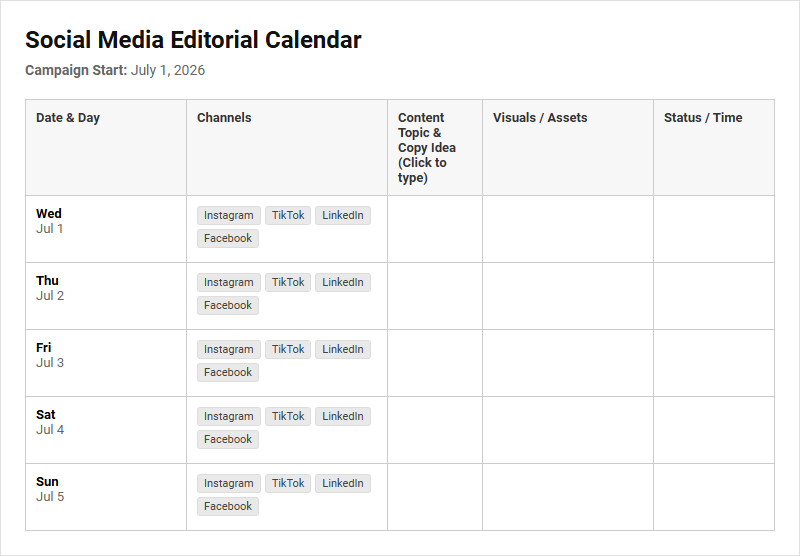
Managing a consistent content pipeline often leaves marketing teams overwhelmed by shifting deadlines. While organizations typically allocate heavy marketing budget funding to complex SaaS tools, a physical Yearly Calendars printable calendar grants unmatched strategic clarity. Crucially, paper templates do not replace digital scheduling but complement them; mapping major Q4 campaigns on a physical grid simply ensures immediate team alignment. Below, we outline how to utilize these printables to streamline your social media editorial calendar.
Create Your Social Media Editorial Calendar
Done customizing?
Social Media Editorial Calendar - Good to Know
Content Pillars
Content pillars represent the foundational themes that define your brand's messaging strategy. These core topics guide your creation process, ensuring consistency across all marketing channels. By establishing three to five distinct pillars, you create a robust framework that supports your brand identity while addressing your audience's diverse needs. For example, a fitness brand might focus on nutrition, strength training, mental wellness, and community stories. Strategically defining these areas helps streamline your workflow and prevents writer's block. It ensures that every piece of published material aligns with your overarching business goals. Utilizing these thematic guideposts allows your audience to easily understand what your brand stands for, fostering trust and long-term loyalty. This structured approach simplifies planning, making it easier to delegate tasks to your team while maintaining a cohesive and authoritative voice across every platform you inhabit.
Content Batching
Content batching is a productivity technique where you group similar tasks and complete them within a dedicated timeframe. Instead of creating, editing, and scheduling posts daily, you dedicate specific blocks of time to execute these tasks in bulk. For instance, you might spend one full day writing captions, another day capturing photography, and a third day scheduling the final assets. This systematic workflow minimizes the cognitive load associated with task-switching, allowing you to enter a deep state of creative focus. Many digital marketers leverage this method to maintain a consistent online presence without feeling perpetually overwhelmed. By streamlining your production pipeline, you free up valuable mental bandwidth to focus on real-time engagement and high-level strategy. Adopting this efficient practice transforms content creation from a chaotic daily chore into a structured, manageable, and highly scalable business process.
Grid Aesthetic
A cohesive grid aesthetic serves as your digital storefront's visual handshake. On visually driven platforms like Instagram, the overall appearance of your profile feed influences a visitor's decision to follow your account within seconds. Achieving a harmonious grid requires deliberate planning of color palettes, imagery styles, typography, and layout patterns. Visual storytelling is enhanced when individual posts look stunning on their own while contributing to a larger, unified mosaic. Marketers often utilize checkerboard patterns, diagonal themes, or consistent filter presets to cultivate this distinct visual identity. By curation of high-quality visuals that reflect your brand guidelines, you signal professionalism and attention to detail. This aesthetic coherence not only elevates your brand perception but also enhances the user experience, inviting audiences to scroll deeper through your historical catalog and engage more profoundly with your brand's narrative.
Evergreen Content
Evergreen content refers to optimized media and articles that remain relevant, valuable, and traffic-driving over an extended period. Unlike trending news or seasonal updates, these assets address fundamental questions, industry concepts, and timeless pain points that your target audience continuously encounters. Investing in high-quality evergreen assets provides sustainable, compounding organic traffic to your website or social media channels. Common formats include comprehensive how-to guides, detailed glossaries, product tutorials, and industry resource lists. By focusing on search engine optimization (SEO) best practices during the creation phase, you ensure these pieces rank well for high-intent search queries. This continuous relevance reduces the pressure to constantly produce fresh updates, as a single well-crafted asset can generate consistent leads, downloads, and brand authority for months or even years after its initial publication date.
Content Buckets
Content buckets, often referred to as sub-categories of your main pillars, represent the specific formats and delivery methods used to engage your audience. While pillars define the what, buckets define the how. These subdivisions help vary the type of material you share, ensuring your feed remains dynamic and engaging. Typical categories include:
- Educational Content: Sharing tutorials, industry insights, and quick tips to build authority.
- Inspirational Stories: Quotes, success stories, and motivational messages that drive connection.
- Promotional Offers: Showcasing product features, customer testimonials, and direct sales copy.
- Behind-the-Scenes: Revealing company culture, workspace tours, and creative processes.
Balancing these buckets prevents your audience from experiencing fatigue. A diverse mix keeps users intrigued, catering to different learning styles and purchasing stages while steadily guiding prospects through your marketing funnel.
Posting Cadence
Establishing a consistent posting cadence is vital for algorithmic success and audience retention. Rather than overwhelming your followers with sporadic bursts of activity followed by long periods of silence, a steady schedule builds expectation and trust. Algorithms on major social platforms reward consistency, favoring active creators who reliably supply high-quality interactions. Determining the ideal frequency requires analyzing your team's production capacity alongside your audience's consumption habits. Whether you publish once a day or three times a week, the key is maintaining quality over sheer volume. A predictable publication schedule keeps your brand top-of-mind, fostering habitual engagement. By setting clear expectations, you cultivate a loyal community that looks forward to your regular updates. Monitoring performance metrics allows you to adjust your frequency, ensuring your distribution strategy aligns precisely with active user engagement patterns.
Content Repository
A centralized content repository functions as the single source of truth for all marketing assets, drafts, and historical publications. This organized digital library houses everything from raw copy to finalized graphics, making them easily searchable and accessible to your entire team. Utilizing tools like databases, cloud storage, or specialized project management systems ensures that valuable intellectual property is never lost. A well-structured repository cataloging past performances, target keywords, and visual assets drastically reduces production bottlenecks. It allows team members to quickly locate, repurpose, or update older materials without starting from scratch. By maintaining historical records, you gain a clear overview of your content evolution, enabling data-driven decisions regarding future campaigns. This infrastructure facilitates seamless collaboration, smooth onboarding for new staff, and a highly agile marketing department capable of pivoting rapidly.
Optimal Posting Times
Identifying the optimal posting times is a data-driven strategy to maximize initial organic reach and engagement. While generic industry benchmarks offer a starting point, the most effective windows are highly specific to your unique audience demographics and geographic locations. Analyzing your built-in platform analytics reveals when your followers are most active online, allowing you to schedule updates just before peak traffic hours. Publishing during these high-activity windows triggers immediate engagement signals, such as likes, shares, and comments, which prompts algorithms to distribute your post to a broader audience. It is essential to continuously test and refine these timing hypotheses, as consumer behaviors shift due to seasonality, holidays, or algorithm updates. Mastering this timing ensures that your carefully crafted messages do not get buried in noisy feeds, receiving the visibility they deserve.
Social Listening
Social listening involves actively monitoring digital conversations, mentions, and industry trends to understand public sentiment surrounding your brand and competitors. Unlike basic monitoring which simply tracks direct notifications, active listening analyzes the broader context of online discussions. This practice yields invaluable insights into customer pain points, emerging market demands, and overall brand perception. By tuning into these authentic conversations, you gather qualitative data that directly informs your product development and content strategies. It allows you to address customer concerns proactively, mitigate potential public relations crises, and engage with your community in a deeply personalized manner. Utilizing specialized software to track specific keywords and industry-related hashtags ensures you never miss critical feedback, enabling your team to respond with timely, empathetic, and highly relevant solutions that resonate.
Asset Library
An organized asset library is a vital repository for your brand's visual and multimedia resources. This structured database stores high-resolution logos, brand typography, approved photography, video b-roll, and custom vector graphics. Having these elements readily available ensures strict brand consistency across all marketing outputs, regardless of which team member designs the final product. Streamlining asset management reduces design friction, preventing the accidental use of outdated logos or low-quality imagery. By utilizing intuitive tagging systems and folder structures, creators can easily locate specific visual components, speeding up the production process. A comprehensive visual library acts as the creative foundation for your brand's digital presence, empowering your team to quickly generate cohesive, polished, and on-brand marketing collateral that captures attention and reinforces professional standards in a crowded marketplace.
Leave a comment