
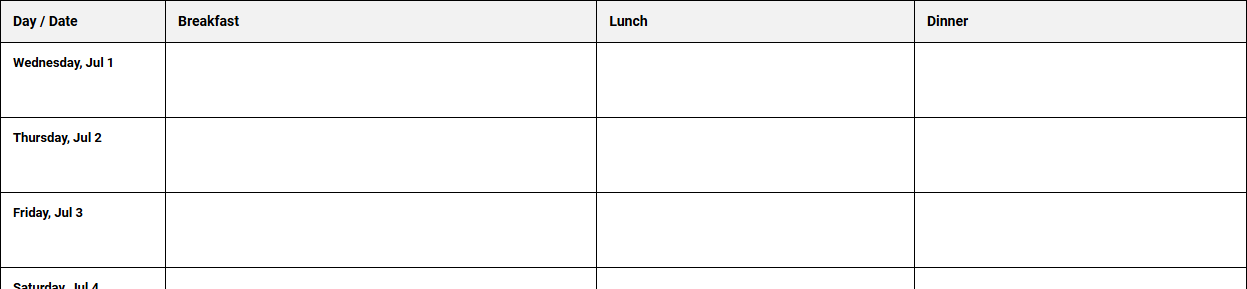
Managing daily household meals often leads to chronic decision fatigue and wasted ingredients. While standard time-management resources and grocery budgets provide a baseline, they rarely address daily menu execution. Utilizing a structured Daily Breakfast Lunch and Dinner Grid grants families immediate organization and dietary control. Though successful implementation stipulates a brief weekly planning commitment, the resulting efficiency is undeniable. Below, we outline strategies to maximize this printable calendar for your household.
Create Your Daily Breakfast Lunch and Dinner Grid
Done customizing?
Daily Breakfast Lunch and Dinner Grid - Good to Know
Meal prep grid
A meal prep grid serves as the foundational blueprint for organized culinary preparation. By visualizing your entire week on a spatial grid, you can systematically coordinate grocery shopping, ingredient prep, and batch cooking sessions. This structured approach minimizes food waste and prevents the mid-week decision fatigue that often leads to unhealthy takeout choices.
Utilizing a clean grid format allows you to see overlapping ingredients, meaning you can chop vegetables or roast meats once and distribute them across multiple dishes. To maximize efficiency, categorize your grid by:
- Prep days (e.g., Sunday and Wednesday)
- Storage container types (glass vs. BPA-free plastic)
- Preservation methods (refrigeration vs. freezing)
Many culinary enthusiasts find that dedicating just two hours on the weekend to populate their grid yields hours of reclaimed time during busy weeknights, while keeping nutritional goals firmly on track.
Daily food tracker
Implementing a daily food tracker is a powerful habit for anyone seeking to cultivate mindfulness around their eating patterns. This tool captures the immediate reality of your daily consumption, recording everything from main courses to spontaneous snacks and beverages. Beyond mere calorie counting, a detailed tracker helps you identify emotional triggers, hunger cues, and energy fluctuations correlated with specific foods.
By consistently documenting your intake, you develop a deeper awareness of how different macronutrients affect your physical performance and cognitive clarity throughout the day. To get the most out of your daily food tracker, consider logging these metrics:
- Time of consumption and hunger levels
- Water intake tracking (in ounces or milliliters)
- Post-meal physical symptoms or energy shifts
Logging your meals in real-time, rather than relying on memory at the end of the day, fosters immediate accountability and ensures every choice aligns with your broader wellness objectives.
Breakfast lunch dinner spreadsheet
A breakfast lunch dinner spreadsheet offers a highly structured, data-driven approach to managing your daily meals. This digital matrix organizes your culinary schedule into clear rows and columns, separating the three primary meals of the day for seamless tracking. By utilizing formulas and conditional formatting, you can automatically calculate nutritional totals, estimate weekly grocery costs, and even color-code meals based on specific dietary preferences or preparation times.
The spreadsheet format is particularly beneficial for families or individuals managing complex dietary restrictions, as it provides a clear, shareable visual overview that ensures everyone's nutritional needs are met. Whether you prefer a cloud-based solution or a local file, archiving your weekly spreadsheets builds a personal recipe library and historical record of your eating habits, making future meal planning effortless and highly customizable.
Weekly menu planner
Designing a weekly menu planner is an excellent strategy for bringing harmony and predictability to your kitchen. This proactive tool allows you to map out breakfast, lunch, dinner, and snacks for the entire week ahead, transforming grocery shopping from a chaotic chore into a streamlined mission. When you plan your menu in advance, you can strategically incorporate leftovers, schedule quick-cooking meals for busy evenings, and plan more elaborate culinary experiments for the weekends.
A well-designed planner also supports budgetary discipline by preventing impulse purchases at the supermarket. To enhance your planning experience, consider integrating these strategies:
- Establishing theme nights (e.g., Taco Tuesday or Meatless Monday)
- Checking your pantry inventory before writing the plan
- Leaving one night open for creative leftovers or dining out
Organizing your culinary life through a weekly planner ensures that nutritious, home-cooked meals remain a consistent reality.
Macro tracking template
A macro tracking template is an indispensable resource for athletes, fitness enthusiasts, and individuals with specific body composition goals. Rather than focusing solely on caloric volume, this specialized template breaks down your food intake into the three primary macronutrients: proteins, carbohydrates, and dietary fats. Achieving the optimal balance of these macros is essential for muscle recovery, sustained energy levels, and efficient metabolic function.
A well-designed template allows you to input custom target ratios based on your activity level and fitness objectives, showing real-time progress bars or percentage breakdowns as you log your food throughout the day. By monitoring these ratios closely, you can make precise adjustments to your diet, ensuring your body receives the exact fuel it needs to perform at its peak during intense workouts and daily activities.
Daily meal log
Maintaining a daily meal log provides a direct, uncomplicated snapshot of your nutritional habits. Unlike more complex tracking systems, a simple meal log focuses on the straightforward documentation of what you eat and when you eat it. This daily practice encourages immediate accountability and helps curb mindless grazing between meals. By writing down or digitally recording your food choices, you create a tangible connection between your dietary habits and your physical well-being.
Many individuals find that keeping a log reveals hidden patterns, such as afternoon energy slumps associated with high-sugar lunches, or dehydration mistaken for hunger. Keeping a consistent daily meal log builds a foundation of self-awareness, allowing you to make gradual, sustainable adjustments to your diet that support long-term health, vitality, and overall wellness without the stress of obsessive metric tracking.
Dietary intake journal
A dietary intake journal transcends basic food tracking by incorporating qualitative reflections alongside quantitative data. This holistic tool encourages you to document not only what you eat, but also how you feel before and after consumption. By noting symptoms like bloating, fatigue, skin breakouts, or mood shifts, you can identify potential food sensitivities and discover which ingredients truly nourish your body.
The dietary intake journal serves as an invaluable resource when working with nutritionists, dietitians, or physicians, providing them with rich, contextual data to guide their recommendations. Embracing this mindful journaling practice fosters a healthier, more intuitive relationship with food, shifting the focus from restriction to nourishment, and empowering you to make informed decisions that optimize your digestive health, systemic well-being, and daily energy levels.
Digital meal grid
Transitioning to a digital meal grid modernizes your nutritional planning by leveraging technology for greater convenience and flexibility. Accessible across smartphones, tablets, and laptops, a digital grid ensures your meal plan and shopping list are always at your fingertips. Many digital platforms allow you to drag and drop meals, import recipes directly from the web, and automatically generate consolidated grocery lists based on your planned ingredients.
This dynamic approach makes it incredibly easy to adapt to sudden schedule changes, swap out meals on the fly, and collaborate with family members in real-time. By centralizing your culinary planning in a digital space, you eliminate paper clutter and streamline the entire process, making consistent, healthy eating a seamless part of your modern, fast-paced lifestyle. You can synchronize your grid with online grocery delivery services for maximum efficiency.
Nourishment schedule
Establishing a structured nourishment schedule is key to stabilizing your metabolism and maintaining consistent energy levels throughout the day. Rather than eating sporadically or skipping meals, a nourishment schedule defines optimal windows for consuming meals and snacks, aligning with your body's natural circadian rhythms. This consistent timing helps regulate hunger hormones, prevents overeating at night, and ensures a steady supply of nutrients to support brain and muscle function.
When designing your schedule, consider your daily routine, workout times, and sleep patterns to create a balanced flow of nutrient delivery. Prioritizing regular intervals for hydration and nutrient-dense food intake supports digestive efficiency, cognitive focus, and athletic performance, helping you feel sustained, balanced, and vibrant from morning to night.
Portion control tracker
A portion control tracker is a practical tool designed to help you manage food volume without the need for meticulous calorie counting. By utilizing standardized visual guides, hand measurements, or color-coded containers, this tracking method ensures you consume the appropriate balance of food groups. Managing portion sizes is vital for weight management, digestive comfort, and preventing the sluggishness that follows overeating.
A dedicated tracker helps you visualize your plate, encouraging a healthy ratio of:
- Fibrous green vegetables and leafy greens
- Lean proteins for muscle maintenance
- Complex carbohydrates for sustained energy
- Healthy fats for hormone health
By documenting your portions, you train your eye to recognize appropriate serving sizes naturally over time, simplifying healthy eating and making it easier to maintain dietary balance over the long term.
Leave a comment