
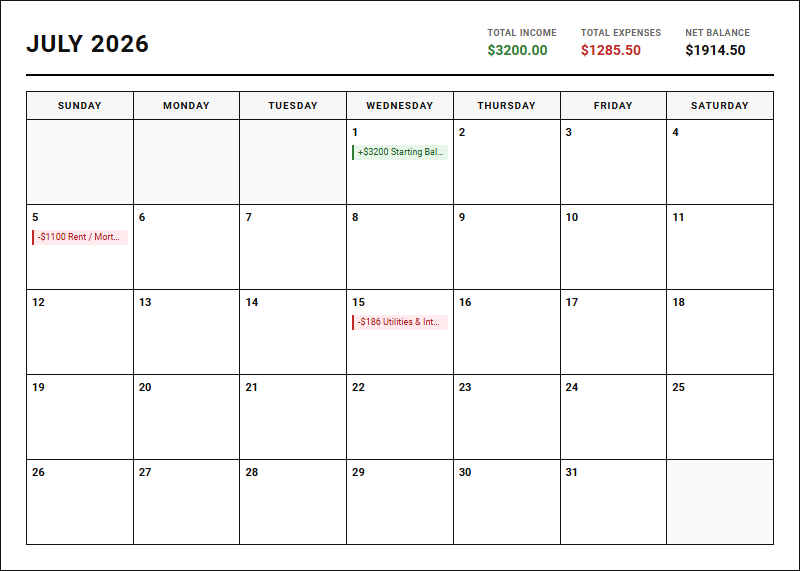
Managing fluctuating monthly expenses often leaves households feeling financially overwhelmed. While traditional income sources provide a baseline, tracking them requires precise organization. Blank and custom printable budget planner calendars grant users immediate visual control over cash flow. However, success stipulates consistent, active updating rather than passive monitoring. For instance, using a dedicated weekly zero-based calendar helps families eliminate hidden subscription leaks. Below, we outline how to customize these templates to master your financial planning.
Create Your Budget Planner Calendar
| Sunday | Monday | Tuesday | Wednesday | Thursday | Friday | Saturday |
|---|
Done customizing?
Budget Planner Calendar - Good to Know
Zero-based budget calendar
A zero-based budget calendar requires you to allocate every single dollar of your income to a specific financial category until your net balance reaches exactly zero. Unlike traditional budgeting methods that leave discretionary funds floating loosely in your account, this rigorous approach ensures that no money is left unaccounted for. By mapping this system onto a monthly calendar, you can visualize exactly when income arrives and when specific expenses, savings contributions, or debt payments must occur.
Implementing this calendar system allows you to proactively prevent impulse spending. When your schedule dictates where every dollar goes before the month even begins, you regain complete control over your cash flow. Consider these essential steps for success:
- Identify Total Income: Write down all incoming revenue sources at the start of the month.
- List Fixed Expenses: Note critical bills like rent, utilities, and insurance on their exact due dates.
- Allocate Residual Funds: Direct remaining balances to savings accounts, investments, or extra debt payments.
Payday budget planner
A payday budget planner aligns your spending cycle directly with your income stream. Instead of looking at your finances on a strict monthly basis, you plan your disbursements from one paycheck to the next. This method prevents the common mistake of spending too heavily early in the month and struggling before the next deposit. By breaking your financial timeline into smaller, manageable chunks, you can easily match specific bills to the paycheck that will fund them.
This planning style is exceptionally beneficial for households that experience irregular income or seasonal fluctuations. Using a chronological planner helps you allocate funds logically and maintain peace of mind. To optimize this strategy, follow this structured process:
- Map Pay Dates: Highlight all scheduled paydays on your physical or digital calendar.
- Assign Bills to Paychecks: Deduct specific recurring bills from the paycheck immediately preceding the due date.
- Determine Discretionary Allowances: Set aside pocket money and grocery funds for the specific days leading up to the next pay cycle.
Biweekly budget calendar
Managing a biweekly pay schedule can be challenging, but a biweekly budget calendar simplifies the process by mapping out the 26 pay periods that occur each year. Since most calendar months contain two paychecks, but some contain three, this specialized calendar helps you strategically allocate those "extra" paychecks that occur twice a year. Without a visual map, these bonus cycles are often absorbed by mindless spending rather than being leveraged for wealth creation.
By organizing your financial obligations biweekly, you can balance your cash flow more evenly across the entire year. It allows you to split large, monthly expenses-like mortgage payments or rent-into two smaller, more manageable deductions. This ensures your bank account balance remains stable, avoiding the dramatic peaks and valleys associated with monthly bill cycles. Consequently, you can build a more resilient and predictable financial life.
Sinking funds calendar
A sinking funds calendar is essential for managing irregular, non-monthly expenses like annual insurance premiums, holiday gifts, vacation costs, or car maintenance. Instead of facing a massive, stressful bill all at once, you break the total cost down into manageable monthly savings contributions. By plotting these target dates on a dedicated calendar, you can easily track how much money you need to save each month to hit your specific objectives.
This proactive strategy eliminates the shock of large, seasonal expenses and keeps your primary budget intact. To utilize this tool effectively, structure your savings goals using this simple methodology:
- Determine the Target Date: Mark the exact month or day the major expense is due.
- Calculate Monthly Savings: Divide the total estimated cost by the number of months remaining.
- Automate Transfers: Set up automatic recurring transfers to separate savings accounts dedicated to each fund.
Digital budget calendar
Embracing a digital budget calendar leverages modern technology to automate and streamline your financial management. By syncing your budget with cloud-based platforms like Google Calendar, Apple Calendar, or specialized personal finance applications, you can establish real-time notifications for upcoming bills and payday events. This dynamic accessibility ensures that your financial itinerary is always at your fingertips, whether you are on your computer or mobile device.
Digital solutions also offer unparalleled flexibility, allowing you to easily adjust dates, color-code different types of transactions, and set recurring reminders. You can share access with a partner or family member, fostering transparency and collaborative financial planning. Incorporating digital tools reduces human error, eliminates the clutter of paper statements, and provides a clean, searchable database of your historic financial commitments, making tax preparation and annual financial reviews significantly easier.
Bill payment calendar
Missing a bill payment can result in costly late fees, elevated interest rates, and severe damage to your credit score. A dedicated bill payment calendar solves this issue by providing a clear, chronological overview of all recurring liabilities. By visualizing your financial commitments on a monthly grid, you can easily spot weeks with heavy payment concentration and adjust your cash reserves accordingly to avoid overdraft fees.
Creating a highly visual system helps keep your financial integrity intact. It is beneficial to categorize your bills into groups to manage them more efficiently:
- Fixed Essential Bills: Highlight mortgage payments, utility bills, and insurance premiums.
- Variable Subscriptions: Track streaming services, gym memberships, and software subscriptions.
- Debt Obligations: Monitor minimum credit card payments, student loans, and auto loans.
Cash flow calendar tracker
A cash flow calendar tracker focuses entirely on the timing of your income and expenses. While a standard budget tells you how much money you can spend, a cash flow tracker shows you when that money is actually available. This distinction is critical for maintaining liquidity, as a positive net worth on paper does not prevent a temporary overdraft if your bills are due on the 5th and your paycheck does not arrive until the 15th.
By tracking daily balances, you can identify potential bottlenecks where outflows threaten to exceed inflows. This allows you to negotiate alternative due dates with service providers or adjust your spending habits to maintain a comfortable cash cushion. Implementing this proactive tracker ensures your checking account remains in a healthy, positive state throughout the entire month.
Financial goal calendar
Achieving long-term prosperity requires structure, and a financial goal calendar provides the timeline necessary to turn your aspirations into reality. Whether you want to build an emergency fund, pay off a credit card, purchase a home, or invest for retirement, this specialized tool keeps you accountable. Breaking massive, long-term goals into smaller, monthly milestones prevents burnout and provides consistent motivation as you cross off each achieved target.
A structured timeline transforms vague financial desires into actionable, time-bound objectives. Consider incorporating these key milestones into your tracker:
- Short-Term Milestones: Establish 1-to-3-month goals, such as saving a specific dollar amount for emergency reserves.
- Medium-Term Progress: Set 6-to-12-month targets, like paying down a specific loan balance.
- Long-Term Objectives: Outline multi-year targets, including retirement fund benchmarks or down payment savings.
Debt payoff tracker calendar
Visualizing your path to financial freedom is highly motivating, and a debt payoff tracker calendar serves as your strategic roadmap. By plotting your debt elimination strategy-such as the debt snowball or debt avalanche method-onto a monthly timeline, you can track your progress as outstanding balances decrease. Marking off completed payments and celebrating debt-free milestones on your calendar reinforces positive financial behaviors.
This visual system also helps you coordinate extra principal payments when extra cash becomes available. Seeing the actual date your debts will be fully resolved provides a tangible light at the end of the tunnel. This psychological boost helps you stay committed to your repayment plan, even during months when discretionary spending must be tightly restricted to meet your goals.
Expense tracking calendar
An expense tracking calendar offers a retrospective look at your daily spending habits. Rather than just planning for future costs, you log actual expenditures on the day they occur. This daily habit helps identify hidden patterns, impulse purchases, and areas where you might be overspending. Comparing your budgeted expectations against your actual daily spending calendar reveals the realistic state of your financial health.
Over time, this visual documentation helps you refine your budgeting categories to reflect reality more accurately. It highlights which days of the week pose the greatest spending temptations, allowing you to develop strategies to curb unnecessary consumption. Consistently updating this calendar builds strong financial awareness, making you a more conscious and deliberate consumer in every aspect of your life.
Leave a comment