
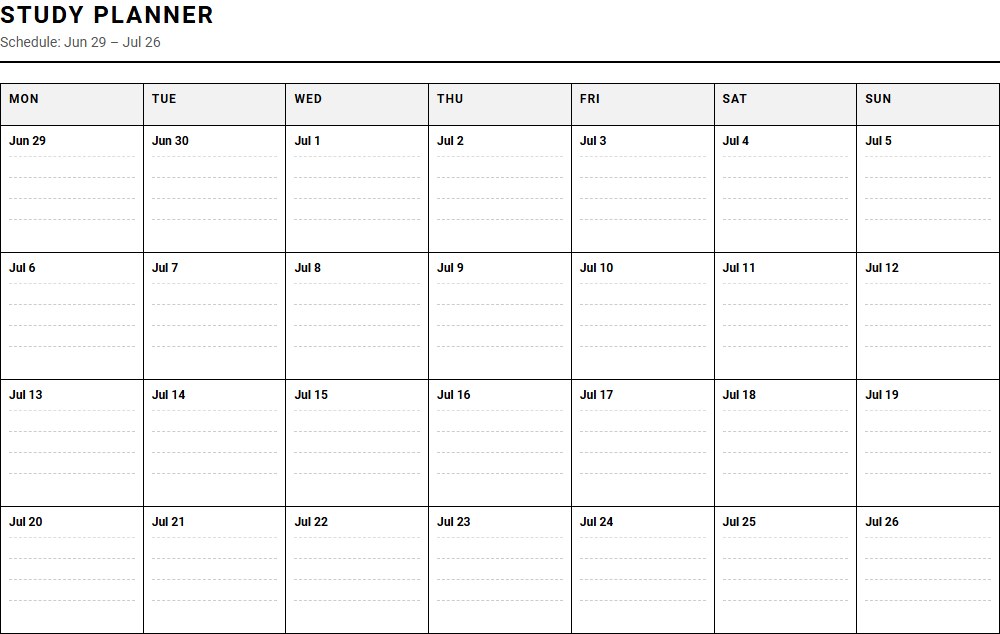
Balancing rigorous coursework often leads to academic burnout. While standard digital calendars or rigid pre-designed planners offer basic scheduling, they frequently fail to adapt to complex study flows. Printable custom templates grant students the precise flexibility needed to design tailored revision schedules.
However, effectiveness stipulates a structured approach to time-blocking. For instance, mapping weekly syllabus breakdowns and active recall intervals ensures consistent retention. Below, we examine the best strategies to configure your study planner calendar for maximum academic success.
Create Your Study Planner Calendar
Done customizing?
Study Planner Calendar - Good to Know
Time blocking
Time blocking is a highly effective time management methodology where you divide your day into distinct, dedicated blocks of time. Instead of working from an open-ended, overwhelming to-do list, this method forces you to assign every minute of your day to a specific task or category. By scheduling concrete blocks for deep study, administrative tasks, and personal breaks, you establish a clear boundary around your focus areas.
Using this approach minimizes the cognitive load associated with decision fatigue. When you know exactly what you should be working on at any given moment, you eliminate the constant distraction of multitasking. To implement this strategy successfully, consider the following layout:
- Focus Blocks: Dedicate 90-minute windows to high-priority, complex subjects.
- Buffer Blocks: Allocate 15-30 minutes for unexpected emails, queries, or quick rests.
- Recreation Blocks: Schedule non-negotiable downtime to ensure long-term sustainability.
Spaced repetition schedule
A spaced repetition schedule leverages the psychological spacing effect to help students move information from short-term to long-term memory. Rather than cramming large volumes of information right before an examination, you systematically review concepts at progressively larger intervals. This evidence-based technique directly counters the natural decay of memory known as the forgetting curve.
By organizing your study sessions so that you encounter difficult topics just as you are about to forget them, you stimulate neural pathways, reinforcing memory retention. Implementing a structured schedule typically involves tracking specific intervals for each topic:
- Immediate review (within 24 hours of first exposure)
- Short-term consolidation (3 days later)
- Intermediate reinforcement (7 days later)
- Long-term mastery check (30 days later)
Aesthetic study planner
An aesthetic study planner blends functional organization with visual appeal, transforming routine task tracking into an inspiring creative outlet. Utilizing cohesive color schemes, minimalist typography, and artistic layouts, these planners reduce academic anxiety and stimulate intrinsic motivation. When a workspace is visually pleasing, students are naturally more inclined to engage with their academic obligations daily.
"A beautiful layout clarifies a cluttered mind, making complex study targets feel achievable and inviting."
Whether designed on paper or via modern digital applications, an effective aesthetic planner should feature customized mood trackers, goal-setting sidebars, and clean habit-tracking grids. Balancing form and function ensures that the visual design enhances, rather than distracts from, the core task of learning. Selecting clean layouts, cohesive pastel or neutral color palettes, and elegant structural dividers will elevate your daily academic experience.
Academic calendar
An academic calendar serves as the foundational blueprint for a student's entire school year or university term. This high-level overview tracks vital institutional milestones, registration deadlines, examination periods, and official holidays. By maintaining a centralized, macro-level perspective of your academic timeline, you can anticipate high-pressure weeks and plan your preparation phases accordingly.
Integrating your syllabus details directly into an interactive digital calendar helps mitigate the risk of missed deadlines. This master schedule provides the necessary structural context to help you budget your time effectively over months rather than days. Essential items to include in this comprehensive calendar are:
- Major assignment submission deadlines and project due dates
- Midterm and final examination schedules
- Course registration, drop-add, and tuition payment deadlines
- National holidays, university breaks, and reading periods
Notion study template
A Notion study template offers unparalleled flexibility for modern students looking to build a highly customized digital workspace. By combining databases, relational links, and nested pages, Notion allows you to consolidate lecture notes, task lists, and academic resources into a singular, interconnected system. This centralized workspace eliminates the fragmentation that occurs when using multiple disconnected applications.
A typical high-performance template uses databases equipped with tag features, deadlines, and progress bars. You can dynamically filter these databases to view your tasks by urgency, subject area, or status. Through the use of customized toggles and embedded web widgets, you can craft an interactive study portal. The modularity of this tool enables you to scale your system seamlessly as your coursework grows more complex across semesters.
Revision timetable
A robust revision timetable is an indispensable tool when preparing for high-stakes standardized exams or final assessments. This schedule breaks down extensive course syllabi into manageable daily revision blocks, ensuring comprehensive coverage of all critical subjects. The primary objective is to eliminate the panic of cramming by promoting systematic, incremental mastery of your academic materials over time.
When constructing your revision timetable, prioritize your weakest subjects during your peak energy hours when mental clarity is highest. To maintain an realistic routine, build flexible rest days and review cushions into the schedule to accommodate unavoidable delays. A structured, realistic plan transforms an intimidating volume of information into a clear, linear path toward exam-day confidence and academic success.
Pomodoro planner
The Pomodoro planner is a time-management framework designed to maximize intense focus while preventing mental burnout. Centered around the famous Pomodoro Technique, this method organizes your study day into 25-minute periods of absolute concentration, called pomodoros, separated by short five-minute breaks. Every four cycles, you reward yourself with a longer, restorative rest of 25 to 30 minutes.
This rhythmic cycling of work and rest sustains a high level of mental agility throughout the day. It trains the brain to resist distractions, knowing a dedicated break is always just a few minutes away. To make the most of this planner, follow this structured routine:
- Select one task: Commit fully to a single objective per cycle.
- Work with intensity: Avoid checking phones or switching browser tabs.
- Rest fully: Walk away from your desk during breaks to refresh your eyes.
Active recall tracker
An active recall tracker is a specialized tool designed to monitor how efficiently you retrieve information from memory without looking at your notes. Unlike passive reading or highlighting, active recall forces the brain to construct an answer independently, which significantly strengthens neural connections. The tracker acts as a diagnostic ledger, logging your recall performance across multiple review sessions.
"Testing yourself, rather than re-reading text, is the single most powerful way to secure new knowledge."
Typically, this tracker records the date of each self-test along with a color-coded performance score (e.g., Red for poor recall, Yellow for partial recall, and Green for perfect recall). This visual diagnostic system allows you to identify weak spots instantly, ensuring that you target your remaining study hours where they are needed most.
Semester schedule
A semester schedule provides a comprehensive, medium-term overview of your weekly routine throughout the academic term. This schedule maps out your recurring commitments, such as university lectures, laboratory sessions, study groups, extracurricular activities, and part-time work. Establishing this fixed weekly skeleton helps you identify open windows of free time that can be allocated to self-directed study.
By visualizing how your weekly hours are distributed, you can strike a healthy, sustainable balance between your academic ambitions and personal life. Adjusting this schedule at the start of each semester ensures that you remain aligned with your evolving course demands. Understanding your fixed weekly time commitments prevents over-scheduling and protects you against the chronic exhaustion often experienced by busy students.
Leitner system calendar
The Leitner system calendar is a highly structured method of managing flashcards using a physical or digital box system based on the principles of spaced repetition. Flashcards are sorted into different boxes, each representing a different review frequency. Cards that are answered correctly graduate to the next box for less frequent review, while incorrect answers demote the cards back to box one.
The accompanying calendar dictates exactly which boxes need to be reviewed on any given day. This ensures you do not waste time reviewing concepts you have already mastered, allowing you to focus your mental energy on difficult material. A standard calendar configuration might operate as follows:
- Box 1: Reviewed every single day (unfamiliar or difficult terms).
- Box 2: Reviewed every other day (moderately understood terms).
- Box 3: Reviewed twice a week (well-retained concepts).
Leave a comment