
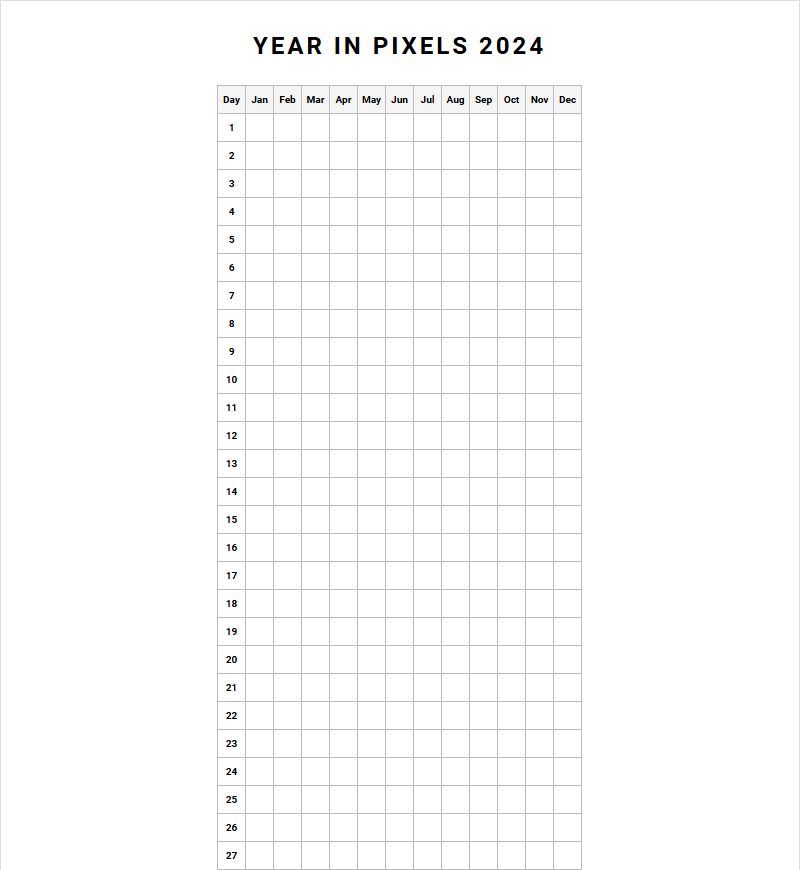
Staying committed to long-term fitness goals often feels overwhelming, leading many to abandon their resolutions early. While digital apps and rigid spreadsheets offer standard tracking options, they frequently lack tangible, long-term engagement.
The "Year in Pixels" printable calendar bridges this gap, granting users an immediate, visually rewarding overview of daily habits. Under the stipulation of consistent manual entry, tracking concrete metrics like a 10,000-step goal becomes an engaging ritual. Below, we outline how to configure your printable tracker for sustained success.
Create Your Year in Pixels Habit Tracker
Done customizing?
Year in Pixels Habit Tracker - Good to Know
Mood tracker
A mood tracker serves as a personal diagnostic instrument, allowing individuals to record their emotional states at regular intervals. By documenting daily feelings, users can identify subtle patterns, environmental triggers, and seasonal fluctuations in their overall well-being. This mindful practice encourages people to pause and assess their internal landscape, fostering a deeper connection with themselves.
Over time, the accumulated data reveals how external factors influence happiness, as outlined below:
- Sleep hygiene: Rest quality directly correlates with emotional resilience.
- Physical activity: Exercise acts as a natural endorphin booster.
- Social interactions: Quality time with loved ones mitigates stress.
Integrating a tracker into your daily routine promotes emotional regulation and self-awareness, yielding invaluable data for personal growth.
Bullet journal
The BuJo or bullet journal is a highly customizable, analog organization system developed by Ryder Carroll. It seamlessly combines scheduling, task management, brainstorming, and diary-keeping into a single notebook. Its modular nature allows users to adapt the layout to their evolving needs, making it an excellent medium for tracking habits and daily moods.
- Rapid Logging: Using quick bullet points and symbols to record tasks.
- Monthly Logs: Providing a birds-eye view of upcoming events.
- Future Logs: Mapping out long-term goals and aspirations.
By utilizing rapid logging, journalers can efficiently manage their daily responsibilities while reserving creative spaces for artistic expression, reflection, and habit tracking, turning a simple notebook into a comprehensive life archives system.
Pixel grid
A pixel grid is a highly visual representation tool where each day of the year is represented by a single square, or pixel. This grid layout, typically arranged in a twelve-month matrix, provides a compact yet comprehensive overview of an individual's emotional journey over a long period. By coloring in one pixel per day, users can visualize an entire year of moods on a single page.
"The pixel grid simplifies the complexity of human emotion into a beautiful, cohesive tapestry of colors."
This macroscopic view helps identify long-term trends, seasonal affective changes, and cyclical patterns that might otherwise go unnoticed in the noise of daily life, making it a favorite layout for artistic journalers.
Color-coded key
The foundation of any visual tracking system is a well-defined color-coded key. This legend assigns specific, consistent hues to distinct emotional states, energy levels, or mental conditions. By establishing a systematic spectrum, complex psychological states are translated into an intuitive visual language that is easy to interpret at a glance.
- Vibrant Yellow
- Represents high energy, joy, and productivity.
- Calm Blue
- Indicates tranquility, peace, and relaxation.
- Muted Gray
- Signifies low energy, apathy, or mild sadness.
This structured approach simplifies the logging process, enabling quick daily entries and immediate visual analysis without requiring lengthy, exhausting written explanations during stressful times.
Mental health tracking
Mental health tracking involves the systematic observation and documentation of psychological well-being. This proactive approach assists individuals in managing conditions like anxiety, depression, or chronic stress by identifying early warning signs of emotional distress. When shared with healthcare professionals, these detailed logs provide invaluable, objective data to guide therapeutic interventions.
By monitoring daily anxiety levels, panic triggers, and coping mechanism efficacy, individuals gain agency over their psychological wellness. This structured observation fosters self-advocacy, helping people recognize when to implement self-care strategies or seek external support before reaching a point of crisis.
Micro-journaling
Micro-journaling is the practice of writing brief, highly condensed entries instead of long-form, time-consuming narratives. This method significantly lowers the barrier to entry for journaling, making it highly accessible for individuals with busy lifestyles or limited writing endurance. By focusing on single sentences, bullet points, or ultra-short paragraphs, micro-journalists capture the essence of their day quickly.
Common prompts used in this practice include:
- What was the highlight of the day?
- One thing I am grateful for today.
- What challenged me today?
This highly sustainable practice ensures consistency over months and years, allowing individuals to maintain a continuous, valuable record of their life events and emotional shifts without experiencing journal fatigue.
Self-care log
A self-care log is a dedicated registry for tracking activities that actively nourish physical, mental, and emotional health. Documenting practices such as meditation, proper hydration, hobbies, and boundary-setting ensures that personal wellness remains a priority amidst daily professional demands. By monitoring these activities alongside mood logs, users can directly observe the positive correlations between deliberate self-care and improved emotional states.
To implement an effective self-care log, consider tracking the following categories:
- Physical: Sleep hours, water intake, nutritious meals.
- Mental: Reading, learning, digital detox time.
- Emotional: Therapy sessions, journaling, expressing gratitude.
This habit reinforces healthy behaviors, providing clear visual proof that dedicating time to oneself is crucial for sustaining overall life satisfaction.
Emotion mapping
Emotion mapping goes beyond basic mood tracking by exploring the complex landscape of human feelings and their physiological triggers. This technique involves identifying exactly where emotions are physically felt in the body and analyzing the environmental contexts in which they arise. By mapping these physical sensations and situational variables, individuals gain a granular understanding of their emotional triggers.
For example, anxiety might map to a tight chest, while excitement manifests as butterflies in the stomach. Recognizing these somatic cues allows for quicker emotional processing. This deep insight facilitates the development of healthier coping mechanisms, improved emotional intelligence, and more harmonious interpersonal relationships as individuals learn to respond rather than react to their internal states.
Daily reflection
Daily reflection is a quiet, meditative practice of looking back on the day's events, decisions, and feelings. Taking a few dedicated moments each evening to contemplate successes, challenges, and lessons learned promotes healthy cognitive processing and emotional closure before sleep. This deliberate pause helps prevent daily stressors from accumulating into chronic anxiety.
"We do not learn from experience... we learn from reflecting on experience."
Through regular reflection, individuals can align their daily actions with their long-term personal values. This practice transforms passive experiences into active lessons, fostering personal growth, gratitude, and a clearer sense of purpose in everyday life.
Digital pixel tracker
A digital pixel tracker modernizes the traditional analog grid through mobile applications and web-based platforms. These software solutions offer automated data visualization, instantly generating charts, correlation graphs, and weekly statistics from simple daily inputs. Digital trackers provide unmatched convenience, secure cloud backups, and privacy features like biometric password locks.
Key advantages of digital tracking systems include:
- Automatic reminders to ensure consistent logging.
- Data export capabilities for sharing with therapists.
- Advanced search functions to find past entries instantly.
By leveraging modern technology, users can easily maintain their tracking habits, receive daily reminders, and gain deeper, algorithmically-generated insights into their emotional well-being without the need for physical notebooks or art supplies.
Leave a comment