
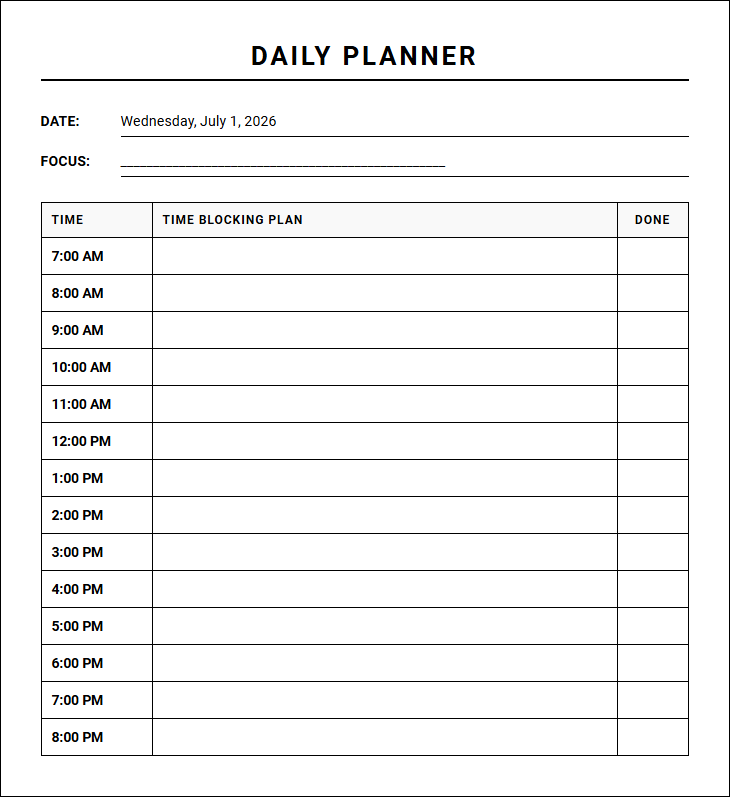
Managing a chaotic workday often leads to intense decision fatigue and lost productivity. While standard corporate funding sources typically prioritize complex digital enterprise software, these platforms often lack personal daily structure. Fortunately, a dedicated hourly time-blocking planner grants professionals immediate visual clarity and control. For sustainable success, however, one must apply realistic scheduling constraints-such as the 15-minute transition buffers featured in the Daily Agendas printable calendar. Below, we analyze how to effectively implement this framework.
Create Your Hourly Time Blocking Planner
Planner Details
Top Priorities
Hourly Time Blocks
Done customizing?
Hourly Time Blocking Planner - Good to Know
Time Boxing
Time boxing is a highly effective time management technique where you allocate a fixed, limited time period to a specific activity. By defining strict boundaries, you prevent tasks from expanding to fill your entire day, a phenomenon known as Parkinson's Law. This approach fosters a sense of urgency, boosting focus and reducing procrastination. Instead of working indefinitely on a project, you commit to a dedicated block of time, such as sixty minutes, and stop when the timer ends.
This structured constraint encourages you to prioritize essential actions. Many professionals combine this with the Pomodoro Technique to maintain peak mental agility. Implementing this strategy helps establish clear milestones and measurable progress. Consequently, you gain greater control over your daily schedule, transforming intimidating, large-scale projects into manageable, bite-sized achievements that fit seamlessly within your planned routine.
Zero-Based Calendar
A zero-based calendar requires you to account for every single minute of your day, leaving zero empty spaces on your schedule. Similar to zero-based budgeting, where every dollar has a specific job, this productivity method ensures that every hour is intentionally assigned to a task, meeting, rest period, or personal activity. By planning your day with such granular precision, you eliminate the cognitive load of deciding what to do next. You simply follow your pre-planned itinerary.
- Proactive Planning: Allocate time for commute, meals, and self-care.
- Reduced Decision Fatigue: Avoid wasting energy on spontaneous scheduling choices.
- Enhanced Accountability: Visualize exactly where your time goes each week.
This deliberate visualization exposes hidden gaps where time is typically wasted, helping you reclaim control over your daily life.
Deep Work Scheduling
Deep work scheduling, a concept popularized by Cal Newport, involves setting aside dedicated, distraction-free blocks of time for cognitively demanding tasks. During these sessions, you must disconnect from all communication channels, including emails, instant messaging, and social media. This allows your brain to reach a state of intense concentration required to solve complex problems or produce high-quality creative output.
- Identify high-impact tasks requiring deep cognitive focus.
- Block out uninterrupted periods of two to four hours.
- Eliminate environmental and digital interruptions completely.
By training your brain to sustain focus, you significantly improve both the quality and quantity of your output. This structured approach distinguishes shallow, administrative work from the valuable, creative breakthroughs that propel your professional career forward.
Task Batching
Task batching is the practice of grouping similar, low-cognitive tasks together and completing them during a dedicated time block. By clustering comparable activities, you minimize the mental friction caused by context switching-the process of jumping between unrelated tasks. When you switch focus constantly, your brain experiences a "cognitive residue" that degrades your overall productivity and focus.
- Administrative Batching: Answering emails, filing expenses, and updating spreadsheets simultaneously.
- Communication Batching: Returning phone calls and replying to messages in one session.
- Creative Batching: Brainstorming multiple content ideas or writing drafts in one sitting.
Consolidating these repetitive tasks allows you to streamline your workflow and maintain a steady momentum, ensuring your energy is preserved for more demanding creative challenges throughout the week.
Chronotype Scheduling
Chronotype scheduling aligns your daily task list with your biological clock, maximizing natural productivity peaks. Each individual falls into a specific chronotype-often categorized as Lions, Bears, Wolves, or Dolphins-which dictates their optimal times for waking, sleeping, and peak cognitive performance. By understanding your unique circadian rhythm, you can design a schedule that leverages your natural energy levels.
For example, Lions excel early in the morning and should schedule their most critical analytical work before noon. Conversely, Wolves experience a surge of energy in the late afternoon and evening, making that the ideal period for creative problem-solving. Aligning work demands with these biological peaks minimizes friction, reduces fatigue, and ensures you perform tasks when your brain is naturally most alert, rather than fighting against your body's internal clock.
Theme Days
Theme days involve dedicating entire days of the week to a single focus or category of work. This method is highly favored by entrepreneurs and executives who manage multiple departments and complex responsibilities. By assigning a specific theme to each day, you create a deep, cohesive cognitive focus that eliminates the mental fragmentation associated with multitasking.
- Monday: Marketing and brand outreach.
- Tuesday: Product development and design.
- Wednesday: Administrative tasks and team meetings.
- Thursday: Content creation and writing.
- Friday: Financial planning and weekly reviews.
This thematic consistency allows you to immerse yourself fully in one business area, facilitating deeper strategic thinking and preventing the constant interruption of competing priorities.
Ultradian Rhythm Planning
Ultradian rhythm planning is based on the biological cycles that govern our bodies throughout the day. Unlike circadian rhythms, which operate on a 24-hour cycle, ultradian rhythms are shorter cycles of roughly 90 to 120 minutes. During these cycles, our brains experience a peak of high-frequency brainwave activity followed by a 20-minute trough where energy and focus decline.
To optimize productivity, you should work in highly focused 90-minute blocks, followed by a mandatory 15-to-20-minute rest period. During these breaks, it is crucial to step away from screens, engage in light stretching, take a walk, or hydrate. Working in harmony with these natural biological waves prevents burnout, sustains high performance, and ensures that you do not push your brain past its natural capacity for deep concentration and mental clarity.
Hyper-scheduling
Hyper-scheduling is an intense, meticulous form of time management where every single activity-down to fifteen-minute increments-is mapped out on a calendar. This technique leaves virtually no room for ambiguity, ensuring that every minute of the working day is deliberately utilized. It is particularly effective for individuals managing exceptionally busy schedules who need to maximize efficiency.
By planning at such a granular level, you are forced to make realistic estimates about how long tasks actually take. This practice helps combat the planning fallacy-our natural tendency to underestimate task duration. While hyper-scheduling requires a high level of discipline, it provides an unparalleled visualization of your day. This clarity helps you identify inefficiencies, eliminate distractions, and commit fully to the task at hand without wondering what you should prioritize next.
Buffer Blocks
Buffer blocks are intentional, unstructured pockets of time integrated into your daily schedule to absorb unexpected delays, overruns, and spontaneous tasks. Without these cushions, a single meeting running late or an urgent, unplanned request can derail your entire day's agenda. Creating these strategic pauses ensures your calendar remains resilient under pressure.
- Transition Buffers: Short ten-minute gaps between back-to-back meetings to rest and prepare.
- Recovery Buffers: A thirty-minute block in the afternoon to handle urgent, last-minute emails.
- Mental Decompression: Time set aside to step away from work before transitioning home.
Integrating these flexible intervals reduces stress, prevents schedule collapse, and allows you to handle daily crises with composure while keeping your core priorities on track.
Day Chunking
Day chunking is a strategic productivity method that divides your day into distinct, broad phases, each dedicated to a specific type of mental energy. Unlike granular hourly scheduling, chunking focuses on matching your macro-level energy states with appropriate task categories. A typical workday can be split into three core chunks: morning, afternoon, and late afternoon.
The morning chunk is often designated for high-value, proactive work requiring peak cognitive stamina. The afternoon chunk is ideal for collaborative efforts, such as team meetings, brainstorming sessions, and client calls. Finally, the late afternoon chunk can be reserved for low-energy administrative tasks like email sorting, filing, and planning for the next day. This division ensures that you align your most demanding work with your highest energy reserves, maintaining steady productivity throughout the entire day.
Leave a comment