
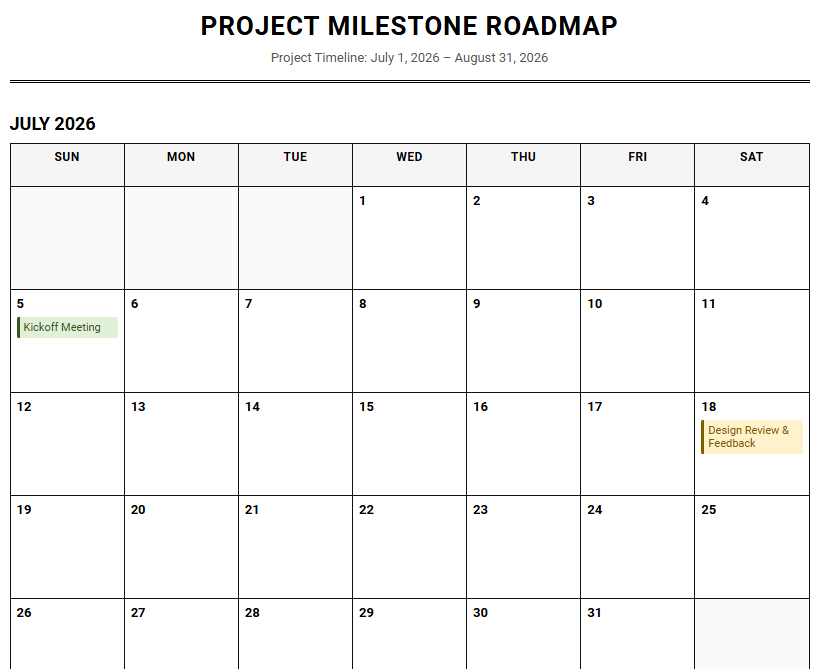
Managing complex project timelines often leads to missed deadlines. While standard funding sources secure a project's launch, financial backing alone cannot drive daily execution. A Project Milestone Tracker Calendar grants teams the precise visual clarity needed to align daily efforts with overarching goals. However, maximum efficiency is stipulated on active, daily team updates. Tracking specific milestones, such as product launch phases, ensures accountability. Below, we outline how to utilize this printable calendar to optimize your workflow.
Create Your Project Milestone Tracker Calendar
Done customizing?
Project Milestone Tracker Calendar - Good to Know
Gantt Chart
The Gantt Chart remains an indispensable tool in modern project management, offering a highly visual, horizontal bar chart that maps out tasks against a continuous timeline. This framework allows project managers and team members to comprehend the entire project lifecycle at a single glance. By defining start dates, end dates, and overlapping activities, teams can easily monitor progress and identify potential scheduling conflicts before they disrupt productivity.
Using Gantt charts enhances clarity across complex workflows. Key benefits include:
- Clear ownership: Assigning specific tasks to team members directly on the timeline.
- Progress tracking: Visualizing percentage-of-completion shading for individual bars.
- Resource management: Preventing team burnout by identifying overallocation of tasks.
Integrating these charts into your planning software ensures that team coordination remains synchronized, keeping stakeholders informed of milestones and shifts in real-time.
Critical Path Method
The Critical Path Method (CPM) is a mathematically based algorithm used for scheduling a set of project activities. By identifying the longest stretch of dependent tasks, CPM determines the absolute shortest time required to complete the entire project. Any delay in a critical path task directly impacts the final completion date, making these tasks the highest priority for project supervisors.
To implement CPM effectively, planners must categorize tasks based on flexibility. Consider the following structural components:
- Critical Tasks: Activities with zero float or slack time that must stay on schedule.
- Non-critical Tasks: Flexible activities that can be delayed slightly without affecting the final deadline.
- Float (Slack): The amount of time an activity can be delayed without delaying subsequent tasks.
Analyzing these components allows managers to allocate contingency resources precisely where they are needed most to secure project success.
Milestone Trend Analysis
Evaluating project trajectory requires tools like Milestone Trend Analysis (MTA), a graphical method used to monitor the progress of milestones over time. By plotting milestone completion dates against successive reporting intervals, managers can identify early warning signs of schedule slippage or optimistic planning. If the trend lines curve upward, it indicates persistent delays; downward curves represent accelerated progress.
MTA fosters a culture of honest reporting and proactive adjustments. It is exceptionally useful during executive reviews because it simplifies complex progress metrics into clean, interpretable visual trends. Regular reviews of these charts help teams recognize systemic planning flaws, encouraging more realistic estimating practices in future sprints. By maintaining a steady feedback loop, organizations cultivate a more resilient operational framework.
Dependency Mapping
In intricate projects, tasks rarely exist in isolation; they are bound by complex relationships. Dependency Mapping is the process of identifying, documenting, and managing these crucial interrelationships. By visualizing how the output of one task serves as the input for another, teams can prevent costly bottlenecks and resource idle time. This mapping ensures that sequential workflows remain fluid and logical.
Common dependency types analyzed during this process include:
- Finish-to-Start (FS): Task B cannot start until Task A finishes.
- Start-to-Start (SS): Task B cannot start until Task A has started.
- Finish-to-Finish (FF): Task B cannot finish until Task A finishes.
Proactively mapping these connections minimizes the risk of sudden project halts, fostering cross-functional alignment and improving overall team agility.
Sprint Roadmap
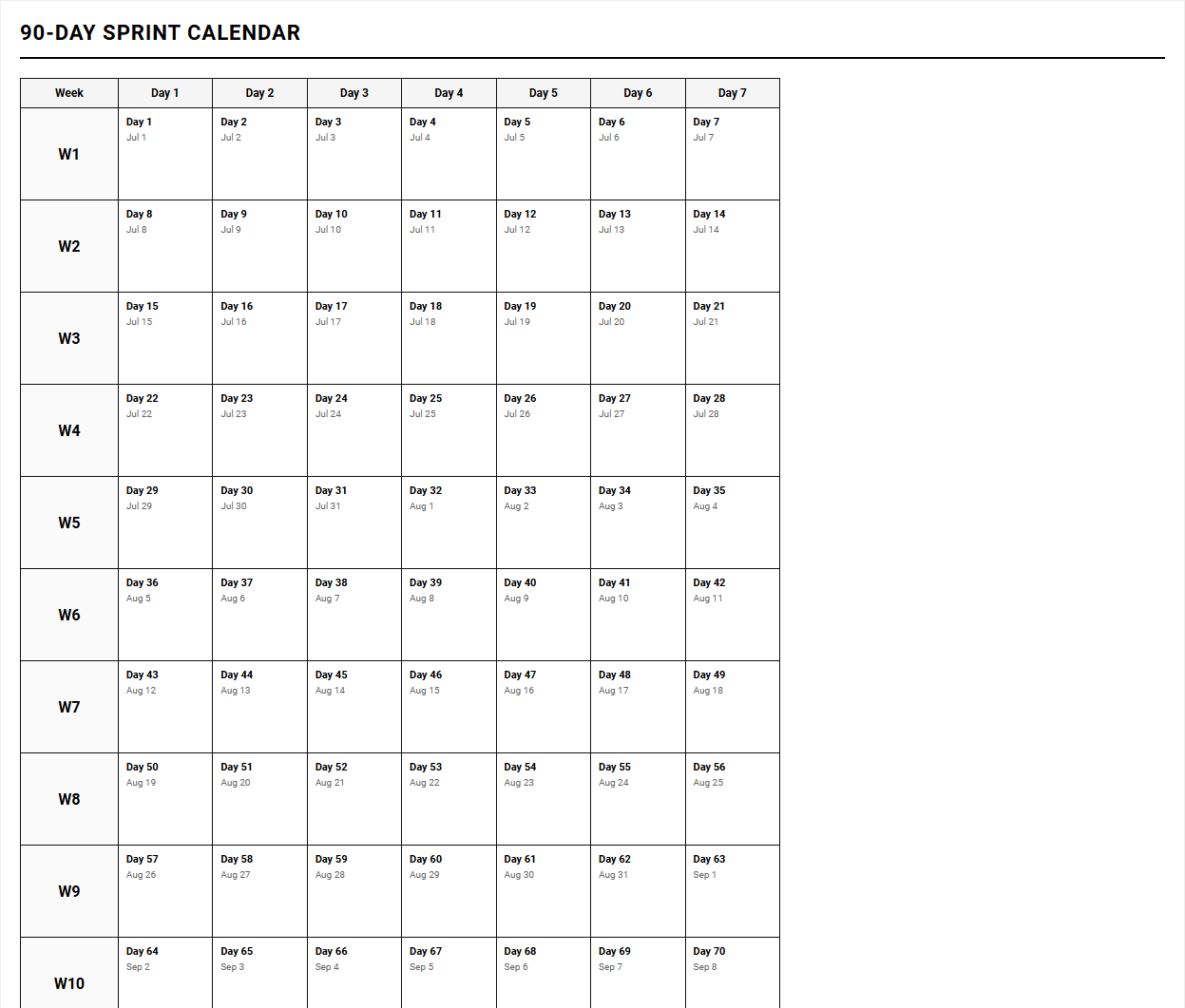
An essential artifact in Agile methodologies, a Sprint Roadmap outlines the strategic direction and short-term goals of upcoming development cycles. Unlike static plans, the sprint roadmap is highly adaptive, aligning the product backlog with broader organizational objectives over a series of short, focused iterations. This ensures that the development team delivers continuous value while maintaining the flexibility to pivot based on user feedback.
Typically structured over several weeks, the roadmap details high-level themes, epic progress, and specific sprint goals. It serves as a vital communication bridge between technical teams and external stakeholders, managing expectations without committing to rigid, long-term feature releases. Keeping the roadmap transparent ensures that everyone involved understands the immediate product vision and priority hierarchy.
Schedule Variance
To maintain strict control over project timelines, managers rely on Schedule Variance (SV), a metric calculated within Earned Value Management (EVM). Schedule Variance measures the difference between the work actually performed and the work scheduled for completion up to a specific point. Calculated as SV = Earned Value (EV) - Planned Value (PV), this metric provides an objective, numerical indicator of schedule performance.
Interpreting Schedule Variance values is straightforward but critical for decision-making:
- Negative SV: The project is behind schedule, requiring immediate intervention or resource reallocation.
- Positive SV: The project is ahead of schedule, potentially allowing for cost savings or scope refinement.
- Zero SV: The project is progressing precisely in line with the baseline plan.
Regularly calculated variance reports keep projects financially and operationally accountable.
Visual Timeline
While detailed databases and Gantt charts are perfect for managers, a simplified Visual Timeline is often the best tool for broader stakeholder engagement. A visual timeline presents key milestones, major phases, and high-level deliverables in an uncluttered, linear format. This simplification strips away complex dependencies and operational minutiae, focusing instead on the essential narrative of the project journey.
These timelines are ideal for executive presentations, marketing launches, and client onboarding sessions. By utilizing clean design principles, distinct color-coding, and intuitive icons, complex project phases become accessible to non-technical audiences. Maintaining an updated visual timeline ensures that external partners remain aligned with core project phases without getting overwhelmed by daily operational tasks.
Time Blocking
At the individual and small team level, Time Blocking serves as a powerful productivity technique to combat distractions and maximize output. This method involves dividing the workday into distinct blocks of time, with each block dedicated exclusively to a specific task or group of similar activities. By committing to a pre-planned schedule, professionals can deeply focus on high-priority objectives rather than constantly reacting to incoming notifications.
Effective time blocking encourages deep work and reduces cognitive fatigue caused by frequent multitasking. To implement this technique, individuals should audit their daily energy levels, designate blocks for administrative tasks, and protect their most creative hours for critical problem-solving. This disciplined approach structure transforms erratic workdays into structured, predictable engines of consistent professional progress.
Critical Chain
Derived from the Theory of Constraints, the Critical Chain project management method shifts focus from rigid task deadlines to flexible resource allocation and strategic buffer management. Unlike traditional scheduling, Critical Chain accounts for human behavior, such as Parkinson's Law, by stripping individual tasks of their safety margins. Instead, these individual buffers are pooled together and placed at the end of the project as a collective safety net.
Key buffers used in this methodology include:
- Project Buffer: Placed at the very end to protect the final delivery date from delays.
- Feeding Buffers: Inserted where non-critical paths merge into the main critical chain.
- Resource Buffers: Set to ensure key personnel are available when critical tasks begin.
This dynamic pacing model reduces project durations significantly while minimizing systemic multitasking bottlenecking.
Deliverable Deadline
Every successful project schedule culminates in a series of firm Deliverable Deadlines. A deliverable deadline is a concrete date by which a tangible, verified output-such as a software feature, market report, or physical prototype-must be submitted to the client or stakeholder. Unlike internal target dates, these deadlines are often contractually binding and tied directly to project financing, milestone payments, and organizational reputation.
Managing these deadlines requires rigorous quality assurance and realistic buffer estimation. Missing a deliverable deadline can trigger a cascade of delays throughout the supply chain or client organization. By establishing clear acceptance criteria and maintaining open lines of communication regarding potential obstacles, teams can confidently meet their external commitments, reinforcing trust and securing long-term business partnerships.
Leave a comment