
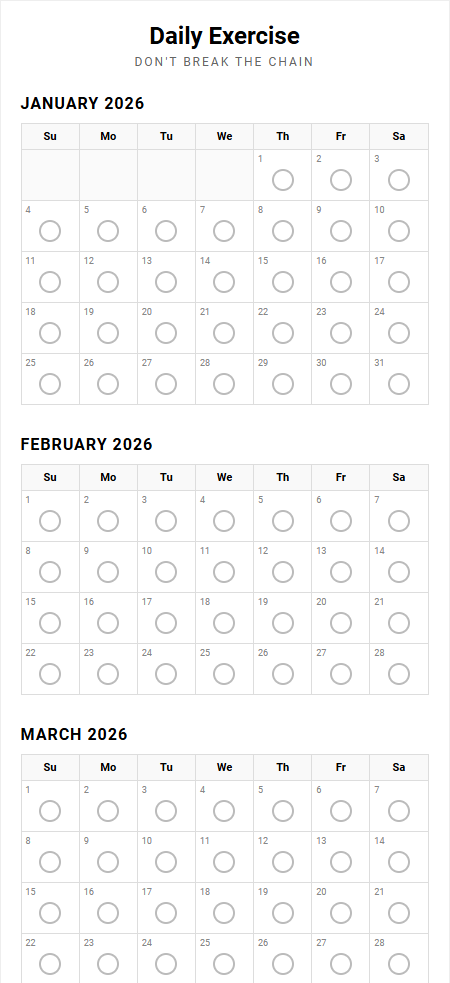
Many professionals struggle to maintain daily consistency, watching key goals slip away. While standard planners provide organization, they often fail to sustain momentum. The "Don't Break the Chain" Habit Calendar bridges this gap, offering a visual psychology famously used by figures like Jerry Seinfeld to lock in habits. Though success requires strict daily discipline, this printable tool turns routine into visible progress. Below, we outline how to implement this system to transform your daily productivity.
Create Your Don't Break the Chain Habit Calendar
Done customizing?
Don't Break the Chain Habit Calendar - Good to Know
Seinfeld Method
Jerry Seinfeld's productivity secret is remarkably simple yet incredibly effective: "don't break the chain." To implement this, you place a prominent wall calendar in a highly visible location and use a bold marker to track progress. For each day you complete your target task, you mark a large symbol over that day. After a few days, a visual chain begins to form.
Your sole objective is to avoid breaking this chain of consistency. This approach shifts your focus from a daunting long-term goal to a manageable daily action. By concentrating on the immediate daily task, you easily bypass procrastination.
- Provides an immediate dopamine hit upon completion.
- Shifts focus from results to the daily process.
- Builds an escalating psychological barrier against quitting.
Over weeks and months, this visual representation becomes an undeniable testament to your dedication, making daily execution an automatic habit.
Habit Streak
A habit streak represents consecutive days of performing a specific behavior, leveraging loss aversion to maintain momentum. Once a streak reaches a significant milestone-be it ten, fifty, or one hundred days-the psychological cost of breaking it rises dramatically. Human psychology naturally seeks to protect accumulated progress and avoid resetting back to zero.
This concept is widely used in modern software applications, but its core remains deeply rooted in classic behavioral psychology. Building a streak helps automate decisions, reducing the cognitive load associated with initiating action.
- Automates decision-making: Removes the daily debate of whether to perform the task.
- Enhances identity: Transitions your mindset from "trying" to "doing."
- Creates positive peer pressure: Sharing streaks fosters community accountability.
Instead of constantly debating whether to exercise or write today, the desire to preserve your hard-earned streak makes the choice completely automatic.
The X Effect
Originating from online self-improvement communities, The X Effect relies on a highly tactile, physical grid system. Typically, practitioners draw a hand-made seven-by-seven grid on an index card, representing a focused forty-nine-day challenge. Each day of successful execution receives a bold, physical marker mark directly on the paper.
This physical card is placed where it cannot be ignored, such as on a desk or nightstand. This tangible presence acts as a constant environmental trigger. Unlike digital notifications that can be easily swiped away, a physical card demands direct attention.
- Visceral satisfaction: The physical act of drawing carries more psychological weight than clicking a screen.
- Frictionless tracking: No apps, logins, or batteries required.
- Optimal duration: Forty-nine days is long enough to wire a new neural pathway.
The strategic timeline is short enough to feel achievable, yet long enough to establish lasting change.
Visual Progress Tracker
Visual progress trackers transform abstract goals into concrete reality. When progress remains invisible, motivation naturally wanes, leading to abandonment. By utilizing charts, progress bars, marble jars, or digital dashboards, you externalize your dedication. Seeing a visual representation of your hard work stimulates the brain's reward center.
This external feedback loop is crucial during the plateau phase of habit formation, where internal rewards are not yet apparent. Visual tracking provides objective data, removing emotional bias from your self-assessment.
Consider implementing one of these common tracking methods:
- A physical progress bar that you color in gradually.
- A jar filled with marbles representing completed sessions.
- A detailed digital spreadsheet with automated charts.
You no longer have to wonder if you are making progress; the evidence is displayed clearly before you, proving your daily efforts accumulate into meaningful results.
Micro-habits
Micro-habits involve scaling down desired behaviors to their absolute simplest form, making them practically impossible to fail. For example, instead of aiming to read for an hour daily, a micro-habit would be reading a single page. Instead of a grueling workout, you might do just one pushup.
This method targets the hardest part of any habit: the friction of starting. By lowering the barrier to entry, you bypass the mental resistance and procrastination that typically derail new routines. Once you begin the micro-action, you often find the momentum to continue far beyond the initial target.
- Establishes the neural loop of consistency first.
- Eliminates excuses related to time or energy.
- Allows you to scale up the intensity naturally.
Focusing on the routine first allows you to expand the habit once the pattern is firmly locked into your daily lifestyle.
Habit Stacking
Habit stacking is a powerful strategy that pairs a new habit with an existing, deeply ingrained daily routine. This formula relies on the brain's existing neural networks. Rather than trying to build a habit out of thin air, you anchor it to an established trigger, such as pouring your morning coffee or brushing your teeth.
The basic formula is straightforward: "After [Current Habit], I will [New Habit]." This approach eliminates the need to decide when and where to perform the new behavior, drastically reducing decision fatigue.
- Identify your current, non-negotiable daily habits.
- Select a new micro-habit to insert immediately after.
- Execute the stack consistently to build a strong association.
By piggybacking on reliable triggers, you utilize pre-existing cognitive pathways to automate new behaviors, making the integration of positive changes seamless and highly sustainable.
Red X Method
The Red X Method is a variation of traditional tracking that emphasizes the visceral impact of color psychology. The color red is universally associated with importance, urgency, and focus. When applied to a progress tracker, a bold red mark commands immediate cognitive attention.
This striking visual cue serves two main functions: it acts as a highly satisfying badge of daily success, and it highlights any gaps in performance with glaring clarity. Empty spaces on a calendar stand out starkly against a sea of vibrant red markers.
- High contrast: Makes missed days look jarring and uncomfortable.
- Psychological weight: Red triggers a stronger emotional response than neutral colors.
- Simplicity: Focuses purely on binary success or failure.
By leveraging this intense visual contrast, the Red X Method ensures that your daily commitments remain at the absolute forefront of your conscious awareness.
Streak Freeze
While consistency is vital, rigid systems often fail because life is inherently unpredictable. The Streak Freeze concept introduces necessary flexibility into habit building, preventing the devastating "all-or-nothing" psychological trap. When a person misses a single day, they often experience a sense of failure that leads to complete abandonment.
A streak freeze acts as a buffer-a safety valve that allows you to pause your progress without resetting your score to zero. This mechanism recognizes that occasional disruptions are inevitable.
To use this strategy effectively, consider these guidelines:
- Limit freezes to a maximum of two per month.
- Never allow two freeze days to occur consecutively.
- Earn freeze tokens through periods of perfect consistency.
By incorporating planned flexibility, you maintain long-term motivation, ensuring occasional disruptions do not ruin your momentum.
Gamified Consistency
Gamified consistency applies game design elements to personal development, turning routine habits into an engaging adventure. By incorporating experience points, level-ups, quests, and virtual rewards, this approach taps into our innate desire for play and achievement.
Digital platforms often structure habits as virtual battles or building projects, where daily completion translates to in-game currency or character progression. This gamification transforms mundane tasks into exciting challenges, making the process intrinsically rewarding.
- Dopamine alignment: Leverages gaming feedback loops for positive real-world actions.
- Social integration: Allows you to form guilds or complete quests with friends.
- Tangible progression: Translates efforts into measurable levels and stats.
Reframing routine chores as active quests shifts your mindset from obligation to play, keeping motivation high even during periods of low willpower.
Behavioral Design
Behavioral design is the practice of systematically altering your environment to make good habits easy and bad habits difficult. This methodology recognizes that human willpower is a finite resource, and relies instead on architecting your surroundings to guide your choices automatically.
If you want to floss daily, you place the dental floss directly next to your toothbrush. If you want to practice an instrument, you place it on a stand in the middle of your living room rather than hiding it away in a dark closet.
- Reduce friction: Make the desired behavior as easy to access as possible.
- Increase friction: Put barriers between yourself and bad habits.
- Optimize cues: Ensure positive triggers are highly visible in your space.
By designing a path of least resistance, your environment becomes an active partner that naturally leads you to long-term success.
Leave a comment