
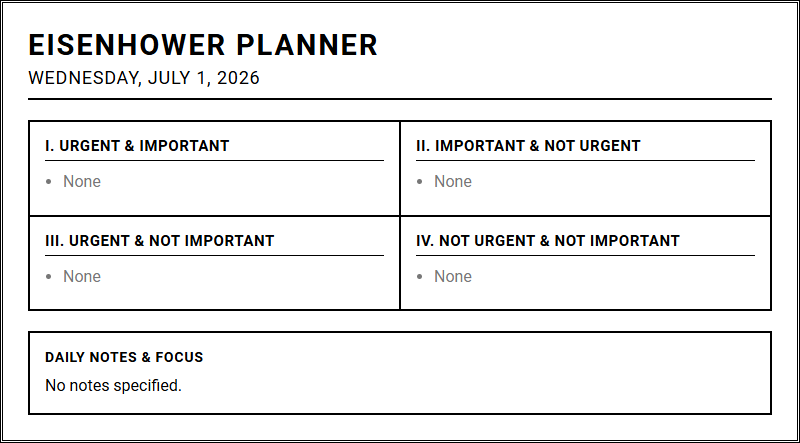
Professionals often struggle to maintain focus amidst chaotic daily schedules. While standard digital calendars track your time, they lack a strategic prioritization framework. Integrating a Daily Agendas printable calendar powered by the Eisenhower Matrix grants users immediate cognitive clarity and control. However, long-term success requires a commitment to strictly categorizing tasks by urgency and importance, specifically utilizing the four classic quadrants. Below, we examine how this prioritized planner structures your day for peak efficiency.
Create Your Eisenhower Matrix Prioritized Planner
|
I. Urgent & Important
|
II. Important & Not Urgent
|
|
III. Urgent & Not Important
|
IV. Not Urgent & Not Important
|
No notes specified.
Done customizing?
Eisenhower Matrix Prioritized Planner - Good to Know
Urgent-Important Matrix
The Urgent-Important Matrix, frequently associated with high-efficiency workflows, serves as a powerful cognitive tool for categorizing daily responsibilities. By separating tasks based on their immediate deadlines versus their long-term value, professionals can navigate overwhelming workloads with systematic precision. This matrix forces individuals to distinguish between mere noise and genuine progress.
Implementing this system involves mapping your current to-do list onto a simple grid. The horizontal axis represents urgency, while the vertical axis represents importance. Understanding this distinction prevents the common trap of reactive working, where one constantly responds to burning issues while neglecting strategic development.
- Urgent tasks demand immediate attention and are often associated with achieving someone else's goals.
- Important tasks contribute to long-term mission, values, and vital professional objectives.
By regularly auditing your commitments through this analytical lens, you cultivate a sustainable workflow that prioritizes meaningful advancement over chaotic busywork.
Four Quadrants Method
The Four Quadrants Method operationalizes task sorting by dividing a grid into four distinct zones, each requiring a unique behavioral response. This classification scheme optimizes decision-making by pre-determining the action required for any given responsibility. Instead of debating what to do next, you simply look at the quadrant designation.
- Quadrant I (Do): Crises, pressing problems, and deadline-driven projects that require instant execution.
- Quadrant II (Plan): Strategic planning, relationship building, and personal development activities.
- Quadrant III (Delegate): Interruptions, some meetings, and popular activities that mimic urgency.
- Quadrant IV (Eliminate): Trivia, busywork, and excessive escape activities that drain productive energy.
By consciously shifting focus toward Quadrant II, individuals can prevent crises before they manifest. Cultivating a habit of proactive planning reduces the time spent putting out fires in Quadrant I, leading to a balanced and highly productive professional life.
Task Prioritization Framework
A robust Task Prioritization Framework acts as an organizational compass in fast-paced corporate environments. Without a structured methodology, human psychology naturally gravitates toward easier, low-impact tasks, leaving critical objectives unfulfilled. Applying a standardized framework removes emotional bias from your daily schedule, ensuring that resources are allocated to high-yield projects first.
"Prioritization is not about doing more things; it is about doing the right things at the right time with the maximum focus."
To establish this framework, professionals must evaluate each assignment against predefined metrics, such as potential return on investment, resource availability, and alignment with organizational benchmarks. This analytical evaluation establishes clear boundaries, allowing team members to confidently decline low-value requests. The consequence of this structured approach is a significant reduction in project bottlenecks and a substantial increase in team performance and overall output quality.
The 4 Ds of Productivity
The 4 Ds of Productivity offer an actionable protocol for processing incoming tasks, emails, and projects rapidly. This method streamlines workflow management by restricting your response options to four specific choices, thereby preventing decision fatigue. When faced with a new demand, you must immediately select one of the following paths:
- Do: If a task takes less than two minutes, complete it immediately without hesitation.
- Defer: If it requires significant time, schedule a specific block on your calendar to address it later.
- Delegate: If someone else possesses the skills or capacity, transfer the responsibility promptly.
- Delete: If the task lacks measurable value or relevance, remove it entirely from your queue.
Applying this rapid-fire decision model prevents inbox clutter and reduces the mental overhead of carrying unfinished business, leading to a streamlined, highly functional work day.
Covey Time Management
Popularized by leadership expert Stephen Covey, the Covey Time Management philosophy emphasizes relationship preservation and long-term effectiveness over mere speed. This paradigm argues that time management is actually self-management. Instead of focusing on clocks and schedules, individuals should focus on their compass, which aligns daily actions with core values and overarching life goals.
This approach advocates for a weekly planning cycle rather than a daily scramble. By scheduling your "big rocks"-the most critical commitments-first, you guarantee that essential goals receive adequate focus before minor distractions fill your schedule. Consequently, this holistic strategy fosters professional growth, reduces burnout, and ensures that personal well-being is never sacrificed for superficial professional victories.
Action Priority Matrix
The Action Priority Matrix is an invaluable tool for maximizing return on effort. By plotting tasks along two dimensions-effort required and potential impact-this matrix categorizes items into four operational segments. This visualization helps teams rapidly identify low-hanging fruit and avoid high-effort, low-reward traps.
- Quick Wins: High impact, low effort. These tasks should be executed immediately to build momentum.
- Major Projects: High impact, high effort. These require dedicated, planned focus blocks.
- Fill-ins: Low impact, low effort. Do these only when you have spare time between major tasks.
- Thankless Tasks: Low impact, high effort. These should be actively minimized or avoided entirely.
Utilizing this matrix ensures that energy is deployed strategically, magnifying the visible results of your hard work while conserving valuable cognitive resources.
Cognitive Load Reduction
Modern professionals operate in an environment saturated with digital distractions, making Cognitive Load Reduction vital for maintaining high performance. Human working memory is a finite resource; overloading it with unresolved commitments, open tabs, and chaotic schedules degrades decision-making quality. Reducing this burden requires externalizing your memory through reliable organizational systems.
"Your brain is for having ideas, not holding them." - David Allen
By documenting every commitment, idea, and task in a trusted external system, you free up processing power for deep work and creative problem-solving. This cognitive offloading minimizes anxiety and enhances focus, enabling you to dedicate your full intelligence to the complex challenge directly in front of you without distraction.
Digital Kanban Integration
Integrating a Digital Kanban system translates abstract priorities into a highly visual, tactile workflow. Kanban relies on cards and columns to track progress from initiation to completion. This visual layout immediately highlights bottlenecks, making it clear where tasks are accumulating and why projects are stalled.
- To-Do: A backlog of prioritized tasks waiting for execution.
- In Progress: Active tasks, strictly limited to prevent multitasking.
- Done: Completed items, providing positive reinforcement and a clear history of progress.
By enforcing limits on Work-in-Progress (WIP), Digital Kanban forces focus on completing current tasks before starting new ones. This shift from starting to finishing significantly accelerates delivery times and improves team alignment across complex projects.
Time Boxing Technique
The Time Boxing Technique transforms task management by shifting focus from task lists to strict temporal boundaries. Instead of working on a task until it is completed, you allocate a fixed, unyielding block of time to that activity. This method leverages Parkinson's Law, which states that work expands to fill the time available for its completion.
- Estimate the realistic duration required for a specific task.
- Schedule a dedicated block of time on your calendar for this work.
- Eliminate all external distractions during this designated period.
- Stop working when the time box expires, assessing your progress objectively.
This deliberate constraint prevents perfectionism, enhances concentration, and guarantees that minor tasks do not consume hours of valuable time that should be spent on higher-priority objectives.
Elimination Quadrant
The Elimination Quadrant focuses entirely on stripping away the non-essential tasks that deplete organizational efficiency. Often overlooked, this quadrant is where unproductive habits, redundant reporting, and administrative bloat reside. Identifying and ruthlessly purging these items is crucial for maintaining a lean and agile workflow.
To successfully utilize this concept, one must challenge the necessity of recurring commitments and automatic acceptances. Asking critical questions about the actual value generated by specific meetings or daily routines often reveals opportunities for systemic elimination. Removing these low-value activities creates the necessary space to focus on high-impact strategies, leading to sustained personal and professional growth.
Leave a comment