
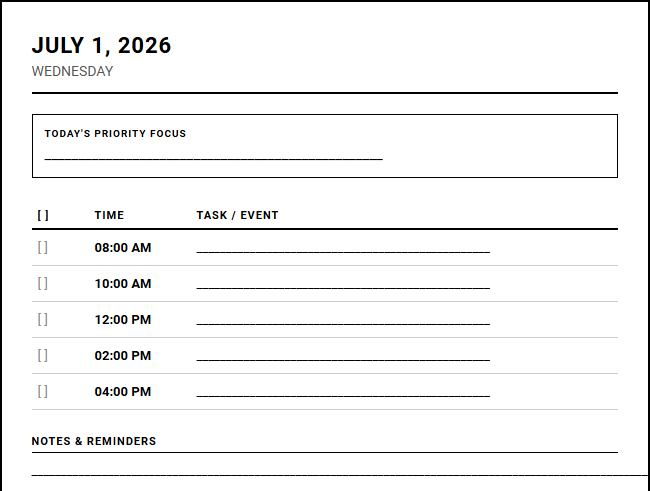
Staying organized in a fast-paced work environment is a constant struggle, often leading to burnout. While teams often rely on standard operational funding sources to secure complex digital tools, simple physical alternatives are frequently overlooked. Utilizing a printable daily agenda grants professionals immediate, distraction-free cognitive clarity. Note that templates are tools, not cures; they require daily discipline to be effective. Incorporating proven systems like the 'Top 3 Priorities' block ensures maximum efficiency. Next, we will examine how to select and implement the ideal tracker for your workflow.
Create Your Daily To Do List Tracker
| [ ] | Time | Task / Event |
|---|
Done customizing?
Daily To Do List Tracker - Good to Know
Time blocking
Time blocking is a highly effective scheduling method where you carve out dedicated segments of your day for specific tasks or projects. Instead of working from a reactionary, open-ended to-do list, you proactively assign every hour of your workday to a particular activity. This method minimizes cognitive fatigue by eliminating the constant decision-making of what to do next. To implement this strategy successfully:
- Assess your daily biological peaks to schedule high-focus work when energy is highest.
- Group administrative tasks like email correspondence into designated, shorter blocks.
- Include buffer blocks to handle unexpected interruptions or spontaneous meetings.
By treating these time blocks as non-negotiable appointments with yourself, you cultivate deep focus and protect your schedule from external demands. It transitions your workflow from reactive chaos to structured productivity, allowing you to make measurable progress on high-priority objectives.
Eisenhower matrix
The Eisenhower matrix is a powerful decision-making framework designed to help you prioritize tasks by analyzing their urgency and importance. This matrix divides your workload into four distinct quadrants, guiding your immediate actions and long-term planning.
- Do First: Urgent and important tasks requiring immediate attention, such as critical deadlines or emergencies.
- Schedule: Important but not urgent tasks, which are vital for long-term growth and should be scheduled carefully.
- Delegate: Urgent but unimportant tasks that can be handed off to others to free up your cognitive capacity.
- Eliminate: Neither urgent nor important tasks that act as distractions and should be ruthlessly discarded.
By systematically filtering your daily responsibilities through these four categories, you prevent urgent but trivial tasks from crowding out the truly impactful work that drives your career and personal life forward.
Habit tracking
Habit tracking provides a visual record of your daily behaviors, leveraging the psychological power of momentum to build lasting routines. By checking off completed habits on a daily basis, you create an immediate feedback loop that triggers a small release of dopamine, reinforcing the positive behavior. This technique is highly effective because it focuses on the process rather than just the final outcome.
- Visual motivation: Seeing an unbroken chain of completed tasks builds strong psychological resistance against skipping a day.
- Self-awareness: It exposes patterns in your behavior, revealing which days or environments lead to slip-ups.
- Incremental progress: It emphasizes small, compounding daily improvements over overwhelming, sudden lifestyle overhauls.
Whether you use a simple paper journal or a sophisticated digital app, maintaining a habit tracker transforms abstract goals into concrete, daily actions that gradually reshape your personal identity and long-term capabilities.
Task batching
Task batching is the practice of grouping similar, low-effort tasks together and completing them during a dedicated time period. This method targets the high cognitive cost of context switching, which occurs when your brain repeatedly transitions between vastly different activities. When you batch tasks, you maintain a singular mental state, allowing you to reach a deeper state of flow.
For example, instead of answering emails instantly throughout the day, you might batch communications into two specific blocks: one in the late morning and one before signing off. Similarly, content creators might batch outline writing, recording, and editing into separate days. By consolidating repetitive administrative activities, you free up large, uninterrupted blocks of time for deep, creative thinking. Consequently, this approach significantly reduces mental fatigue, increases your overall output, and ensures that your focal energy remains sharp and undivided.
Digital planner
A digital planner serves as a dynamic, centralized hub for your schedule, tasks, and notes, offering unparalleled flexibility compared to traditional paper systems. By integrating calendars, reminders, and databases, digital planners allow you to seamlessly synchronize your schedule across multiple devices. This ensures that your plans are always accessible, whether you are working at your desk or commuting.
Key advantages of adopting a digital planning system include:
- Infinite customizability: Easily modify layouts, add hyperlinked pages, and reorganize sections without ruining the aesthetic.
- Search functionality: Retrieve archived notes, past meeting agendas, and future goals in a matter of seconds.
- Automation: Set recurring tasks and sync deadlines directly with external email and calendar applications.
This modern approach to organization minimizes clutter, reduces physical baggage, and provides an adaptable framework that evolves alongside your shifting professional and personal priorities.
ADHD-friendly task manager
An ADHD-friendly task manager is specifically engineered to accommodate neurodivergent minds by reducing executive dysfunction and cognitive overload. Traditional, linear to-do lists can often feel overwhelming or visually monotonous, leading to task paralysis. In contrast, ADHD-friendly systems prioritize high-contrast visual cues, minimal friction for task entry, and interactive elements that maintain engagement.
These tools frequently incorporate features like progress bars, color-coded urgency indicators, and customizable widgets that make tasks feel tangible. By offering flexible viewing options-such as toggling between Kanban boards, lists, or calendar views-users can adapt the interface to match their fluctuating focus levels. Additionally, incorporating gentle, non-intrusive notifications helps prevent time blindness, ensuring that critical deadlines are met without triggering anxiety. This supportive digital environment transforms task organization from a source of stress into a manageable, structured, and validating process.
Gamified productivity
Gamified productivity applies game design elements, such as experience points, levels, quests, and virtual rewards, to mundane daily responsibilities. By reframing boring chores and complex professional assignments as engaging quests, you tap into your brain's intrinsic reward pathways. This method turns self-improvement into an interactive adventure, where completing tasks directly contributes to character growth or unlocks digital achievements.
- Experience Points (XP): Earn points for every task checked off, visualising your productivity growth.
- Custom Rewards: Exchange accumulated points for real-life treats, like a favorite snack or guilt-free leisure time.
- Social Accountability: Join guilds or parties with friends to tackle shared goals and maintain collective motivation.
This playful structure bypasses procrastination by injecting fun and immediate gratification into long-term goals. It proves that discipline does not always require strict austerity; instead, it can be sustained through playfulness, creativity, and consistent positive reinforcement.
Kanban board
A Kanban board is a visual project management tool that maps out workflows using cards, columns, and swimlanes. Originating from Japanese manufacturing principles, this agile system helps individuals and teams visualize work progress, limit work-in-progress, and maximize efficiency. Each card represents a unique task, which is moved from left to right across various stages of completion.
Typically, a basic Kanban layout consists of three primary columns:
- To Do: A backlog of pending tasks that need to be addressed.
- In Progress: Tasks currently being actively worked on, highlighting current cognitive load.
- Done: Successfully completed items, providing a satisfying visual record of achievement.
By restricting the number of tasks allowed in the "In Progress" column, Kanban prevents multitasking and highlights bottlenecks. This visual clarity fosters collaborative transparency and ensures a steady, sustainable flow of productivity.
Timeboxing
Timeboxing is a results-oriented productivity technique where you allocate a fixed, rigid period of time-called a "box"-to a specific activity. Unlike time blocking, which simply schedules the activity, timeboxing sets a strict limit on how long you can spend working on it. This approach leverages Parkinson's Law, which states that work expands to fill the time available for its completion.
By working against a ticking clock, you are forced to make rapid decisions, bypass perfectionism, and focus strictly on the core requirements of the task. Common intervals include thirty-minute or one-hour boxes, followed by a brief recess. This method is incredibly useful for open-ended projects, such as research or creative writing, which can easily consume entire days if left unrestricted. Adopting a strict time limit builds momentum, instills urgency, and ensures that you deliver functional results within predefined boundaries.
Micro-tasking
Micro-tasking is the practice of breaking down large, intimidating projects into the smallest possible actionable components. When faced with a massive objective, our brains often perceive it as a threat, triggering procrastination and avoidance behaviors. By deconstructing a major goal into bite-sized, micro-steps that take less than ten minutes to complete, you lower the barrier to entry.
- Reduce friction: Starting is the hardest part; a tiny task requires minimal willpower.
- Build momentum: Each micro-task completed creates a sense of accomplishment, propelling you to the next step.
- Clarify action: "Write report" is vague; "Write introduction paragraph" is highly specific and manageable.
This granular strategy is highly effective for overcoming initial resistance. It shifts your focus from the overwhelming scale of the mountain to the simple act of taking the very next step, leading to steady progress.
Leave a comment