
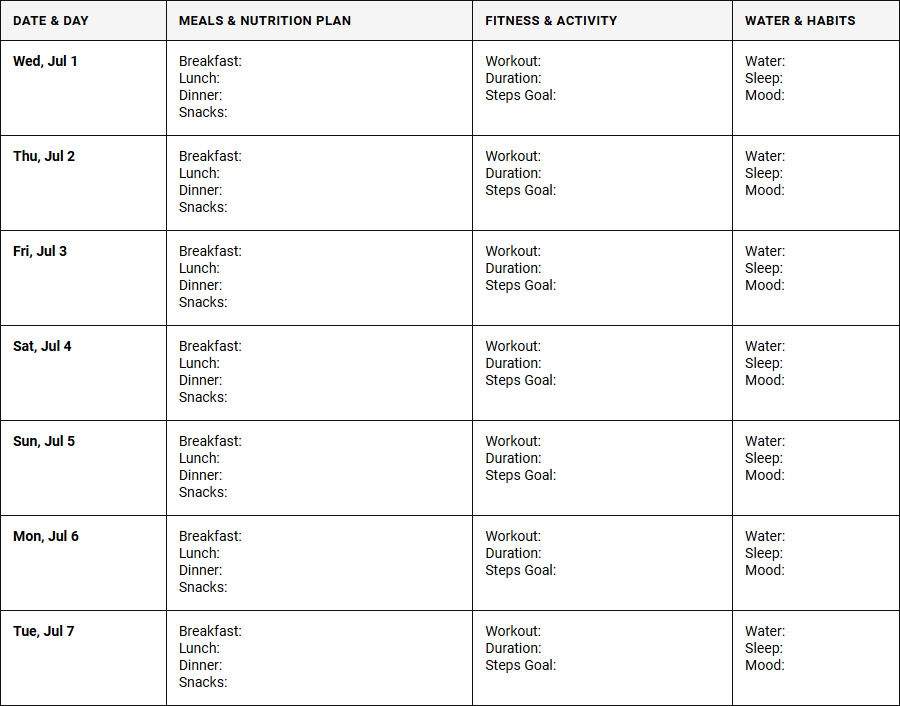
Staying consistent with health goals is notoriously difficult. While many fund their wellness journey through expensive memberships and apps, a structured Daily Agendas printable calendar grants you immediate, cost-free control over daily habits. Under the stipulation that self-discipline remains essential, using targeted tools like the Daily Meal and Fitness Tracker simplifies progress. Below, we explore how to strategically implement this printable layout to streamline your nutrition and exercise benchmarks.
Create Your Daily Meal And Fitness Tracker
Tip: You can click inside the calendar cells below to type details directly before printing, or print it blank!
Done customizing?
Daily Meal And Fitness Tracker - Good to Know
Macronutrients
Achieving optimal health requires a deep understanding of macronutrients, the primary dietary compounds your body needs in large quantities to function. These nutrients are categorized into three major groups, each serving a distinct physiological purpose:
- Proteins: Crucial for muscle repair, cellular regeneration, and enzyme production.
- Carbohydrates: The preferred fuel source for your brain and high-intensity physical activities.
- Fats: Essential for hormone synthesis, brain health, and the absorption of fat-soluble vitamins.
Balancing these macronutrients is not a one-size-fits-all endeavor. An endurance athlete may require a higher ratio of carbohydrates, whereas someone managing insulin resistance might prioritize healthy fats and proteins. By meticulously adjusting your daily intake of these vital components, you can significantly influence your body composition, daily cognitive performance, and sustained energy levels throughout the day.
Total Daily Energy Expenditure
Your Total Daily Energy Expenditure (TDEE) represents the cumulative number of calories your body burns within a twenty-four-hour window. This metric is a cornerstone of metabolic science, determined by four primary components:
- Basal Metabolic Rate (BMR): The energy required to keep you alive at rest.
- Thermic Effect of Food (TEF): Energy used to digest and process nutrients.
- Exercise Activity Thermogenesis (EAT): Calories burned during structured workouts.
- Non-Exercise Activity Thermogenesis (NEAT): Energy expended during daily movement.
Understanding your TDEE is vital because it establishes the precise baseline for any body composition goal. Calculating this figure involves evaluating your height, weight, age, biological sex, and general activity levels. Armed with an accurate TDEE estimate, you can make highly informed, data-driven decisions regarding your nutritional planning and physical training regimens.
Calories In Calories Out
The fundamental law of thermodynamics governs weight management through the concept of Calories In, Calories Out (CICO). This framework simplifies weight fluctuations into a basic energy balance equation. Consuming more energy than you expend results in a surplus, leading to weight gain, while expending more than you consume leads to weight loss.
However, the simplicity of CICO can sometimes mask the underlying complexity of food quality. While a calorie is a unit of energy, the source of that calorie dictates how your body processes it. For instance:
- Whole foods promote satiety and have a higher thermic effect.
- Ultra-processed foods induce rapid spikes in blood sugar and trigger subsequent cravings.
To master CICO, individuals should focus on tracking intake accurately via digital food scales while simultaneously monitoring daily output to maintain a reliable, predictable energy balance.
Non Exercise Activity Thermogenesis
Often overlooked in traditional fitness plans, Non-Exercise Activity Thermogenesis (NEAT) accounts for the energy expended during everything we do outside of eating, sleeping, and sports-like exercise. This includes minor physical tasks such as walking to your car, typing on a keyboard, cleaning the house, and even fidgeting.
For sedentary office workers, NEAT can be incredibly low, drastically reducing their daily metabolic output. Conversely, increasing your NEAT can be a highly effective strategy for weight management without adding the physical stress of extra gym sessions. Simple lifestyle modifications can significantly boost this metric:
- Choosing the stairs instead of the elevator.
- Using a standing desk throughout the workday.
- Pacing while taking phone calls.
Consistently elevating your daily NEAT contributes to a more resilient metabolism and facilitates easier fat loss over time.
Portion Control
Sustaining a healthy weight often depends less on what you eat and more on how much you consume, making portion control an indispensable skill. In modern food environments, served portions are frequently twice the size of recommended dietary standards, leading to passive overconsumption and unintended weight gain.
To combat this, practical strategy and environmental design must be utilized. Employing smaller dinnerware, pre-portioning snacks into individual containers instead of eating directly from the box, and learning to visually estimate serving sizes can protect against surplus calories. Additionally, utilizing digital food scales provides objective data, removing the guesswork that often derails fitness goals. Over time, practicing mindful portion control recalibrates your internal hunger cues, helping you recognize true physiological fullness and fostering a healthier, more balanced relationship with food.
Biometrics
To optimize physical performance and health, tracking biometrics offers invaluable objective insights into your physiological state. Biometrics encompass measurable biological data points that reflect your internal health, recovery, and overall fitness progression. Key metrics to monitor include:
- Resting Heart Rate (RHR): An indicator of cardiovascular efficiency.
- Heart Rate Variability (HRV): A measure of nervous system recovery and stress resilience.
- Body Fat Percentage: A more accurate metric of body composition than scale weight alone.
By analyzing these biological signals over time, you can move away from generic fitness plans and tailor your nutrition, sleep, and training to your unique physiology. Tracking biometrics ensures that you make adjustments based on hard data rather than subjective feelings, leading to safer and more sustainable progress.
Caloric Deficit
The absolute biological prerequisite for fat loss is a sustained caloric deficit. This state occurs when you systematically supply your body with fewer calories than it requires to maintain its current weight, forcing it to utilize stored adipose tissue for energy.
While establishing a deficit is straightforward in theory, executing it safely requires a delicate balance. A deficit that is too aggressive can lead to muscle loss, metabolic adaptation, and severe nutrient deficiencies. Experts generally recommend a moderate deficit of 300 to 500 calories below your maintenance level. This controlled approach preserves lean muscle mass, maintains thyroid function, and prevents the extreme hunger cravings that often lead to binge eating. Achieving a deficit through a combination of increased physical movement and structured nutritional adjustments remains the safest path to long-term body recomposition.
Activity Rings
With the rise of wearable technology, activity rings have transformed how we monitor daily movement. These visual metrics gamify physical activity, encouraging users to close three distinct rings each day: move, exercise, and stand. By transforming abstract physical data into clear, colorful circles, wearables provide immediate feedback and positive reinforcement.
This gamified approach is highly effective for building long-term habits. Closing your rings daily fosters consistency, turning sporadic exercise routines into deeply ingrained daily rituals. It also prevents prolonged periods of sedentary behavior by prompting you to stand for at least one minute during consecutive hours. While these sensors are not perfectly accurate down to the individual calorie, they serve as excellent tools for tracking trends, keeping you accountable, and pushing you toward a more active lifestyle.
Hydration Tracking
While often overshadowed by macronutrient tracking, hydration tracking is equally vital for maintaining peak physical and mental performance. Water is the primary medium for cellular chemical reactions, joint lubrication, temperature regulation, and nutrient transport throughout the human body.
Even mild dehydration, representing a mere two percent drop in body water weight, can result in cognitive decline, muscle fatigue, and a slower metabolic rate. Tracking your daily water intake helps prevent these performance drops. You can monitor hydration levels by using specialized smartphone apps, carrying marked water bottles, or observing urine color, aiming for a pale straw-like hue. Maintaining optimal hydration aids in digestion, suppresses false hunger cues, and optimizes kidney function. Prioritizing consistent fluid intake is a simple yet incredibly powerful way to support your broader health and wellness endeavors.
Intermittent Fasting Window
The practice of utilizing an intermittent fasting window has emerged as a highly effective tool for both weight management and cellular health. Rather than restricting what you eat, this dietary protocol focuses on restricting when you eat, typically dividing the day into a fasting phase and an eating phase.
Common schedules include the popular 16:8 method, where you fast for sixteen hours and consume all daily calories within an eight-hour window. During the fasting state, insulin levels drop significantly, which facilitates fat burning and initiates autophagy-a natural cellular cleanup process. This structured eating schedule naturally limits opportunities for late-night snacking, making it easier to maintain a caloric deficit. Adhering to a consistent fasting window aligns your nutrition with your body's natural circadian rhythms, improving metabolic flexibility, digestive rest, and energy levels.

Leave a comment