
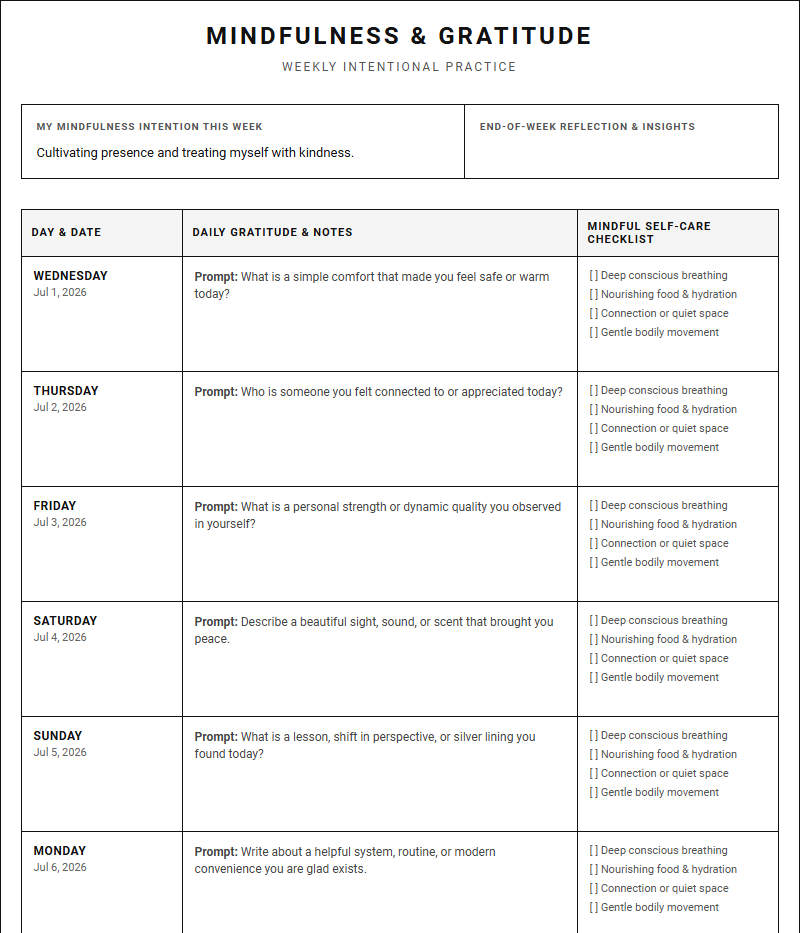
Many professionals struggle to maintain mental clarity amidst overwhelming schedules. While standard digital calendars organize time, they often overlook emotional well-being. Integrating a Daily Agendas printable calendar into your Daily Gratitude And Mindfulness Journal bridges this gap, providing a tangible layout that reduces stress. Note that this practice requires consistent, active engagement rather than passive logging. Reflecting on concrete prompts, such as listing three daily wins, builds lasting resilience. Below, we outline how to structure these templates for optimal daily focus.
Create Your Daily Gratitude And Mindfulness Journal
| Day & Date | Daily Gratitude & Notes | Mindful Self-Care Checklist |
|---|
Done customizing?
Daily Gratitude And Mindfulness Journal - Good to Know
Intention setting
Intention setting is the deliberate practice of deciding how you want to channel your energy, focus, and attitude before diving into the day's demands. Unlike rigid goals, which focus purely on future outcomes, intentions anchor you in the present moment by defining the manner in which you wish to live. Cultivating this habit allows you to transition from a state of passive reaction to one of conscious creation.
To begin, sit quietly for a moment and ask yourself what energy you need to cultivate. You can structure your intentions using these focus areas:
- Patience: Choosing to breathe deeply during moments of unexpected delay.
- Boundaries: Honoring your personal limits without experiencing guilt.
- Curiosity: Approaching unfamiliar challenges with an open, learning mindset.
By writing down your daily intention, you establish a reliable psychological compass that guides your decisions and reactions throughout the day.
Shadow work prompts
Shadow work involves exploring the unconscious aspects of your personality that you repress, deny, or dislike. This therapeutic concept, pioneered by Carl Jung, helps integrate these hidden fragments of the self to foster genuine wholeness. By shining a light on your internal triggers, you neutralize their power over your behavioral patterns.
"The shadow is not something to be feared or destroyed; it is a repository of unaligned energy waiting to be understood and integrated."
To engage in this profound self-exploration, try utilizing these targeted reflective prompts in your daily journal:
- Identify a recent moment when you felt irrationally irritated by someone else's behavior. What unacknowledged trait within yourself does that irritation mirror?
- What boundaries do you consistently fail to enforce, and what fear prevents you from holding those boundaries?
Approaching these inquiries with radical honesty unlocks deep emotional healing and self-compassion.
Somatic tracking
Somatic tracking is a mindfulness-based technique that teaches you to observe physical sensations in your body without judgment. Often, emotional stress manifests as physical tension, such as a tight chest, shallow breathing, or a clenched jaw. By focusing your attention on these sensations, you send reassuring signals of safety to your central nervous system.
To practice, close your eyes and scan your body from head to toe. When you encounter discomfort, describe it objectively. Ask yourself: Is it sharp, warm, heavy, or vibrating? Avoid trying to force the feeling to change immediately.
Instead, simply sit with the sensation, breathing into the space it occupies. Over time, this neutral observation helps desensitize the brain's alarm system, transforming how you experience physical anxiety. This practice bridges the gap between cognitive understanding and bodily experience, restoring a profound sense of internal safety.
Morning pages
Popularized by author Julia Cameron, Morning Pages consist of writing three pages of stream-of-consciousness thoughts immediately upon waking. This exercise is not meant to be high art or even coherent literature; rather, it serves as an active brain dump to clear your mental windshield of accumulated debris before the day officially begins.
There is no wrong way to write them. If you cannot think of anything to say, you simply write, "I don't know what to write" until your mind shifts gears. By transferring your anxieties, to-do lists, and random fragments of thought onto paper, you bypass your inner critic.
This daily practice acts as a form of mental hygiene, leaving you with enhanced focus, unexpected creative insights, and a lighter emotional load. It is a powerful tool for anyone seeking to dissolve creative blocks and quiet a noisy mind.
Grounding exercises
Grounding exercises are vital therapeutic tools designed to pull you out of anxious future-tripping or painful past-ruminating. When your nervous system enters a fight-or-flight state, these exercises work rapidly to anchor your awareness back into the physical reality of your current environment.
One of the most effective methods is the classic 5-4-3-2-1 technique, which systematically engages all five of your physical senses. Try identifying the following elements in your immediate surroundings:
- 5 things you can clearly see around the room.
- 4 physical textures you can feel with your hands.
- 3 distinct sounds occurring in your environment.
- 2 scents you can actively inhale and identify.
- 1 lingering taste you can sense in your mouth.
This deliberate sensory engagement disrupts runaway cognitive loops, lowering your heart rate and restoring cognitive control.
Savoring practice
Savoring is the active practice of noticing, appreciating, and prolonging the positive experiences in our daily lives. While happiness is a fleeting emotion, savoring is an active cognitive process that stretches that positive feeling, converting temporary experiences into lasting neural changes. It counteracts the brain's evolutionary survival instinct to focus primarily on negative stimuli.
To implement this practice, choose one routine activity today-such as sipping your morning coffee or walking to your car. Slow down the experience entirely. Focus on the rich aroma of the roast, the warmth of the mug against your hands, and the gentle transition of temperature as you drink.
By intentionally lingering on these minor pleasures for at least twenty seconds, you deepen your capacity for joy and build a resilient reservoir of positive memories that support your long-term psychological well-being.
Affirmation prompts
Affirmation prompts are structured linguistic tools designed to rewire negative self-talk and dismantle subconscious limiting beliefs. However, generic affirmations often fail because the brain rejects statements that feel inherently untrue. To make them effective, affirmations must feel believable, actionable, and aligned with your personal growth journey.
Instead of reciting unrealistic statements like "I am always happy and successful," pivot toward affirmations that focus on resilience, adaptability, and self-worth. Consider focusing on these realistic prompts:
- "I am capable of navigating difficult emotions without losing my inner peace."
- "My worth is not tied to my productivity; I am allowed to rest."
- "I have survived challenging days before, and I can handle what comes next."
Repetitive, mindful engagement with these grounded statements gradually reshapes your self-narrative, building authentic self-esteem from the inside out.
Daily reflection
A daily reflection serves as an essential mirror for your personal growth, allowing you to examine your actions, choices, and emotional reactions at the close of each day. Without conscious reflection, we risk repeating unproductive behavioral loops. This practice provides the structured space required to celebrate small wins and identify areas for gentle course correction.
Set aside five to ten minutes each evening to review your day. Ask yourself these constructive questions to guide your self-analysis:
- What choice did I make today that aligned with my core values?
- Where did I experience friction, and how did I choose to respond to it?
- What did today teach me that I can apply to tomorrow?
Documenting these answers transforms raw experience into actionable wisdom, fostering continuous, intentional self-development over time.
Five-minute gratitude
A five-minute gratitude practice is a highly efficient way to recalibrate your mental outlook. Our brains are hardwired with a negativity bias, designed to scan the horizon for threats and problems. Spending five minutes intentionally listing specific, positive aspects of your life trains your mind to scan for resources and opportunities instead.
To maximize the impact of this practice, avoid generic lists. Instead of simply writing "my family," delve deeper into specific, concrete details:
"I am grateful for the laughter shared over breakfast this morning, the cool breeze during my afternoon walk, and the reassuring text message from a close friend."
Focusing on these micro-moments of joy creates a visceral, emotional response that reduces cortisol levels, improves sleep quality, and strengthens your overall mental resilience.
Emotional release journaling
Unlike structured planning or reflective analysis, emotional release journaling is raw, unedited, and cathartic. It serves as a safe container to vent difficult emotions-such as anger, jealousy, or grief-without the fear of external judgment or the need to find immediate solutions. This process externalizes your internal chaos, rendering it manageable.
To practice, write quickly and without inhibition. Do not worry about spelling, grammar, or legibility. Let the words pour out exactly as they exist in your head, no matter how irrational they might seem. Some people even choose to discard, shred, or safely burn the paper afterward to symbolize letting go.
Allowing yourself to express these heavy emotions fully prevents them from becoming trapped in your body, facilitating a deep sense of relief, clarity, and renewed emotional spaciousness.
Leave a comment