
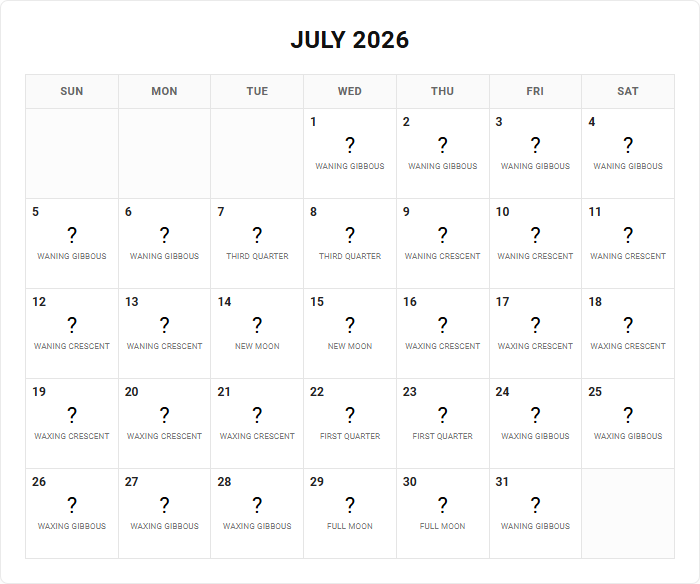
Tracking subtle lunar transitions can be frustrating for those relying on standard digital tools. While conventional Gregorian planners provide basic dates, they fail to visualize the continuous rhythm of the night sky. A dedicated Yearly Calendars printable lunar calendar grants instant, at-a-glance clarity for your endeavors. However, precise application stipulates adjusting for localized time zone variances, crucial for activities like biodynamic farming or tidal planning. Below, we explore the optimal layouts to align your yearly schedule with the moon's natural cycles.
Create Your Lunar and Moon Phase Calendar
| Sun | Mon | Tue | Wed | Thu | Fri | Sat |
|---|
Done customizing?
Lunar and Moon Phase Calendar - Good to Know
Synodic Month
The synodic month, often referred to as a lunar month, is the precise period of time it takes for the Moon to realign with the Sun as viewed from the Earth. Spanning approximately 29.53 days, this cycle dictates the familiar progression of lunar phases, beginning at one New Moon and concluding at the next. This duration is slightly longer than the sidereal month (about 27.3 days) because, as the Moon orbits the Earth, our planet also advances along its orbital path around the Sun.
To restore the exact geometric alignment required for a New Moon, the Moon must travel a bit further along its trajectory. This fundamental cycle has historically served as the biological and cultural basis for many calendar systems worldwide. The synodic cycle governs:
- The physical rise and fall of oceanic tides
- The scheduling of agricultural planting intervals
- The chronological foundations of lunisolar calendars
Void-of-Course Moon
In astrological terminology, a Void-of-Course (VoC) Moon describes the specific interval during which the Moon makes its final major aspect to another planet before transitioning into the next zodiac sign. Because the Moon moves so rapidly, these periods can last from a few brief minutes to several hours, or occasionally an entire day. Astrologers view this period as a time of energetic pause, reflection, and internal processing rather than external progression.
During a Void-of-Course phase, practitioners generally advise against starting significant endeavors, signing legally binding contracts, or making major purchases. Instead, this celestial window is considered ideal for activities such as:
- Cleaning and organizing physical spaces
- Meditating and engaging in reflective journaling
- Completing ongoing projects rather than initiating new ones
By aligning with this lunar pause, individuals often report a natural reduction in daily stress and decision-making fatigue.
Waxing Gibbous
The Waxing Gibbous phase marks the energetic bridge between the First Quarter Moon and the luminous peak of the Full Moon. During this period, the visible portion of the Moon is more than half-illuminated and continues to grow larger each night. This phase represents a critical time of refinement, adjustment, and steady momentum as projects initiated at the New Moon approach fruition.
Astronomically, the Waxing Gibbous Moon rises in the late afternoon and remains highly visible in the sky long before sunset, finally setting in the early morning hours. In symbolic traditions, this phase is associated with analytical thinking, critical evaluations, and the dedication required to overcome final obstacles. It is a period to look closely at your progress, tweak your strategies, and prepare emotionally for the high energy of the upcoming Full Moon peak.
Lunation
A lunation refers to the complete cycle of lunar phases, measured from one New Moon to the next. In modern astronomy, this cycle is systematically cataloged using the Brown Lunation Number system, which began counting consecutive lunations starting with the New Moon of January 16, 1923. Each lunation is unique due to the elliptical orbit of the Moon, which causes subtle variations in its velocity and apparent size throughout the cycle.
Historically, tracking lunations allowed ancient civilizations to establish structured timekeeping long before mechanical clocks existed. Today, understanding the nuances of a lunation remains crucial for astronomers calculating celestial coordinates, marine biologists studying nocturnal marine behavior, and cultural communities determining the dates of movable religious holidays such as Passover, Easter, and Diwali.
Supermoon
A Supermoon occurs when a Full Moon or New Moon coincides closely with the Moon's perigee, which is the point in its elliptical orbit where it is closest to the Earth. When this alignment occurs, the lunar disk can appear up to 14 percent larger and 30 percent brighter than a typical micro-moon (which occurs at apogee, the farthest point from Earth).
While the term "Supermoon" originated in modern astrology, it has gained widespread acceptance in popular astronomy due to the spectacular skywatching opportunities it provides. This close proximity creates stronger gravitational pulls, resulting in notably higher and lower tides, known as perigean spring tides. Observatories and casual stargazers alike look forward to these events, which happen only a few times each year, offering a brilliant display of our nearest celestial neighbor's rugged terrain.
Lunar Gardening
The practice of Lunar Gardening, or planting by the phases of the Moon, is an ancient agricultural methodology based on the gravitational pull of the Moon and its changing light levels. Practitioners of this method believe that just as the Moon pulls the tides in the oceans, it also influences the moisture levels within the soil and the movement of sap within plants.
This traditional gardening system categorizes agricultural tasks into distinct lunar phases:
- Waxing Phase: Rising sap levels encourage leaf, stem, and above-ground crop growth.
- Waning Phase: Receding sap directs energy downward, making it the perfect time to plant root vegetables, prune trees, and transplant seedlings.
- New Moon: A period of rest, ideal for weeding, tilling, and managing pests.
Esbat
In modern pagan and Wiccan spiritual traditions, an Esbat is a ritual gathering or celebration held to honor the energy of the Moon, most commonly during its full phase. Unlike the eight major solar holidays known as Sabbats, which celebrate seasonal turning points, Esbats occur monthly, corresponding with the lunar cycle. These gatherings are deeply personal and are focused on lunar magic, healing work, intuitive development, and personal reflection.
During an Esbat, practitioners often perform rituals such as Drawing Down the Moon, where the high priestess invokes the lunar goddess directly into her being. The ritual space is usually adorned with silver, white candles, and water-filled chalices to catch the reflection of the moonlight, fostering a profound psychological and spiritual connection to the natural cycles of growth, release, and renewal.
Astrological Moon Sign
In astrology, your Moon sign represents your emotional inner world, your subconscious patterns, and your instinctual reactions to the surrounding environment. While the Sun sign reflects your core identity, ego, and external vitality, the Moon sign governs how you process feelings, seek comfort, and nurture yourself and others. The Moon moves through all twelve zodiac signs rapidly, spending roughly 2.5 days in each sign.
Understanding this placement in your natal chart can provide deep insights into your psychological makeup, including:
- How you respond to unexpected emotional crises
- The types of environments where you feel most secure
- Your intuitive capabilities and hidden creative talents
This celestial placement serves as the emotional foundation of your astrological identity, guiding your deepest personal relationships.
Waning Crescent
The Waning Crescent, also known as the Balsamic Moon, represents the final phase of the lunar cycle before the Moon disappears into the shadow of the New Moon. During this time, the sliver of reflected sunlight shrinks daily, rising in the early morning hours and setting in the afternoon. This phase is characterized by a natural decline in physical energy and an invitation to look inward.
Metaphorically, the Waning Crescent is a sacred time of surrender, release, and deep rest. It is the perfect opportunity to clear away mental and physical clutter, break unhealthy habits, and reflect on the lessons learned over the past month. Rather than starting new endeavors, the focus should be on resting, recharging, and preparing the soil of your mind for the seeds of intention you will plant during the next New Moon cycle.
Ephemeris
An ephemeris is a highly detailed mathematical table or data file that provides the exact positions of naturally occurring celestial bodies in the sky at regular intervals over a specific period. Historically hand-calculated by astronomers, modern ephemerides are generated using sophisticated computer models. They provide crucial data including right ascension, declination, distance, and velocity for the Sun, Moon, planets, and major asteroids.
For astronomers, these tables are indispensable for pointing telescopes and planning space exploration missions. For astrologers, a specialized geocentric ephemeris is used to track the rapid movements of the Moon through the zodiac signs and houses, allowing for the precise calculation of natal charts and transit forecasts. Whether in digital database format or a printed book, the ephemeris is the mathematical foundation of celestial tracking.
Leave a comment