
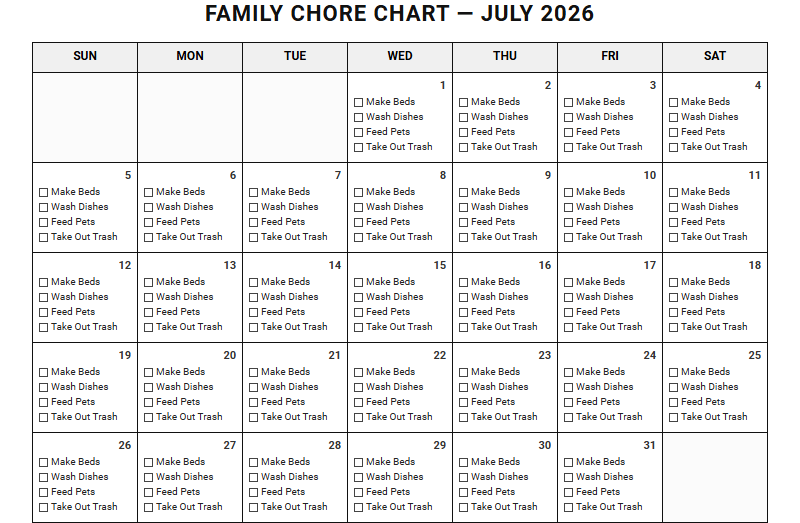
Managing household responsibilities often leads to daily friction and forgotten tasks. While digital reminder apps or verbal agreements offer basic tracking, they frequently fail to sustain long-term cooperation. A dedicated Monthly Chore Chart Calendar solves this by granting immediate, visual accountability for the entire household. To succeed, however, families must establish realistic daily limits. By mapping out concrete tasks like trash rotation and dusting, everyone understands their role. Below, we explore the best printable layouts to streamline your home management.
Create Your Monthly Chore Chart Calendar
Done customizing?
Monthly Chore Chart Calendar - Good to Know
Dry erase chore calendar
A dry erase chore calendar offers a tactile, highly visible solution for managing household responsibilities. Placed in a central location like the kitchen, this physical board serves as a constant visual reminder for all family members. The glossy surface allows for quick updates, color-coding, and immediate satisfaction when crossing off completed tasks.
To maximize the effectiveness of your whiteboard setup, consider incorporating these essential elements:
- Color-coded markers: Assign a specific color to each family member to easily distinguish individual responsibilities.
- Daily and weekly grids: Divide the board into daily habits and weekly deep-cleaning tasks.
- Notes section: Reserve a corner for household announcements, grocery needs, or motivational quotes.
By using a physical calendar, you eliminate the friction of opening an app, making it an excellent tool for instilling accountability and routine in children and adults alike.
Digital chore board
Embracing a digital chore board modernizes household management by syncing tasks across multiple devices in real-time. These software-based solutions can be displayed on a dedicated wall-mounted tablet or accessed via smartphones, ensuring that everyone stays updated no matter where they are. With automated notifications and progress tracking, a digital board removes the need for constant verbal reminders.
Many families leverage digital screens to streamline their daily routines because they support:
- Automated recurring tasks that reset daily, weekly, or monthly without manual intervention.
- Real-time synchronization which prevents duplicate effort and ensures instant updates.
- Customizable alerts that gently prompt family members when a deadline is approaching.
This tech-forward approach reduces mental load for parents and aligns perfectly with modern, connected lifestyles, transforming chaotic routines into streamlined workflows.
Zone cleaning schedule
A zone cleaning schedule prevents household maintenance from becoming overwhelming by dividing the home into distinct physical areas. Instead of attempting to clean the entire house in a single, exhausting day, you focus your energy on one specific zone each week. Over the course of a month, every corner of your living space receives deep, focused attention.
An effective monthly rotation typically breaks down into the following structural zones:
- Zone 1: Entryway, front porch, and dining room.
- Zone 2: Kitchen, pantry, and main cooking areas.
- Zone 3: Bathrooms and guest bedrooms.
- Zone 4: Master bedroom and living room space.
This methodical approach ensures deep-cleaning tasks are consistently tackled. By breaking the home down into manageable segments, maintaining a spotless environment becomes a stress-free, sustainable habit.
Chore rotation system
To prevent resentment and boredom, a structured chore rotation system ensures that household burdens are shared equally over time. Instead of assigning permanent tasks, responsibilities shift among family members on a weekly or monthly basis. This system teaches valuable life skills to younger members while keeping daily maintenance fair and engaging for everyone involved.
When designing a fair rotation framework, consider implementing these key strategies:
- Task pairing: Match less desirable chores with popular ones to balance the workload.
- Clear rotation intervals: Use a physical wheel or spreadsheet to show who inherits which task next.
- Skill-level matching: Ensure rotated tasks remain age-appropriate and safe for younger participants.
Implementing a fair rotation fosters a sense of teamwork and mutual respect, proving that a clean home is the collective responsibility of the entire household.
Gamified household chores
Transforming mundane tasks into gamified household chores turns routine cleaning into an engaging, interactive experience. By applying video game mechanics such as experience points, levels, and quests to real-life duties, daily cleaning becomes competitive and fun. This approach is highly effective for motivating teenagers and competitive family members who find traditional chore charts uninspiring.
You can easily gamify your home environment by integrating these playful mechanics:
- XP and Leveling: Assign point values based on chore difficulty and let players "level up."
- Mystery Quests: Place hidden rewards or surprise tasks in sealed envelopes for a element of chance.
- Boss Battles: Tackle massive cleaning projects, like garage organization, as a cooperative group raid.
Shifting the perception of chores from a boring obligation to an exciting challenge boosts morale and keeps the entire household actively engaged.
Shared family calendar app
A shared family calendar app serves as the central nervous system for busy modern households. By combining chore tracking with school schedules, sports practices, and social appointments, these applications offer a holistic view of the family's weekly commitments. This integration ensures that chore expectations remain realistic and adapt to the fluctuating schedules of daily life.
Top features to look for in a collaborative scheduling application include:
- Task assignment: Directly link specific chores to individual calendar events or deadlines.
- Push notifications: Send gentle, automated nudges directly to a family member's phone.
- Shared lists: Keep running shopping lists alongside daily household tasks for maximum efficiency.
Coordinating schedules and chores within a unified digital space reduces communication breakdowns and helps the entire household run like a well-oiled machine.
Visual routine chart
A visual routine chart is an invaluable tool for toddlers, young children, and visual learners who benefit from concrete representations of daily tasks. Utilizing clear icons, photos, or simple drawings, these charts outline morning and evening routines step-by-step. This visual structure fosters independence, allowing children to self-direct their activities without constant parental prompting.
To build a highly functional visual chart, focus on incorporating these design components:
- Sequential icons: Use clear, chronological images representing actions like brushing teeth or making the bed.
- Interactive elements: Include velcro patches or sliding doors that let kids physically mark a task as completed.
- Simple phrasing: Keep text minimal, letting the illustrations do the heavy lifting for pre-readers.
Providing a clear roadmap empowers children, reduces transition anxiety, and builds healthy habits that last a lifetime.
Chore economy rewards
A structured chore economy rewards system teaches children essential financial literacy while keeping the household clean. By associating specific tasks with virtual currency or points, children learn the direct connection between labor and reward. These accumulated points can then be redeemed for real-world privileges, screen time, or monetary allowance, providing tangible incentives for hard work.
Setting up a balanced household economy relies on clear guidelines and consistent rules:
- Base vs. Extra Chores: Distinguish between non-paid citizenship duties and paid, extra-effort tasks.
- A transparent menu: Publish a clear exchange rate detailing what chores earn and what rewards cost.
- Saving goals: Encourage kids to budget their points for high-value items or special outings.
This practical reward structure models real-world economics, teaching responsibility, patience, and the value of a dollar within a safe home environment.
ADHD-friendly chore tracker
An ADHD-friendly chore tracker focuses on reducing cognitive load, minimizing distractions, and providing immediate hit of dopamine upon completion. Traditional, rigid schedules often lead to overwhelm for neurodivergent individuals. A specialized tracker prioritizes flexibility, novelty, and sensory satisfaction, breaking large multi-step cleaning projects down into tiny, actionable micro-tasks.
Key design principles for an effective neurodivergent-friendly tracking system include:
- Micro-steps: Instead of "clean kitchen," list individual steps like "put three plates in dishwasher."
- Novelty and choice: Use a randomized draw jar to select the daily chore, preventing executive dysfunction.
- Tactile satisfaction: Incorporate satisfying physical actions, like peeling off velcro strips or popping bubble wrap.
Designing with cognitive differences in mind transforms daunting chores into approachable, low-stress habits that feel achievable every single day.
Minimalist household planner
For those overwhelmed by complex systems, a minimalist household planner strips away the clutter to focus strictly on what matters most. By removing points, colors, and elaborate schedules, this approach prioritizes essential maintenance tasks that keep a home functional. The beauty of a minimalist layout lies in its simplicity, reducing the anxiety often caused by overly detailed organization methods.
Implementing a minimalist planning style involves adopting these core habits:
- The rule of three: Identify only three critical household tasks to complete each day.
- Clean as you go: Focus on immediate habits, like wiping counters instantly, to minimize dedicated cleaning sessions.
- Decluttered templates: Use plain paper or basic digital lists without decorative distractions.
Embracing a minimalist philosophy allows you to maintain a tidy, peaceful living space without letting chore management dominate your mental bandwidth.
Leave a comment