
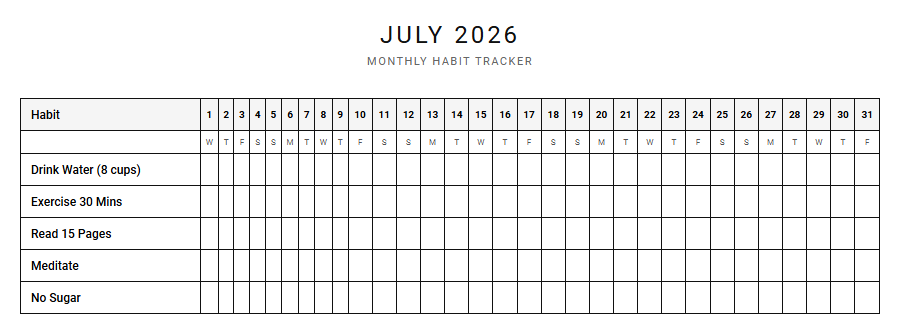
Maintaining daily routine consistency is a common hurdle, as generic digital apps and standard planners often fail to sustain long-term engagement. A dedicated Monthly Habit Tracker Calendar bridges this gap, granting users immediate, tactile visual reinforcement. Successfully adopting this tool requires the stipulation of daily, honest assessment. Whether tracking hydration, meditation, or reading, physical logging fosters accountability. Below, we examine how these printable monthly calendars can systematically optimize your personal routines.
Create Your Monthly Habit Tracker Calendar
Habit Tracker
Monthly Progress
Done customizing?
Monthly Habit Tracker Calendar - Good to Know
Habit Stacking
Habit stacking is a highly effective behavioral modification technique that anchors a new, desired behavior to an already established daily routine. Originally created by author James Clear, this method leverages the strong, pre-existing neural pathways already built in your brain. Instead of trying to remember a new action out of thin air, you pair it with an existing anchor habit that you perform automatically every single day without fail.
To successfully implement this strategy, you can utilize a simple, structured formula:
"After [Current Habit], I will [New Habit]."
- After I pour my morning coffee, I will meditate for two minutes.
- After I close my work laptop, I will immediately change into my exercise clothes.
- After I brush my teeth, I will write down one thing I am grateful for.
By chaining these actions together, you drastically reduce the cognitive friction required to initiate the new behavior. This systematic approach transforms conscious effort into effortless, automatic routines.
Streak Tracking
Streak tracking is the practice of visually documenting consecutive days of completing a habit to build powerful psychological momentum. Made famous by Jerry Seinfeld's "don't break the chain" productivity method, this strategy capitalizes on the human desire for consistency. Every single checkmark on a calendar serves as immediate visual feedback, reinforcing your progress and commitment.
The psychological advantages of maintaining a streak are extensive:
- Visual Progress: It provides a concrete representation of your hard work.
- Loss Aversion: The longer the streak, the more motivated you are to protect it.
- Identity Shift: It shifts your mindset from "trying to write" to "being a writer."
To prevent inevitable disruptions from derailing your progress, it is helpful to establish a strict "never miss twice" rule. While missing one day is an accident, missing two consecutive days is the start of a new, negative habit. Keeping the momentum alive ensures long-term lifestyle transformation.
Micro-habits
Micro-habits are highly simplified, drastically downscaled versions of the larger habits you wish to establish in your life. The core philosophy of this method is to make the target behavior so incredibly easy that you simply cannot say no to it, completely bypassing the need for high motivation. If your objective is to read more, your micro-habit might be reading just one page per night.
"Make it so easy you can't say no." - Leo Babauta
These tiny actions bypass our brain's natural resistance to change and fear of effort. Once the foundational micro-habit is solidified into your daily routine, you can naturally scale the effort upward. This approach prioritizes consistency over intensity, demonstrating that small daily actions compound into monumental achievements over time. It is far better to do a tiny bit of positive action every single day than to wait for perfect conditions to complete a massive task.
Bullet Journal Spread
A Bullet Journal spread is a customized, analog framework designed to track, organize, and reflect on your daily routines and personal habits. Unlike rigid digital applications, a physical journal page offers a tactile, highly personalized, and creative tracking experience. The physical act of putting pen to paper stimulates mindfulness, allowing you to pause and reflect on your daily trajectory.
A well-structured habit tracker spread typically includes the following essential elements:
- A monthly grid displaying the days of the week for quick check-ins.
- Color-coded keys representing different areas of personal development.
- A dedicated space for weekly reflections, lessons learned, and progress adjustments.
By designing a visual representation of your routine, you transform abstract, distant goals into tangible milestones. The visual clarity of a spread helps you spot patterns, recognize barriers, and celebrate the small, quiet victories of daily discipline.
Keystone Habits
Keystone habits are pivotal routines that naturally trigger a positive cascade of other beneficial behaviors throughout various areas of your life. First popularized by Charles Duhigg in his book The Power of Habit, these actions do not just change one isolated behavior; they rewrite your entire daily pattern and self-image.
Consider the widespread ripple effects of a keystone habit like regular physical exercise:
- It naturally leads to better nutritional choices and reduced junk food cravings.
- It improves sleep quality, resulting in higher morning energy levels.
- It fosters increased focus, leading to enhanced workplace productivity.
By identifying and prioritizing a single keystone habit, you can achieve widespread personal growth without feeling overwhelmed. These powerful anchor habits create a new internal culture, making other positive behaviors significantly easier to adopt and maintain over the long run.
Behavior Design
Behavior design is a highly scientific approach to shaping habits by engineering your physical environment and understanding human psychology. Based heavily on BJ Fogg's Behavior Model, this framework asserts that behavior occurs when three distinct elements converge simultaneously: Motivation, Ability, and a Prompt.
To design a successful habit, you must manipulate these three critical variables:
- Increase Ability: Make the desired behavior as simple as possible to execute.
- Optimize Prompts: Ensure there is a highly visible trigger to initiate the action.
- Manage Motivation: Understand that motivation is volatile, so do not rely on it.
By systematically designing your lifestyle, you remove friction from positive habits and introduce obstacles to negative ones. This methodology shifts your primary focus away from relying on unsustainable willpower, focusing instead on smart, structural design to achieve effortless success.
Habit Loop
The habit loop is the neurological pattern that governs every single habit, consisting of three core components: the cue, the routine, and the reward. Understanding the mechanics of this loop is the fundamental key to both building constructive habits and dismantling destructive, unwanted routines.
- The Cue:
- A specific sensory trigger that tells your brain to go into automatic mode and initiates the behavior.
- The Routine:
- The actual physical, mental, or emotional action that you perform in response to the cue.
- The Reward:
- The positive reinforcement that helps your brain decide if this loop is worth remembering for the future.
To successfully alter an unwanted habit, you must keep the original cue and the desired reward the same, but consciously insert a healthier, alternative routine into the middle of the loop.
Implementation Intentions
Implementation intentions are highly specific, pre-determined plans that outline exactly when, where, and how you will execute a target behavior. Developed by psychologist Peter Gollwitzer, this cognitive strategy bridges the gap between your general goals and your actual daily actions.
The execution of this strategy relies on a simple, predictive "if-then" framework:
"If [Situation X] occurs, then I will perform [Response Y]."
This planning technique works by delegating control of the behavior to a specific environmental trigger. Instead of deciding what to do in the heat of the moment-when your mental willpower might be completely drained-your brain pre-authorizes the action beforehand. Research consistently shows that writing down these concrete plans dramatically increases follow-through by removing decision fatigue and ambiguity from your daily schedule.
Visual Cue
A visual cue is an environmental trigger that serves as a physical reminder to perform a specific, positive habit. Because human beings are highly visual creatures, our immediate surroundings dictate a massive portion of our daily choices. If you want to practice an instrument, you should place it in the center of the room. If you want to drink more water, place a filled bottle directly on your desk.
An effective visual cue must meet several criteria:
- Highly Obvious: It must be positioned directly in your path of movement.
- Highly Attractive: It should look inviting, which naturally increases desire.
- Completely Frictionless: It must require zero setup before the action can begin.
By intentionally designing your environment to display obvious cues for positive habits and hiding cues for negative ones, you effortlessly steer your daily behaviors in a better direction.
Gamified Tracking
Gamified tracking applies game-design elements-such as points, levels, quests, and rewards-to personal development. By transforming repetitive daily routines into an engaging game, this tracking method taps into our natural desire for achievement, feedback, and competition. It makes the daily grind feel playful and rewarding.
Common gamification elements utilized in tracking include:
- Earning experience points (XP) and leveling up your real-life avatar.
- Unlocking virtual badges and custom rewards for consistent performance.
- Participating in multiplayer habit quests with friends or global communities.
This engaging approach provides immediate gratification for completing difficult tasks, which sustains long-term motivation. By introducing instant feedback loops and playful incentives, gamification turns routine personal growth into an exciting adventure, making long-term habit formation highly enjoyable.
Leave a comment