
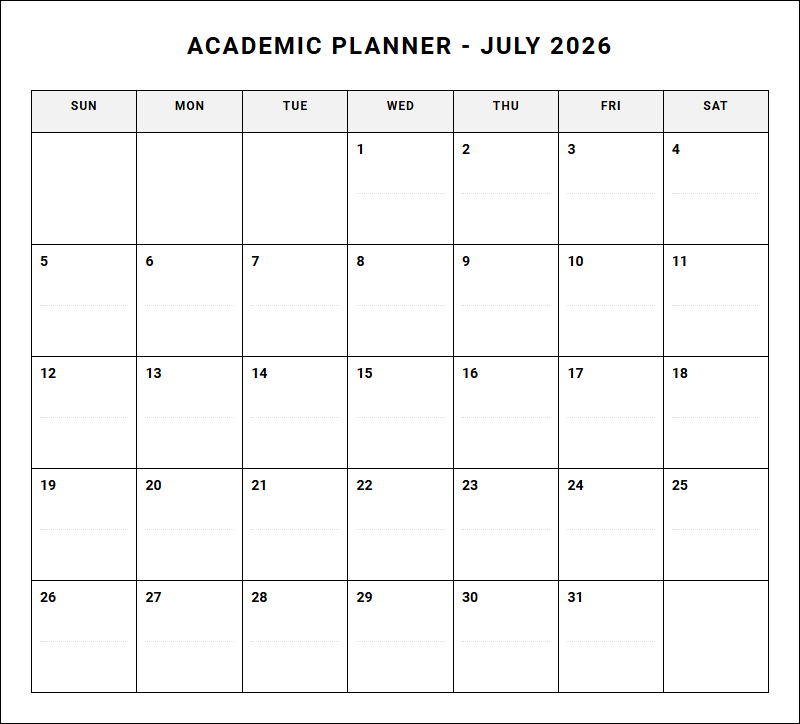
Managing complex semester workloads often leads to academic overwhelm. While standard department planners and university-allocated resource tools provide basic timelines, they rarely align with individual study habits. Utilizing a specialized Monthly Academic Planner Calendar grants learners the personalized structure necessary for success.
Although printable formats lack automated notifications, they actively reinforce task retention. By physically mapping exam schedules and assignment deadlines, you regain control. Below, we explore how to utilize these printable monthly calendars to optimize your academic year.
Create Your Monthly Academic Planner Calendar
Done customizing?
Monthly Academic Planner Calendar - Good to Know
Digital academic dashboard
A digital academic dashboard serves as the central nervous system for your educational journey. By integrating multiple streams of information into a single, intuitive interface, students can monitor their academic health at a glance. Typically hosted on cloud platforms, these dashboards consolidate grade calculations, upcoming tasks, and class schedules.
Using a unified workspace minimizes the cognitive load associated with switching between different apps, allowing you to focus entirely on learning. Key features of a high-performing digital academic dashboard include:
- Real-time grade tracking to monitor cumulative GPA fluctuations automatically.
- Dynamic to-do lists that filter tasks by priority, class, or due date.
- Quick resource links for fast access to university portals and lecture slides.
Implementing this centralized hub ensures you never lose track of critical deadlines while keeping your long-term academic goals clearly visible.
Syllabus tracker spreadsheet
Navigating multiple course syllabi at the beginning of a semester can feel incredibly overwhelming. A dedicated syllabus tracker spreadsheet transforms cluttered documents into an actionable, sortable database. Built on platforms like Microsoft Excel or Google Sheets, this tool extracts essential data-such as exam weights, reading assignments, and professor contact details-and organizes them systematically.
This structured approach allows you to filter assignments by course to isolate specific weekly workloads, calculate weighted grades using built-in formulas, and prioritize tasks based on their percentage contribution to your final grade. Instead of constantly reopening dusty PDF files, a quick glance at your optimized spreadsheet reveals exactly where to focus your energy for maximum academic return.
By investing a few hours at the start of the term to input this data, you create a reliable roadmap that eliminates administrative friction for the rest of the year.
Undated monthly calendar
The inherent flexibility of an undated monthly calendar makes it an indispensable asset for modern students. Free from the constraints of specific calendar years, this tool allows you to pause and resume tracking without wasting paper or digital pages. It is especially useful for managing seasonal academic terms, intensive summer programs, or self-paced online certifications.
When utilizing an undated template, you can customize layout designs and color-coding schemes to match your current aesthetic or cognitive needs. This blank canvas encourages mindful planning, letting you manually write in dates to reinforce memory. Key benefits of this layout include:
- Adaptable structure that fits any academic term duration perfectly.
- Zero wasted space during holiday breaks or long seasonal vacations.
- Visual clarity that highlights monthly milestones and key events.
Embracing this fluid layout keeps your scheduling adaptive, resilient, and tailored to your shifting academic lifecycle.
Notion student template
Notion has revolutionized the way students organize their academic lives, offering an all-in-one workspace that blends note-taking, project management, and databases. A customized Notion student template leverages relational databases to link notes directly to courses, assignments, and study schedules. This interconnected structure ensures that every piece of information is contextualized.
Using toggles, callout boxes, and custom icons, you can build a highly aesthetic yet deeply functional workspace. Consider integrating the following database views to maximize utility:
- Kanban boards for visual tracking of project phases.
- Gallery views for organizing lecture notes with visual previews.
- Calendar databases that sync with master assignment lists.
By consolidating your entire curriculum into a dynamic workspace, you build a cohesive knowledge management system that supports both daily studying and long-term academic retention.
Hyperlinked academic planner
For students who love the tactile feel of handwriting but require digital convenience, a hyperlinked academic planner is the hybrid solution of choice. Typically designed as interactive PDF documents for tablets, these planners utilize embedded hyperlinks to facilitate instantaneous navigation between yearly, monthly, weekly, and daily pages. A single tap of your digital stylus can transport you from an October overview directly to a specific daily study log.
This seamless navigation reduces friction, encouraging consistent planning habits throughout the semester. These planners feature:
- Instant transitions that prevent tedious scrolling through endless pages.
- Integration with note apps like GoodNotes, Notability, or Noteshelf.
- Endless customization options, including digital stickers and custom paper templates.
Adopting a hyperlinked layout gives you the organization of traditional paper planners combined with the modern, lightweight portability of a digital tablet device.
Time blocking monthly spread
Time blocking is a proven productivity method that partitions your day into dedicated time slots for specific activities. When scaled up to a time blocking monthly spread, this technique provides a macro-level view of your availability, helping you visualize how academic commitments interact with personal life. Rather than merely listing deadlines, this spread reserves dedicated blocks for deep work, classes, and self-care.
By visually designating chunks of time for focused studying, you prevent the common pitfall of overcommitting your schedule. Using this system helps build strong boundaries:
- Visual boundaries protect your free time and prevent burnout.
- Consistent routines are established through recurring weekly time blocks.
- Realistic scheduling ensures you allocate sufficient hours for major assignments.
Mapping your month in blocks changes how you view time, converting abstract deadlines into concrete, manageable intervals of focused concentration.
Assignment deadline tracker
Missed deadlines can severely damage your academic standing, making a robust assignment deadline tracker absolutely essential. This targeted tool goes beyond a simple to-do list by providing critical metadata for every submission, including urgency levels, weighted values, and completion status. By prioritizing tasks through a systematic approach, you can eliminate last-minute cramming sessions.
An effective tracker categorizes your workflow into distinct, manageable stages:
- To-Do: Incoming tasks that require planning and initial research.
- In Progress: Active assignments undergoing drafting and editing.
- Submitted: Completed work awaiting grading and professor feedback.
Maintaining a live, updated overview of all your deadlines provides immense peace of mind, allowing you to approach complex coursework with confidence, clarity, and precise execution.
Semester course roadmap
A semester course roadmap serves as your academic compass, offering a high-level strategic overview of your educational path. While weekly planners focus on daily minutiae, the roadmap visualizes the entire semester's trajectory, highlighting prerequisites, major milestones, and crucial transition periods. This long-term perspective is vital for managing complex degree requirements and preparing for registration cycles.
By charting your academic journey in advance, you can align your study efforts with future career goals and graduation timelines. Key advantages of maintaining a course roadmap include:
- Visualizing progression from foundational to advanced coursework.
- Identifying bottleneck semesters with heavy credit loads.
- Facilitating academic advising discussions with clear visual aids.
Keeping your eye on this comprehensive roadmap ensures that every course you take serves as a purposeful stepping stone toward your degree.
Study habit tracker calendar
Building consistent study routines is far more effective than sporadic, high-stress cram sessions. A study habit tracker calendar visualizes your daily commitment to learning, transforming abstract goals into measurable progress. By marking off days where you successfully engage in active recall, spaced repetition, or deep reading, you build powerful psychological momentum.
Seeing a continuous chain of completed study days acts as a strong visual motivator to maintain consistency. To maximize the effectiveness of your habit tracker, monitor specific metrics:
- Active study hours to measure focused productivity, not just time spent sitting.
- Technique utilization, tracking methods like active recall or the Pomodoro technique.
- Review frequency to ensure regular reinforcement of past materials.
Consistent tracking helps you identify peak study days, allowing you to optimize your weekly routines for academic success.
Midterm and finals planner
Exam periods are undeniably the most stressful times of the academic year, requiring a specialized midterm and finals planner to navigate successfully. This highly focused planner acts as an exam-prep command center, breaking down vast curriculums into bite-sized, reviewable topics. Rather than relying on panic-driven studying, this tool establishes a structured countdown schedule leading up to exam day.
By planning your review weeks in advance, you ensure every subject receives the attention it deserves. Your exam preparation framework should include:
- Content breakdown checklists to track mastery of specific exam topics.
- Practice test schedules to simulate real exam environments and timing.
- Mental wellness check-ins to prioritize rest and mitigate test anxiety.
Approaching high-stakes exams with a methodical, pre-planned study schedule significantly boosts performance and instills a sense of calm control.
Leave a comment